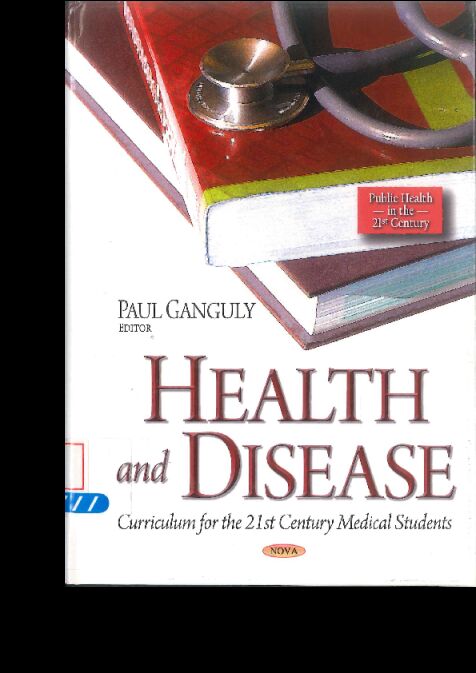
书名:Health and disease
ISBN\ISSN:9781634630528,1634630521
出版时间:2015
出版社:Nova Science Publishers,
前言
According to experts in education the definition of curriculum is, "a study course, or an integrated course of academic studies". This definition outlines courses, coursework, and any other content dealing with courses at a primary scholastic level or university. In a medical setting, the goal of a curriculum is to use various modalities to define parameters of medical education. With this goal in mind, the outlines of the curriculum should encourage students to pursue a wide range of careers. These include, but or not limited to, becoming outstanding practitioners, medical educators or investigators. We as educators, expect our graduates to be leaders in patient care. Thus it is the ultimate goal of medical curriculum to educate and empower medical students to succeed in their respective medical careers.
In the past, a study course in medicine was developed to ensure individuals were able to accommodate subjects related to basic science followed by clinical science. However, such concept arguably forms the foundation of medicine; preclinical courses were introduced before students had encountered patients and strategically learned medicine, surgery, gynecology and obstetrics. The experts in medical education questioned the efficacy of such system. It was apparent that students were not able to integrate a medical problem as they were also refrained from acquiring longtime, lifelong learning. Thus educationists around the globe made several changes in medical curriculum in the late 20th century. The introduction of newer systems such as problem-based learning, integrated curriculum, hybrid curriculum and team-based learning were challenging but very successful in many modern medical schools.
Medical schools of the 21sl century are looking for innovative approaches. These schools have a general mandate outlining teaching medical subjects in the presence of decreased contact hours to fulfill the curricular need of more integration. The question thus remains as to how best can we teach medical students? What is the best medical curriculum? How much integration is acceptable to students? How can we monitor the system? To answer these questions American University of Barbados (AUB), a new medical school organized a symposium on January 20th, 2014 on a theme of 21sl century medical curriculum. Dr. Gary Brar, CEO, AUB invited me to speak on how best we can teach anatomy in a modern curriculum. The idea of synthesizing a book on medical curriculum thus came into existence.
The present book entitled "Health and Disease: curriculum for the 21sl century medical students" addresses the above questions so as to ensure that a medical school can select a curriculum based on its mission, vision and objectives. The book highlights the evolution of medical curriculum and describes a state-of the-art approach that indicates the essential points behind designing a curricular map. Care has been taken to bring a concept that no particular curriculum may fit to the need of a medical school and thus it is necessary to fine tune of a system that is ever rolling and dynamic in the context of medical education. At the end of the study, the students should appreciate the facts of health and disease through a well-described curricular outcome. I sincerely hope that this book will bring many answers that are presently needed. Thus I am indebted to all the contributors in this book.
The book is dedicated to Dr. Khaled A1-Kattan, Dean and Professor of Surgery, College of Medicine, Alfaisal University. Dr. Khaled is also the founding Dean who made Alfaisal University very proud by bringing the College in the map of excellence. In fact, the College of Medicine has surpassed many of the expectations within the span of six years mainly due to Dr. Khaled's hard work and right vision from the very beginning. His message to the students is simple- "when you join the College you will understand from the first day, that we are a student-centered university and we are prepared to provide you with all the knowledge and skills you will need to graduate as an outstanding doctor, who would serve the community with best practice in patient care, together with excellence in research ability and academia". College of medicine believes that Dr. Khaled is an outstanding Dean in true sense of the word. His personal contribution to fine tuning of the curriculum has also a pivotal influence and remains cen er to ongoing activities and success at the College.
It has been a particular privilege to have continued support from outstanding faculty, staff and students at the College of Medicine, Alfaisal University for the past several years. Many of our colleagues have had a long standing interest in the medical education and contributed several chapters in this book. I am grateful to my wife Rina and children, Riya and Rishi for encouragement and motivation for completing and editing this book in time.
查看更多
目录
Preface ix
Chapter 1 History of the Medical Curriculum 1
S. Schofield
Chapter 2 State-of-the Art Curriculum for the 21st Century Medical Students 27
Ahmed Yaqinuddin, Wael Al-Kattan and Khaled Al-Kattan
Chapter 3 Medical Curriculum: Does One Size Fit All? 41
H. Thomas Aretz
Chapter 4 Integration is the Key 65
Sabri Kemahli
Chapter 5 Curriculum Mapping in the Disease Pathway 79
Shabih H. Zaidi
Chapter 6 Interprofessional Education (IPE): The Next Chapter in Health Professions Educatio 91
N. Lynn Eckhert
Chapter 7 Molecular Medicine Is Where Chronic Diseases, Nutrition and Physical Activity Intersect: A Suggestion on How to Deal Chronic Diseases in the Biomedical Curriculum 105
Bernhard H. J. Juurlink and Abdulhadi A. Al-Amodi
Chapter 8 Clinical Skills: How Best Can We Deliver? 139
Muhammed Zafar and Naif Al-Otaibi
Chapter 9 The Why, the What and the How of Simulation Based Education: Preparing for the Future 159
N. Harrison, L. Owen, S. Somerville, K. Stirling and J. Ker
Chapter 10 Enhancing Laboratory Medicine Teaching through Constructive Alignment of the Medical Curriculum 193
Ahlam A Ishedoukhy, Abiola Senok and Khurshid Anwar
Chapter 11 Evaluation and Assessment of a Curriculum: How Do We Do That? 205 Akef Obeidat
Chapter 12 Medical Curriculum: Students' Perspectives 235
Ayman Mohamed Awad Mohamed, Mohammed Marwan Dabbagh, Al-Awwab Mohammad Dabaliz, Abdulazeez Abdulmajeed Barakat, Elhaitham Khaled Ahmed and Akef Obeidat
Index 259
查看PDF
查看更多
馆藏单位
中国医科院医学信息研究所