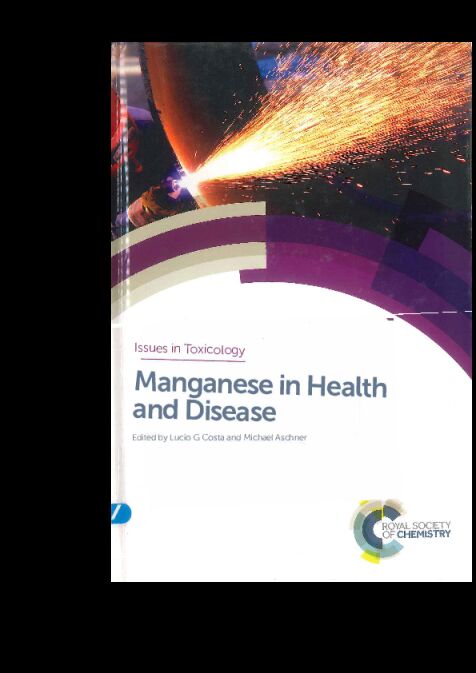
书名:Manganese in health and disease
责任者: Lucio G. Costa and Michael Aschner. | Aschner, Michael,
出版时间:2015
出版社:The Royal Society of Chemistry,
前言
Manganese (Mn) is the twelfth most abundant element in the Earth's crust and present in drinking water and in food. As an essential trace element, Mn is required for multiple biochemical and cellular reactions, and is a necessary component for numerous metallo-enzymes, such as Mn superoxide dismutase, arginase, phosphoenol-pyruvate decarboxylase, and glutamine synthase, to name a few.
Despite its essentiality, exposures to high levels of Mn from occupational, iatrogenic, medical, and environmental exposures may contribute to human morbidity. Excessive Mn accumulation in the brain, primarily in basal ganglia, may cause clinical signs and morphological lesions analogous to those seen in Parkinson's disease (PD), Other tissues may be affected as well.
Mn intoxication cases were originally described over two centuries ago. Manganism, resulting from exposure to exceedingly high levels of this metal, was originally described by James Couper (1837), providing insight into the adverse neurological effects in five Scottish men employed in grinding Mn dioxide ore. As Mn began to be used more widely in the steel alloy industry, more cases were recognized, with stronger epidemiological evidence implicating Mn in a number of neurological diseases. Contemporary exposures to Mn at levels described by Couper are rare, yet concerns about the health effects of Mn remain, given its abundant occurrence and the potential exposures throughout various life-stages.
This book, to our knowledge, is the first multidisciplinary scientific endeavor to address the health effects of Mn. It aims to provide state-of-the-art information and deepen the understanding of Mn's adverse health effects. It commences with a description on various pathways for Mn absorption (lung, gastrointestinal tract, olfactory pathway), followed by its nutritional needs, toxicokinetics and toxicodynamics. A large section of the book is devoted to its adverse effects, emphasizing cellular and molecular mechanisms of toxicity in a host of tissues and organs, particularly the nervous system, with emphasis on sensitivity to Mn at various life-stages. We conclude with a list of research needs that will further improve our understanding of the role of Mn both in health and disease.
We called upon internationally recognized experts on Mn to address and facilitate the understanding of its role in health and disease, making a valiant attempt to provide as broad and multidisciplinary approach as possible. Our goal was to assemble a series of chapters that advance the latest developments and scientific breakthroughs in this fast-paced research area, and to provide information that should be of interest to risk assessors, neurobiologists, and neurotoxicologists, as well as metal and trace element biologists. We are hopeful that the book offers the reader appreciation and renewed sense on contemporary issues in Mn research. We are indebted to the authors for their contributions and hope that, as a reader, whether you are a novice or a seasoned Mn researcher, the knowledge amassed herein will stimulate and transform your novel ideas into better understanding on the role of this unique metal in health and disease. Michael Aschner Lucio G. Costa
查看更多
目录
Chapter 1 Manganese Transport, Trafficking and Function in Invertebrates 1
1.1 Introduction 1
1.2 Function of Manganese in Biological Systems 2
1.2.1 Manganese Metalloenzymes 2
1.2.2 Non-Protein Manganese Antioxidants 2
1.2.3 Manganese and Bacterial Virulence 4
1.3 Manganese Transport in Bacteria 4
1.3.1 Bacterial Manganese Uptake Systems 4
1.3.2 Bacterial Manganese Efflux 8
1.3.3 Regulation of Bacterial Manganese Transport 8
1.4 Manganese Transport in Yeast 10
1.4.1 Yeast High Affinity Manganese Uptake, Smf1p and Smf2p 10
1.4.2 Manganese and Phosphate Coupled Uptake in Yeast, Pho84p 12
1.4.3 Intracellular Manganese Distribution in Yeast 13
1.4.4 Regulation of Yeast Manganese Transporters 15
1.5 Manganese Transport in the nematode Caenorhabditis elegans 19
1.5.1 Nramp Manganese Transporters in C. elegans 19
1.5.2 Regulation of C. elegans Nramp Transporters by Manganese 20
1.5.3 Intracellular Manganese Transporters in C. elegans 20
1.6 Conclusions 21
References 21
Chapter 2 Nutritional Requirements for Manganese 34
2.1 Introduction 34
2.2 Food Sources 35
2.3 Absorption, Transport and Excretion 36
2.4 Approaches to Assessing Mn Requirements 36
2.4.1 Metabolic Balance 37
2.4.2 Blood Levels of Mn 42
2.4.3 Other Biomarkers 43
2.4.4 Extrapolation to Usual Diet Intake 44
2.5 Deficiencies 45
2.6 Nutritional Recommendations for Mn 50
2.6.1 Life Stage and Gender 50
2.6.2 Infants 51
2.6.3 Children and Adolescents 52
2.6.4 Pregnancy 53
2.6.5 Lactation 54
2.6.6 International Variability of Requirements and Dietary Levels for Mn 55
2.7 Influence of Bioavailability 56
2.7.1 Fiber and Phytate 57
2.7.2 Mineral Interactions 58
2.7.3 Fat and Protein 61
2.7.4 Polyphenolic Compounds 61
2.8 Toxicity 61
2.8.1 Parenteral Nutrition 62
2.9 Conclusions 63
References 64
Manganese: Toxicokinetics and Toxicodynamics
Chapter 3 Manganese Superoxide Dismutase 79
3.1 Introduction 79
3.2 Manganese Incorporation into SOD2 82
3.3 Manganese Superoxide Dismutase is Essential for Life 82
3.4 Post-Translational Modification of MnSOD 85
3.4.1 Nitration of MnSOD Compromises Mitochondrial Function in Various Disease States 85
3.4.2 Phosphorylation of MnSOD can Enhance Activity and Stability 88
3.4.3 Acetylation of MnSOD Reduces Enzymatic Activity 88
3.5 MnSOD and Redox Signaling 89
3.6 Transcriptional Regulation of MnSOD Expression 92
3.7 MnSOD and Disease 95
3.7.1 Cancer 95
3.7.2 Cardiovascular Disease 97
3.7.3 Neurodegenerative Disorders 98
3.7.4 MnSOD Polymorphisms and Disease 99
3.8 Future Directions 100
Abbreviation List 101
References 102
Chapter 4 Olfactory Transport of Manganese: Implications for Neurotoxicity 119
4.1 Introduction 119
4.2 Anatomical Features of the Olfactory System 120
4.3 Scientific Evidence in Support of Olfactory Transport of Manganese 121
4.3.1 Manganese Transport Kinetics 124
4.4 Manganese-Enhanced Magnetic Resonance Imaging (MEMRI) of the Olfactory System 125
4.5 Toxicological Significance of Olfactory Transport of Manganese 125
4.5.1 Olfactory System Pathology 126
4.5.2 Biochemical Effects 126
4.5.3 Olfactory Function 127
4.5.4 Species Differences 127
4.6 Conclusions 127
References 128
Chapter 5 Manganese Transport Across the Pulmonary Epithelium 133
5.1 The Air-Blood Barrier 133
5.1.1 Microanatomy of the Lungs 133
5.1.2 Lung Manganese Exposures 134
5.2 Overview of Manganese Transport 135
5.2.1 Divalent Metal Transporter-1 (Slc11a2) 135
5.2.2 Ferroportin (Slc40a1) 136
5.2.3 Transferrin/Transferrin Receptor (CD71) 137
5.2.4 Other Manganese Transporters: Non-Selective Ion Channels 137
5.2.5 Hypothetical Model for Pulmonary Manganese Transport 138
5.3 Interplay Between Manganese and Iron Status 138
5.3.1 Pulmonary Manganese Uptake and Iron Deficiency 140
5.3.2 Iron Overload and Lung Manganese Absorption 142
5.3.3 Roles for Tf and the Tf Receptor in the Lungs 142
5.4 Non-Selective Ion Channels 143
5.5 Toxic Effects of Manganese on Lung Epithelial Cells 144
5.6 Infection and Manganese in the Lungs 145
5.7 Future Directions 146
Acknowledgements 148
References 148
Chapter 6 Are There Distinguishable Roles for the Different Oxidation States of Manganese in Manganese Toxicity? 158
6.1 Introduction 158
6.2 A Brief Review of the Inorganic Chemistry of Mn~2+ and Mn~3+ 159
6.3 Current Physical Techniques Useful in Mn Speciation 160
6.3.1 UV-Visible Spectroscopy 160
6.3.2 XANES Spectroscopy 161
6.3.3 Electron Paramagnetic Resonance Spectroscopy (EPR) 163
6.4 Studies Most Relevant to Mn Speciation 164
6.5 Studies of Biological Effects of Exposure to Mn~2+ or Mn~3+ Complexes 166
6.6 Is Mn~2+ Oxidized to Mn~3+ within Cells or Mitochondria? 170
6.7 Transport of Mn~3+ via the Transferrin Mechanism 171
6.8 The Toxicologically Important Steps of a Mn~2+-Inhibited Process 172
6.9 Effects of Exposure to Nanoparticles Containing a Range of Mn Oxidation States 173
6.10 Conclusions 174
Acknowledgements 176
References 176
Chapter 7 Effect of Manganese on Signaling Pathways 182
7.1 Introduction 182
7.2 Manganese may Alter Cell Signaling in the Striatum 183
7.3 Manganese Modulation of Tyrosine Hydroxylase Activity 187
7.4 Alteration in MAPK and AKT Signaling Induced by Manganese 188
7.5 Manganese Action on GSK-3β and the Canonical Wnt/p-Catenin Pathway 191
7.6 Final Considerations 192
References 192
Chapter 8 Manganese and Oxidative Stress 199
8.1 Introduction 199
8.2 Mechanisms Mediating Mn-Induced Oxidative Stress and Toxicity 201
8.2.1 Mn and Mitochondria 201
8.2.2 Manganese and Dopamine Oxidation 204
8.2.3 Manganese and Antioxidant Homeostasis 205
8.2.4 Manganese and Protein Aggregates 205
8.3 Antioxidant Approach against Manganism 207
8.4 Concluding Remarks 209
References 210
Chapter 9 Mutual Neurotoxic Mechanisms Controlling Manganism and Parkisonism 221
9.1 Introduction 221
9.2 Parkin 224
9.3 DJ-1 226
9.4 PINK1 229
9.5 ATP13A2 230
9.6 LRRK2 233
9.7 α-Synuclein 234
9.8 VPS35 236
9.9 Others 237
9.10 Conclusion 238
References 239
Chapter 10 Mechanism of Manganese-Induced Impairment of Astrocytic Glutamate Transporters 258
10.1 Introduction 258
10.2 Mn Neurotoxicity 259
10.2.1 Sources of Human Exposure to Mn and its Transport to the Central Nervous System 259
10.2.2 Cellular Mechanisms of Mn Neurotoxicity 260
10.3 Role of Astrocytes in Mn Neurotoxicity 262
10.3.1 Mn-induced astrocyte swelling 262
10.3.2 Glial Cell-derived Neuroinflammation in Mn Neurotoxicity 263
10.3.3 Astrocytic Glutamate Transporters in Neurological Disorders 263
10.3.4 Mn Reduces Expression and Function of Astrocytic Glutamate Transporters 264
10.4 Mechanism of Mn-induced Impairment of Astrocytic Glutamate Transporters 264
10.4.1 Mn-activated Signaling Pathways in Astrocytes 264
10.4.2 Mn-induced Transcriptional Regulation of Glutamate Transporter GLT-1: Role of Yin Yang 1 265
10.5 Summary 268
Acknowledgements 268
References 268
Chapter 11 Impairment of Glutamine/Glutamate-γ-aminobutyric Acid Cycle in Manganese Toxicity in the Central Nervous System 279
11.1 Glutamine Content and Regional Distribution and its Role in the Central Nervous System 279
11.2 Glutamine Transporting Systems in General 280
11.3 Glutamate: Role in Central Nervous System and Transporters 281
11.4 The Glutamine/Glutamate-γ-Aminobutyric Acid 283
11.5 Manganese 284
11.5.1 Essentiality and Toxicity 284
11.5.2 Transporting System 284
11.5.3 Manganese Effects on Astrocytes Function and Astrocyte-Neuronal Integrity 285
11.5.4 Manganese Involvement in PKC5 Signalling 286
11.6 Manganese and GGC 287
11.6.1 Manganese and Glutamate Transporting System 287
11.6.2 Manganese and Glutamine Turnover 288
11.6.3 Manganese Involvement in SNAT3 Expression and Function 289
11.7 Summary 290
References 291
Chapter 12 Manganese and Neuroinflammation 297
12.1 Introduction 297
12.2 Astrocytes 298
12.2.1 Description and Distribution of Astrocytes 298
12.2.2 Functional Roles of Astrocytes 298
12.3 Microglia 300
12.3.1 Description and Distribution of Microglia 300
12.3.2 Functional Roles of Microglia 301
12.4 Neuroinflammation 301
12.4.1 Overview of Neuroinflammation in the CNS 301
12.4.2 Role of Astrocytes in Neuroinflammation 303
12.4.3 Role of Microglia in Neuroinflammation 303
12.4.4 NF-κB Signaling in Neuroinflammatory Injury from Manganese 304
12.5 Neuroinflammation in Diseases of the CNS 305
12.5.1 Seizure 305
12.5.2 Parkinson's Disease 306
12.5.3 Manganism 308
12.6 Conclusion 313
References 313
Chapter 13 Modeling Manganese Kinetics for Human Health Risk Assessment 322
13.1 Introduction 322
13.2 Key Findings from Mn Pharmacokinetic Studies 323
13.3 Pharmacokinetic Modeling of Mn 328
13.3.1 Initial Development 328
13.3.2 Mn PBPK Models 329
13.3.3 Inter-species Extrapolation to Non-human Primates 334
13.3.4 Development of Human PBPK Models for Mn 336
13.3.5 Life Stage Extrapolation 338
13.4 Application of PBPK Models in Human Health Risk Assessment 343
13.5 Suggested Research 345
Acknowledgements 346
References 346
Chapter 14 Significance and Usefulness of Biomarkers of Exposure to Manganese 355
14.1 Introduction 355
14.2 Biological Matrices and Reference Values 356
14.2.1 Mn in Blood 356
14.2.2 Mn in Urine 357
14.2.3 Mn in Hair and Nail 357
14.2.4 Mn in Brain 358
14.2.5 Reference Values 359
14.3 Occupationally Exposed Subjects 366
14.3.1 External-Internal Exposure Relationship: Ambient Air-Biomarker 366
14.3.2 Internal Exposure - Effect Relationship 383
14.4 Non-Occupational Exposure 384
14.4.1 Environmental Exposure 384
14.4.2 Other Mn Exposures 385
14.5 Conclusion 386
References 387
Manganese: Health Effects
Chapter 15 Manganese and Parenteral Nutrition 405
15.1 Parenteral Nutrition and Manganese [Mn] Supplementation 405
15.2 Existing Guidelines for Parenteral Manganese Supplementation 406
15.2.1 Adult Guidelines 406
15.2.2 Pediatric Guidelines 407
15.3 Risk Factors for Manganese Excess and Toxiciry 410
15.3.1 Disease States 410
15.3.2 Nutritional Iron Status 411
C\15.4 Consequences of Excessive Parenteral Mn 411
15.4.1 Adults: Manganism and other Neuropsychiatric Disorders 411
15.4.2 Infants and Children: Cognition and Neurodevelopment 412
15.5 Detection of Manganese Body Burden 414
15.5.1 Mn Measurements in Blood 414
15.5.2 Magnetic Resonance Imaging (MRI) 415
15.6 Future Directions for Optimizing Mn in Parenteral Nutrition 416
15.6.1 Knowledge Gaps and Research Priorities 416
15.6.2 Recommendations for Clinical Practice Modifications 416
Acknowledgements 417
References 417
Chapter 16 Developmental Effects of Manganese 426
16.1 Introduction 426
16.2 Manganese Deficiency and Development 427
16.3 Manganese Toxicity and Development 427
16.3.1 Brain Development 428
16.3.2 Birth Outcomes 430
16.3.3 Onset of Puberty 431
16.4 Conclusions 432
References 433
Chapter 17 The Effects of Manganese on Female Pubertal Development 437
17.1 Introduction 437
17.2 Critical Events Associated with the Normal Onset of Female Puberty 438
17.3 Acute Effects of Mn on Puberty-Related Hormones: A Hypothalamic Site of Action 439
17.4 Chronic Effects of Mn on Puberty-Related Hormones and the Timing of Puberty 440
17.5 Downstream Mechanism(s) of Mn Action on GnRH Release 442
17.6 Effect of Mn on GnRH Gene Expression 443
17.7 Upstream Mechanisms of Mn Action in the Control of GnRH Neuronal Activity 447
17.7.1 Mn Action on Kiss-1 Gene Expression 447
17.7.2 A Potential Role for Divalent Metal Transporter-1 449
17.8 Low Level Mn Exposure and Precocious Puberty 450
17.9 Conclusions 451
Acknowledgements 452
References 453
Chapter 18 A Decade of Studies on Manganese Neurotoxicity in Non-Human Primates: Novel Findings and Future Directions 459
18.1 The Early Studies on Manganese Neurotoxicity in Non-Human Primates 459
18.2 Early Behavioral and Neuroimaging Findings 461
18.2.1 Behavioral Findings 461
18.2.2 Positron Emission Tomography Findings 462
18.2.3 Magnetic Resonance Spectroscopy and T1-Weighted Magnetic Resonance Imaging Findings 463
18.3 Chronic Mn Exposure Impairs Dopamine Neuron Function in the Striatum and Produces Extensive Degeneration in the Frontal Cortex 464
18.3.1 Effects of Chronic Mn Exposure on Dopaminergic Neuron Terminals in the Striatum Measured by PET and Confirmation by Ex Vivo Methods 464
18.3.2 Effects of Chronic Mn Exposure on the Glutamatergic and GABAergic Systems 466
18.3.3 The Frontal Cortex in Mn-Exposed Non-Human Primates: Alzheimer's Disease-like Pathology and Neurodegeneration 467
18.4 Behavioral Studies Reveal Significant Impairment in Working Memory and Visuospatial Paired Associative Learning in Mn-Exposed Non-Human Primates 469
18.5 Novel Findings and Future Directions 470
Acknowledgements 471
Dedication 472
References 472
Chapter 19 Imaging Modalities for Manganese Toxicity 477
19.1 Introduction 477
19.2 Magnetic Resonance Imaging 478
19.2.1 Basics of MRI 478
19.2.2 Manganese as MRI Contrast Agent 479
19.2.3 Morphological Changes Assessed by MRI 485
19.2.4 Magnetic Resonance Spectroscopy 486
19.2.5 Diffusion Weighted Imaging 489
19.2.6 Functional MRI 490
19.3 PET and SPECT Imaging 491
19.3.1 PET Studies in Non-Human Primates 492
19.3.2 PET Studies in Human Subjects 493
19.3.3 SPECT Studies 496
19.4 X-Ray Fluorescence 497
19.5 Conclusions 500
Acknowledgements 501
References 501
Chapter 20 Epidemiological Studies of Parkinsonism in Welders 513
20.1 Parkinsonism: Clinical, Pathological, and Epidemiological Features 513
20.2 Manganese and Parkinsonism: Historical Background 514
20.3 Epidemiological Studies of PS/PD among Welders 515
20.4 Discussion 515
References 520
Chapter 21 Cognitive Effects of Manganese in Children and Adults 524
21.1 Introduction 524
21.2 Cognitive Effects in Children 525
21.2.1 Reduction of IQ 528
21.2.2 Executive Functions 528
21.2.3 Memory 529
21.2.4 Academic Achievement 529
21.2.5 Mental Development 530
21.3 Cognitive Effects in Adults 530
21.3.1 Occupational Studies 530
21.3.2 Environmental Studies 532
21.4 Conclusions 533
References 533
Chapter 22 Manganese and Huntington Disease 540
22.1 Huntington Disease Pathobiology and Environmental Influence 540
22.2 A History of HD and Metal Ions 541
22.2.1 Manganese and HD 542
22.2.2 Iron Homeostasis and HD 543
22.2.3 Copper and HD 545
22.3 Manganese Essentiality and Toxicity in HD Related Phenotypes 545
22.3.1 Regulation of Amines and Nitric Oxide 546
22.3.2 Glutamate Exci Co toxicity 547
22.3.3 Mitochondrial Dysfunction: Oxidative Stress and Energetics 551
22.3.4 IGP/PI3K/AKT Signaling in HD and Manganese Exposure 554
22.3.5 p53 Pathway 556
22.4 Conclusions 558
References 559
Chapter 23 Manganese and Prion Disease 574
23.1 Introduction 574
23.2 Prion Diseases 576
23.2.1 Creutzfeldt-Jakob Disease (CJD) 576
23.2.2 Kuru 577
23.2.3 Gerstmann-Straussler-Scheinker Syndrome 578
23.2.4 Fatal Familial Insomnia 578
23.3 Prion Protein (PrP~c) 580
23.3.1 Structure of PrP~c 580
23.3.2 Physiological Function of Prion Protein 581
23.4 Metals and Prion Diseases 583
23.4.1 Manganese 583
23.4.2 Manganese Binding to PrP~c 584
23.4.3 Role of Manganese in the Pathogenesis of Prion Disease 585
23.4.4 Role of Manganese in the Physiological Function and Expression of PrP~c 588
23.4.5 Role of other Metals in Prion Disease 589
23.5 Conclusions 590
Acknowledgements 590
References 590
Chapter 24 DNA Damage Induced by Manganese 604
24.1 Genotoxic Lesions Induced by Manganese 604
24.1.1 Damage Induced by Manganese at the Chromosomal Level 604
24.1.2 Damage Induced by Manganese at the DNA Level 608
24.1.3 Mutations Induced by Manganese 609
24.2 Sources of the Genotoxic Potential of Manganese 610
24.3 Consequences of DNA Damage Induced by Manganese 613
24.4 Conclusions 614
References 614
Post-face 621
Subject Index 624
查看PDF
查看更多
馆藏单位
中国医科院医学信息研究所