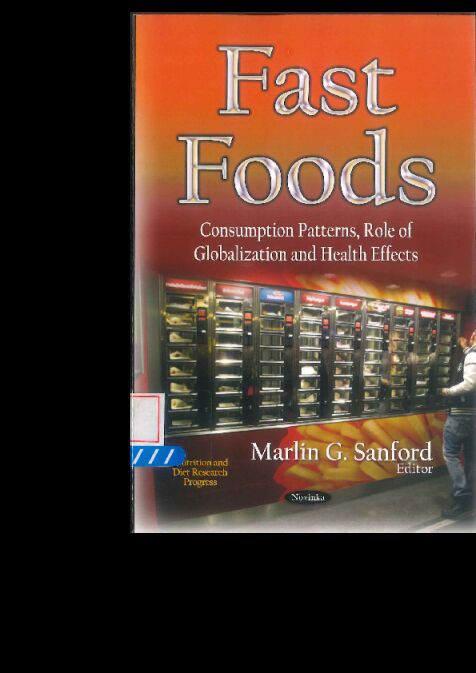
书名:Fast foods
ISBN\ISSN:9781611223521,1611223520
出版时间:2014
出版社:Nova Science Publishers, Inc.,
前言
This book discusses the consumption patterns of fast foods, as well as the role of globalization and the health effects of fast food.
Chapter 1 - Modern societies appear to consume large amounts of convenience and fast food, and its growing popularity is clear. While the consumption of fresh foods has tended to decrease, fast foods are widely consumed as a regular of the habitual diet, especially by older people who live alone, children and adolescents. Several studies indicate that fast foods could largely contribute to the daily intake of essential minerals (i.e. Ca, Mn, Fe, Zn,...) but data on its biovailability are scarce. Recent research suggested that the presence of certain compounds in fast food could negatively affect the bioavailability of some minerals, especially trace elements like Fe and Cu. In addition, exposure of healthy population to Al, Ni, Pb, Cd and other toxic elements, is mainly through the diet. Environmental contamination can be reflected in foods and beverages, and moreover levels of contaminants may increase notably by food additives and during food processing, packaging and storage. Aluminium and stainless, that contain Ni, Cr and other metals, are widely used in food industry. Metals could migrate to the food from the containers during manufacturingand during cooking processes or re-heating. This chapter compiles recently published scientific reports on the content and bioavailability of minerals (essentials and with toxicological effects) in fast foods. The author's will also analyze the repercussion of food technology, and other factors and variables on the presence of toxic metals in ready-to-eat foods. This revision could contribute new data on mineral content in foods that may be potentially useful as supplementary and/or previously unavailable information to current food composition tables in accordance with the actual dietary habits.
Chapter 2 - The evolution of the human food over the past 10,000 years from a Paleolithic diet to our current modern pattern of intake which has occurred very recently for that the human genome to adapt. As consequence several changes in feeding behavior occurred, such as increase of processed foods, high in sodium and hydrogenated fats and low in dietary fiber. Due the current standard of living of called Western population, many diseases have emerged, such as chronic noncommunicable diseases, for e.g. metabolic syndrome. Thus, the author's highlighted in this chapter the main consequences of food transition during 19th - 21st century with focus on dietary fat and what are metabolic implications on the obesity, insulin resistance and inflammation.
Chapter 3 - Thailand is a country in transition due to rapid economic growth and globalization. Traditional Thai fast foods consist of rice served with various types of local main dishes, such as curries, fried meats, fresh or fried vegetables, and soups. In the right combination, traditional Thai fast foods can be complete food groups with balanced energy distribution in terms of macronutrients. Fortunately, people of all socio-economic statuses, even those with low incomes, can access traditional Thai fast foods. During the past two to three decades, however, Thailand's rapid economic growth has led to changes in the eating patterns of the Thai people. Due to aggressive marketing campaigns and advertisements, Western-style fast foods produced by multinational franchise restaurants have become popular among people of all age groups, especially children and teenagers. Multinational franchise restaurants and convenience stores offering Western-style fast foods can be found all over the country. While the total energy intake of Thais has increased only slightly, energy distribution from fat increases annually, similar to sugar consumption. Consequently, Thailand is in transition with the advent of increasing rates of overweight, obesity, and related diseases.
Chapter 4 - Background: There is dearth of data on the nutritional value of food sold in the streets of developing middle-income countries such as South Africa (SA), despite the fact that these foods are commonly sold in urban areas. Many street foods appear to be unhealthy since they are high in saturated fats, trans fats, salt and sugar. Furthermore, they are energy-dense and may contribute to the high prevalence of obesity and its co-morbidities in SA. Aim. To conduct a situational analysis on the type, nutritional content, and hygienic conditions under which foods are sold by vendors on the streets of Cape Town (CT) and surrounding areas. Methods: All locations where vendors (n=820) sold street food (SF) in the CT and surrounding areas were surveyed. These venues included community centers, market areas, major streets, train and bus stations, and taxi ranks. The interviews were conducted by trained fieldworkers using pre-tested questionnaires. Street foods were categorized in different ways: i) by meal; ii) by single food item or beverage; iii) by the level of processing; iv) by method of cooking (fried, boiled, baked, grilled, roasted and steamed) and v) by packaging. Results: The majority of vendors had more than one food item for sale, with some specializing in specific types of food. It was observed that food items most commonly sold were snacks, such as crisps, candy bars, and biscuits (45%), cooked foods (28%), fruits and vegetables (26%), sweetened beverages or flavored water (6%), raw foods (4%), and tea and coffee (1%). Despite the variation in food items, the majority were classified as being unhealthy (i.e. energy-dense), and prepared and sold under poor hygienic conditions as shown by lack of adequate sanitation facilities, poor storage facilities, and inadequate serving procedures. Conclusion: With the exception of fruit and vegetables, the majority of foods and beverages sold by vendors were not healthy options and were prepared and sold under poor hygienic conditions.
查看更多
目录
Preface vii
Chapter 1 Mineral Content in Fast Foods 1
Chapter 2 Dietary Fat and Coming Out of Obesity-Related Metabolic Diseases 35
Chapter 3 Fast Foods in Transition and Nutrition Problems in Thailand 53
Chapter 4 Foods Currently Sold by Street Food Vendors in the Western Cape, South Africa, Do Not Foster Good Health 91
Index 119
查看PDF
查看更多
馆藏单位
中国医科院医学信息研究所