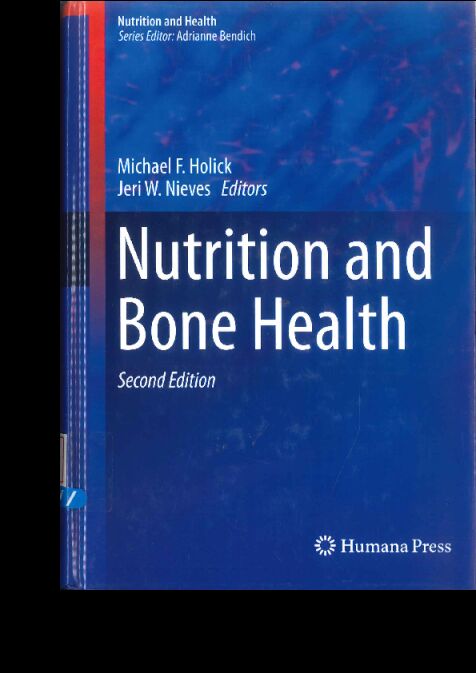
书名:Nutrition and bone health
责任者:Michael F. Holick | Jeri W. Nieves
ISBN\ISSN:9781493920006,9781493920013
出版时间:2015
出版社:Humana Press,
前言
The adage "you are what you eat" is certainly true for skeletal health from birth until death. The skeleton is often perceived as an inert structure that simply acts as the scaffolding for the musculature and to house the brain and other essential organs. Thus, the skeleton is taken for granted. However, just as the intricate scaffolding of a suspension bridge requires constant maintenance, so too does the skeleton require nutritional maintenance. It has a voracious appetite for calcium and other macro- and micronutrients in order for it to maximize its size and to maintain its maximum structural strength.A\The consequences of not providing the skeleton with its nutritional requirements can be quite severe. Infants and young children who do not get an adequate amount of calcium and vitamin D in their diet suffer from growth retardation and bony deformities of their skull, rib cage, arms, and legs. For adolescents and young adults, inadequate nutrition results in not being able to attain their genetically prescribed maximum peak bone mineral density. For middle-aged and older adults, inadequate calcium, vitamin D, protein, and macro- and micronutrient nutrition leads to a more rapid loss of bone that can precipitate and exacerbate osteoporosis. Twenty-five million Americans and an equal number of Europeans and an untold hundreds of millions of adults worldwide are at risk for osteoporosis and its unfortunate consequences. In the USA, approximately one in two women and up to one in four men age 50 and older will break a bone due to osteoporosis. Osteoporosis is responsible for two million broken bones and $19 billion in related costs in the USA every year. Approximately 300,000 of these fractures will be of the hip. Twenty-five percent of women and fifteen percent of men will suffer a hip fracture by the age of 80. It is estimated that between $10-20 billion a year is expended for the acute and chronic care of patients suffering hip fracture. However, the most serious consequences of a hip fracture is that 50 % of patients will never have the quality of life they once had and often become infirm, and 20 % die within the first year after the fracture owing to complications. Therefore, prevention of these devastating fractures becomes very important, and nutrition is a cornerstone of prevention.A\The first objective of the second edition of Nutrition and Bone Health is to provide practicing health professionals, including physicians, dietitians, nutritionists, dentists, pharmacists, health educators, policymakers, research investigators, graduate students, and medical students with comprehensive, well-balanced reviews of the newest clinical findings as well as up-to-date research discoveries regarding the role of nutrition in maintaining a healthy skeleton. It is a given that adequate calcium and vitamin D are important for skeletal health. However, the skeleton craves other nutrients that are equally essential for bone health.A\This second edition of Nutrition and Bone Health explores how our earliest ancestors evolved in a relatively calcium-rich environment that served them well in providing a structurally sound skeleton in a hostile environment. Chapters describing the role of genetics, bone physiology, hormones, and biomechanics of bone provide background to the reader as they delve deeper into the role of nutrition in bone health. The tools used to study nutrition and bone health, including nutritional epidemiology, nutritional assessment and counseling, and dietary patterns, are described and set the stage for the chapters that provide up-to-date reviews of nutritional requirements during pregnancy, for fetal, neonatal, childhood, adolescent, young, middle-aged, and older adult's skeletal health presented in extensively referenced individual chapters. The effects of race and ethnicity on nutrition and bone health are described in detailed chapters.A\The second edition of Nutrition and Bone Health includes several chapters devoted to examining the effects of specific dietary components on bone health: macronutrients (protein and fat), minerals, and micronutrients. Additionally, dietary components such as food groups, and special diets such as vegetarian diets as well as nutraceuticals are discussed in separate chapters. As examples, the importance of proper acid-based balance and the effect of minerals such as calcium, sodium, potassium, phosphorus, and magnesium, as well as micronutrients including fat-soluble vitamins, zinc, and selenium, are reviewed. The chapter on vitamin K provides an expert perspective on the role of vitamin K and its various forms on bone health and cardiovascular disease. Another goal of the second edition of Nutrition and Bone Health is to put into perspective the impact of eating disorders, body weight, exercise, and body weight change on bone health. There are a multitude of diseases and drugs and other environmental and behavioral factors that negatively affect bone health. Among these are cystic flbrosis, celiac disease, HIV/AIDS smoking, and alcohol abuse. The relationship between nutrition, inflammation, and bone health are explored. In addition, the chapter on medications and nutrients provides important information as to the importance of proper nutrition for expensive bone active drags to have favorable effects on the skeleton.A\The role of dietary factors, exercise, and sun exposure on bone cell function and bone mineral density are reviewed in detail to assure that the totality of the evidence presented to the reader provides up-to-date information on these topical, controversial subjects.A\As editors, we are very excited about the expanded contents of the second edition of Nutrition and Bone Health. Chapters are written by experts who provide not only an overview of the subject, but also specific recommendations for how this information can be effectively utilized for practical application by health care professionals. The volume includes numerous tables' and figures to help the reader quickly glean the essentials of each chapter. There is even an app that provides guidance for sensible sun exposure in the chapter on Vitamin D. There is an extensive index that also helps provide a road map to easily cross-reference how particular nutrients, diseases and drugs, environmental factors, race, and age affect bone health.A\Metabolic bone diseases, such as rickets and osteomalacia, as well as osteoporosis, are diseases of neglect. Vigilance for satisfying the nutrient requirements of the skeleton is a small price to pay for remaining erect and fracture free throughout life. The second edition of Nutrition and Bone Health should serve as a critical resource for health care professionals interested in utilizing nutrition, exercise, and other positive lifestyle factors to enhance the overall health and well-being for skeletal health throughout life, minimizing the need for bone active medications which are expensive and associated with many unwanted side effects. Boston, MA, USA: Michael F. Holick; New York, NY, USA: Jeri W. Nieves
查看更多
目录
Part I Basics of Nutrition and Bone Biology
1 Bone Health from an Evolutionary Perspective: Development in Early Human Populations 3
2 Gene-Diet Interactions on Bone 21
3 Bone Physiology: Bone Cells, Modeling, and Remodeling 37
4 Estrogens, Progestins, SERMs, and Osteoporosis 57
5 Bone Biomechanics and the Determinants of Skeletal Fragility 65
6 Clinical and Research Applications of Bone Mineral Density Examinations 81
7 Nutritional Epidemiology: Nutritional Assessment and Analysis 103
8 Dietary Pattern Analysis in Nutritional Science Research: A Review of Current Evidence Relating Dietary Patterns to Indices of Bone Health and Fracture Risk 117
9 Nutrition and Oral Bone Status 133
10 Nutrition Counseling for Skeletal Health 143
Part II Nutrition and Bone: Effects of Life Stages and Race
11 Nutrition in Pregnancy and Lactation 161
12 Nutritional Requirements for Fetal and Neonatal Bone Health and Development 183
13 Nutrition and Bone Health During Skeletal Modeling and Bone Consolidation of Childhood and Adolescence 199
14 Calcium and Vitamin D for Bone Health in Adults 217
15 Nutrition: To Supplement or Not to Supplement the Elderly 231
16 Nutrition and Skeletal Health in Blacks 249
17 Nutrition and Skeletal Health in Other Racial/Ethnic Groups 259
Part III Effects of Dietary Macronutrients
18 Food Groups and Bone Health 277
19 Vegetarianism and Bone Health in Women 291
20 Protein Intake and Bone Health 301
21 Fat and Bone 319
22 Acid-Base Balance and Bone Health 335
Part IV Minerals
23 Quantitative Clinical Nutrition Approaches to the Study of Calcium and Bone Metabolism 361
24 Sodium, Potassium, Phosphorus, and Magnesium 379
25 Assessing Nutritional Requirements for Preterm Infants 395
Part V Fat-Soluble Vitamins/Micronutrients
26 Vitamin A and Bone Health 409
27 Vitamin D 423
28 Vitamin D Utilization in Subhuman Primates 457
29 Vitamin K's Role in Age-Related Bone Loss: A Critical Review 471
Part VI Lifestyle Effects/Supplements
30 Smoking, Alcohol, and Bone Health 489
31 Exercise and Bone Health 505
32 Exercise, Nutrition, and Bone Health 543
33 Body Weight/Composition and Weight Change: Effects on Bone Health 561
34 Nutraceuticals and Bone Health 585
Part VII Nutrition Related Disorders and Secondary Osteoporosis
35 Eating Disorders and Their Effects on Bone Health 599
36 The Role of Nutrition for Bone Health in Cystic Fibrosis 617
37 Celiac Disease and Bone Health 633
38 HIV/AIDS and Bone Health: The Role of Nutrition 645
39 Dietary Factors and Chronic Low-Grade Systemic Inflammation in Relation to Bone Health 659
40 Impact of Nutrition on Medications for Osteoporosis 681
41 Nutrition and Bone Health in Space 687
Index 707
查看PDF
查看更多
馆藏单位
中国医科院医学信息研究所