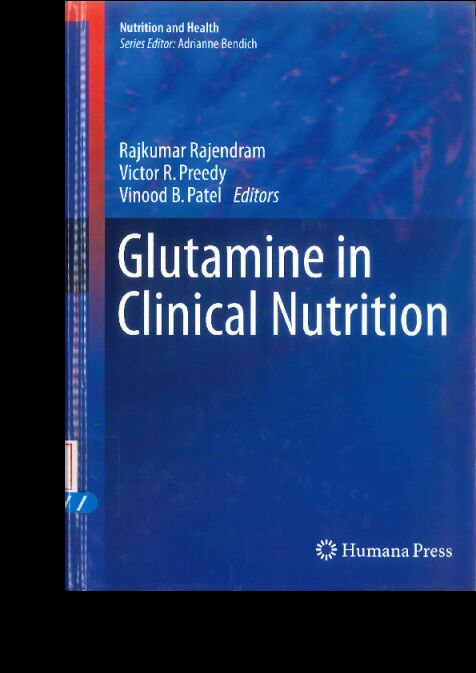
书名:Glutamine in clinical nutrition
责任者:Rajkumar Rajendram | Victor R. Preedy | Vinood B. Patel
ISBN\ISSN:9781493919314,9781493919321
出版时间:2015
出版社:Humana Press,
前言
Glutamine was originally considered a nonessential amino acid due the fact that it can be synthesized from glutamate. Glutamine is also the most abundant amino acid and a major contributor to whole body nitrogen metabolism in man. However, over several decades, evidence has supported the notion that glutamine is "conditionally essential" and thus important in human health. For example, glutamine protects the intestinal tract, skeletal muscle, and neuronal tissue against metabolic stress. Some of the earlier studies showed that reduced intracellular glutamine in muscle was associated with loss of lean tissue or wasting. This led to the development of nutritional support regimens in which glutamine was administered by enteral or parental routes. However, this is rather a simplistic notion of glutamine's role and potential in disease. It is now known that glutamine has an almost ubiquitous function and is important in maintaining the cellular milieu of virtually every organ in the human body. Thus, its supplementation not only modulates skeletal muscle mass in postsurgical stress but also improves lymphocyte count, enhances outcome scores, and ameliorates the peroxidation of lipids as just a few examples. However, more recent studies have suggested that the administration of glutamine conjugated, or co-administered, with substrates provides greater efficacy that glutamine alone. Furthermore the efficacy of conjugated glutamine is enhanced when administered in complex cocktails that may contain other nutraceuticals. The science of glutamine is thus complex, and finding all the relevant information in a single source has hitherto been problematic. This is however addressed in Glutamine in Clinical Nutrition.
It has five major sections: Section 1: Basic Processes at the Cellular Level and in Animal Models Section 2: Glutamine Use in Critically Ill Patients and Their Diagnosis Section 3: Glutamine in Normal Metabolism and Under Surgical Stress Section 4: Clinical Aspects of Glutamine in the Intestine Section 5: Clinical Aspects of Glutamine in Certain Patient Populations
Coverage includes glutamine structure and function, amino acid transporters, glutamine transami-nases, one-carbon metabolism, uptake and immunomodulation, the pituitary gland, thyroid-stimulating hormone release, the TCA cycle, mammary tissue, cancer cells, metabolic imaging, endotoxemia, metabolic stress, major surgery, intensive care, multiple trauma, sepsis, dipeptides, insulin sensitivity, critically ill children, liver cirrhosis, ammonia, encephalopathy, the glutamine-glutamate-alpha-ketoglutarate axis, glutamine cycling, metabolic syndrome, glucagon-like peptide-1, presurgery, malnutrition, diabetic foot ulcers, epithelial tight junction, colitis, Helicobacter pylori infection, intestinal hypoxic injury, dipeptides, intestinal microcirculation, manganese toxicity, epilepsy, glutamine synthetase deficiency, plasma antioxidants, HIV, ischemia reperfusion injury, cancer immunosuppres-sion, exercise, cancer cachexia, skeletal muscle, myostatin, and many other areas. Finally there is a chapter on "Web-Based Resources and Suggested Readings."
Contributors are authors of international and national standing, leaders in the field, and trendsetters. Emerging fields of science and important discoveries are also incorporated in Glutamine in Clinical Nutrition.
This book is designed for nutritionists and dietitians, public health scientists, doctors, epidemiologists, health care professionals of various disciplines, policy makers, and marketing and economic strategists. It is designed for teachers and lecturers, undergraduates and graduates, researchers and professors.
The Editors London, UK Rajkumar Rajendram; Victor R. Preedy; Vinood B.Patel
查看更多
目录
Part I Basic Processes at the Cellular Level and in Animal Models
1 Glutamine Structure and Function: A Starter Pack 3
2 Amino Acid Transporters and Glutamine 21
3 Role of Glutamine Transaminases in Nitrogen, Sulfur, Selenium, and 1-Carbon Metabolism 37
4 Glutamine Uptake and Imnuinomodillation: An Overview 55
5 The Role of Glutamine and Glutamic Acid in the Pituitary Gland Involvement in Thyroid-Stimulating Hormone Release 67
6 Glucose-Independent Glutamine-Driven TCA Cycle in Cancer Cells 77
7 The Role of Glutamine Synthetase in the Glutamine Independence in Mammary Tissue 87
8 Glutamine Addiction of Cancer Cells 99
9 L-[5-~(11)C]-Glutamine and Metabolic Imaging in Cancer Cells 113
10 Endotoxemia and Glutamine 125
Part II Glutamine Use in Critically III Patients and Their Diagnosis
11 Plasma Glutamine and Its Levels in Metabolic Stress 143
12 Glutamine Supplementation in Major Surgery and Intensive Care 153
13 Enteral Nutrition Supplemented with L-glutamine in Patients with Sepsis 169
14 Glutamine Supplementation in Multiple Trauma Patients 181
15 Glutamine Dipeptide and Insulin Sensitivity in Critically 111 Patients 195
16 Potential for Glutamine Supplementation in Critically 111 Children 207
17 Glutamine and Ammonia in Hepatic Encephalopathy 219
18 The Oral Glutamine Challenge in Liver Cirrhosis 229
Part III Glutamine in Normal Metabolism and Under Surgical Stress
19 Insulin Secretion and the Glutamine-Glutamate-Alpha-Ketoglutarate Axis 239
20 Glutamine-Cycling Pathway in Metabolic Syndrome: Systems Biology-Based Characterization of the Glutamate-Related Metabolotype and Advances for Diagnosis and Treatment in Translational Medicine 255
21 Glutamine and Glucagon-Like Peptide-1 Response 277
22 Glutamine Pretreatment and Surgery for Cleft Lip/Cleft Palate in Children 293
23 Use of Perioperative Glutamine Dipeptide in Parenteral Nutrition in Surgical Hospital Patients with Malnutrition 301
24 Therapeutic Use of Glutamine for Diabetic Foot Ulcers and Related Conditions 313
Part IV Clinical Aspects of Glutamine in the Intestine
25 Glutamine Protects GI Epithelial Tight Junctions 323
26 Glutamine Therapy in Colitis Models 339
27 Glutamine Supplementation and Helicobacter pylori Infection 357
28 Small Intestinal Hypoxic Injury and Use of Arginyl-Glutamine Dipeptide: Applications to Pediatrics 369
29 Dipeptide-Bound Glutamine and the Intestinal Microcirculation in Sepsis 383
Part V Clinical Aspects of Glutamine in Certain Patient Populations
30 Manganese Toxicity and the Glutamine-Glutamate Cycle 401
31 Glutamine and Epilepsy 415
32 Glutamine Supplementation in Glutamine Synthetase Deficiency 427
33 Plasma Antioxidants and Glutamine Supplementation in HIV 437
34 Glutamine, Total Antioxidant Systems and Damage in Renal Ischemia-Reperfusion Injury 445
35 Protection by Glutamine After Ischemia/Reperfusion Injury 461
36 Glutamine and Cancer Immunosuppression 475
37 Combining Exercise with Glutamine Supplementation in Cancer-Cachexia Metabolism 487
38 Glutamine and Skeletal Muscle 499
39 Glutamine and Myostatin Expression in Muscle Wasting 513
40 Web-Based Resources and Suggested Readings 527
Index 533
查看PDF
查看更多
馆藏单位
中国医科院医学信息研究所