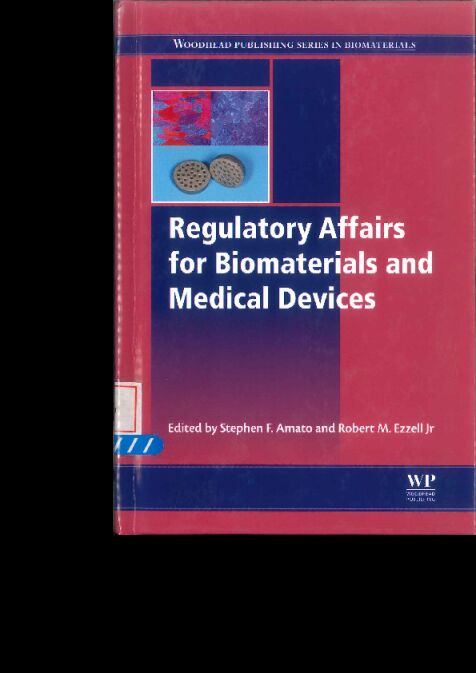
书名:Regulatory affairs for biomaterials and medical devices
责任者: Stephen F. Amato and Robert M. Ezzell Jr. | Ezzell, Robert M.
ISBN\ISSN:9780857095428,0857095420
出版时间:2015
出版社:Woodhead Publishing is an imprint of Elsevier,
摘要
All biomaterials and medical devices are subject to a long list of regulatory practises and policies which must be adhered to in order to receive clearance. This book provides readers with information on the systems in place in the USA and the rest of the world. Chapters focus on a series of procedures and policies including topics such as commercialization, clinical development, general good practise manufacturing and post market surveillance. Addresses global regulations and regulatory issues surrounding biomaterials and medical devices. Especially useful for smaller companies who may not employ a full time vigilance professional. Focuses on procedures and policies including risk management, intellectual protection, marketing authorisation, university patent licenses and general good practise manufacturing
查看更多
目录
List of contributors ix
Woodhead Publishing Series in Biomaterials xi
1 Biomaterials and their applications in medicine 1
1.1 Biomaterials - progression of the definition 1
1.2 The history and future of biomaterials 2
1.3 Types of biomaterials 4
1.4 The major factors contributing to specific biomaterial choices 6
1.5 Important parameters in the development of biomaterials and associated products 7
1.6 Applications of biomaterials 8
1.7 Sources of further information and advice 9 References 10
2 Technical considerations for commercialization of biomaterials 11
2.1 Introduction 11
2.2 General considerations 11
2.3 Regulation of risks associated with medical products 12
2.4 Ensuring the safety of medical products 13
2.5 Demonstrating the efficacy of biomaterials 16
2.6 Specific product scenarios 17
2.7 Biologically derived materials 19
2.8 Understanding and complying with FDA guidelines 21
2.9 Conclusion 25 References 25
3 Regulatory strategies for biomaterials and medical devices in the USA: classification, design, and risk analysis 27
3.1 Food and Drug Administration (FDA) regulatory categorizations and structure 27
3.2 FDA classification of medical devices 31
3.3 FDA Quality Systems Regulations (QSRs) for medical device and biomaterial design control 35
3.4 Medical device and biomaterial risk analysis 38
3.5 Procurement and related processes 42 References 44
4 Clinical development and endpoint strategies for biomaterials and medical devices 47
4.1 Food and Drug Administration (FDA) regulatory considerations for biomaterials 47
4.2 Clinical development pathways for device-based classification 48
4.3 Testing considerations for biomaterials clinical evaluation 53
4.4 Clinical development pathways for biologic-based classification 56
4.5 Clinical development pathways for combination product classification 58
4.6 Clinical development elements required in biomaterials product evaluation in all regulatory pathways 59
Appendix 1: Applicable FDA guidance documents and ASTM standards for biomaterials 60
Appendix 2: Applicable FDA product codes and target areas for Class II biomaterials 63
5 The clinical evaluation and approval threshold of biomaterials and medical devices 67
5.1 The clinical evaluation of biomaterials and medical devices 67
5.2 Geographical differences in clinical evaluations 69
5.3 Clinical quality assurance 70
5.4 Threshold for approval 71
5.5 The current regulatory landscape 74
5.6 Future trends 75 References 77
6 Supply chain controls for biomaterials and medical devices in the USA 79
6.1 Introduction 79
6.2 Overview of supply chain risks and mitigating activities 79
6.3 Product distribution: traditional and emerging risks 80
6.4 Counterfeit challenges 82
6.5 Challenges relating to recalls, imports and environmental management 84
6.6 Risk management system 85
6.7 Regulatory risks affecting sponsor oversight of a supplier 87
6.8 Supplier risks in the supply chain 88
6.9 Supplier impact on product risk 89
6.10 Product liability risks and the supply chain 90
6.11 Summary 92
7 Global marketing authorisation of biomaterials and medical devices 93
7.1 Introduction 93
7.2 Placing devices on the EU market 93
7.3 Placing devices on the US market 105
7.4 Placing devices on the Australian market 109
7.5 Placing devices on the Canadian market 109
7.6 Future trends 112
7.7 Sources of further information and advice 113
8 Good manufacturing practice (GMP) for biomaterials and medical devices in the EU and the USA 115
8.1 Introduction 115
8.2 History of GMP 116
8.3 The essential rules of GMP 117
8.4 Global overview on GMP 120
8.5 GMP and management 121
8.6 Requirements of a GMP quality system: prior to routine production 126
8.7 Requirements of a GMP quality system: preparing and performing routine production 132
8.8 Particular aspects of 'EU GMP' and comparison with 21 CFR Part 820 134
8.9 GMP and product life span 135
8.10 Future trends for GMP 142
8.11 Sources of further information 143
Bibliography 143
9 Postmarket surveillance approaches for biomaterials and medical devices in the USA 145
9.1 Classification-based postmarketing surveillance pathway 145
9.2 Postmarketing surveillance pathway for device-based classification 145
9.3 Postmarketing surveillance pathway for biologics-based classification 152
9.4 Postmarketing surveillance pathway for combination-based classification 154
9.5 Strengthening postmarket surveillance 155 References 157
10 Fundamentals of medical device approval in the Asia Pacific region 159
10.1 Introduction 159
10.2 Asia Pacific regulatory environment - good practice 160
10.3 Defining the regulatory strategy in the Asia Pacific region 164
10.4 Scheduling medical device registrations in the Asia Pacific region (reducing registration lead time) 166
10.5 Follow-up of the device registration 170
10.6 Conclusion 172 References 173 Appendix: glossary of terms 173
Index 175
查看PDF
查看更多
馆藏单位
中国医科院医学信息研究所