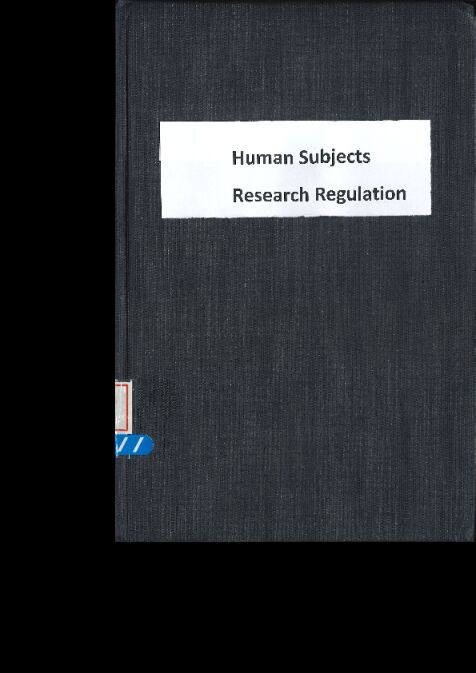
书名:Human subjects research regulation
责任者: I. Glenn Cohen and Holly Fernandez Lynch. | Lynch, Holly Fernandez
ISBN\ISSN:0262027461,9780262526210,0262526212,9780262027465
出版时间:2014
出版社:The MIT Press,
前言
Tens of billions of dollars are spent each year on clinical research of in-vestigational treatments in the United States and around the world (Getz 2010), but clinical trials represent only the tip of the iceberg when it comes to human subjects research. From the scientists involved in mul-timillion dollar clinical trials of potential HIV vaccines, to the university anthropologist who wants to conduct interviews in Chile of shamans in the Mapuche tribe (or nation as they prefer to be called) to understand the ways in which they attach mystical significance to legal texts, to the psychology graduate student studying how other students allocate funding in a simulated charity, all of these disparate researchers have to wrestle with largely the same framework for regulating human subjects research.
The history and details of this framework—which entails elements of both paternalism and preservation of individual autonomy—are described in greater depth in the next chapter and many of the subsequent ones. In the United States it emerged out of the horrors of the Nazi experiments, confronted by the world in the Doctors' Trials at Nuremberg following World War II, as well as the now-infamous Tuskegee syphilis study conducted by government researchers on poor black men in Alabama from 1932 to 1972. The framework has gone through a number of iterations since the initial regulations for protecting human subjects in research supported or conducted by the Department of Health, Education, and Welfare (the precursor to today's Department of Health and Human Services) were first promulgated in 1974 (Porter and Koski 2008), but its foundational essence has remained largely intact since then.
As the authors in this volume catalog, however, the US regulatory system governing human subjects research has a number of major deficiencies: it is slow, it is expensive, it is inconsistent in part due to its decentralized review system, it fetishizes the formalities of informed consent, and it overprotects patients from small potential risks while failing to compensate them for more serious injuries sustained during research, among many other problems. In general, it seems poorly equipped to deal with the realities of human subjects research in the twenty-first century.
When we first gathered these contributing authors together for a conference at Harvard Law School in May 2012, the system seemed poised for its most significant change since the early 1990s, and perhaps since its inception. In July 2011, DHHS had released a much-touted Advanced Notice of Proposed Rulemaking (ANPRM) titled "Human Subjects Research Protections: Enhancing Protections for Research Subjects and Reducing Burden, Delay, and Ambiguity for Investigators" (DHHS 2011a).1 This ANPRM proposed to substantially amend the main federal regulations governing human subjects research (known as the "Common Rule") for the first time in more than twenty years. When the public comment period ended, the Department had received more than 1,100 submissions over the course of only three months, signaling the high level of interest in this issue. In addition, in September 2011, President Obama's Commission for the Study of Bioethical Issues made a number of recommendations to improve the regulatory protection of subjects in federally funded research (DHHS 2011b). When combined with the increasing globalization of human subjects research and the attendant need to harmonize divergent approaches, the more frequent conduct of multiregional clinical trials, and increasing research on biospecimens, it appeared that we were at a moment when the regulatory scheme was ripe for a major course correction.
As we write this introduction approaching autumn of 2013, however, the future of the ANPRM looks much less certain, and there has been no additional movement from the government in more than two years. Dr. Jerry A. Menikoff, the current director of the Office for Human Research Protections at DHHS, and the man charged with reconciling the hundreds of comments received on the ANPRM and the views of the multitude of government agencies directly impacted by any change, has tried to put a brave face on the matter, stating that "[t]his is, of course, a complicated undertaking, as was stated from the outset, and it takes time" (Basken 2013). But J. Thomas Puglisi, a former division chief in the same office, was more pessimistic in a commentary he wrote in The Hastings Center Report, suggesting that the initiative had "become stalled, at least for the foreseeable future, if not permanently. Given the current political climate and the often divergent interests of the seventeen agencies that adhere to the rule, mea ingful systemic modernization of the Common Rule is not likely to occur any time soon." Nonetheless, Puglisi maintained that modernization is "desperately needed" (2013, S40).
Other than Menikoff and Puglisi's vague and somewhat elliptical statements, no one "in the know" has gone on record to explain why the ANPRM process seems to be in paralysis at the moment—if not completely dead. Of course, we can speculate as to why this initiative stalled. Perhaps it was because the interests of those potentially affected by the proposed changes were too heterogeneous. On this line of thought, the ANPRM might have opened up the sutures in the Common Rule that bound together disparate fields of research in terms of methods and values. While these various communities had learned to grudgingly live with the existing Common Rule system, when the opportunity for change arose, it is possible that anything short of a complete overhaul left all parties dissatisfied—and although the ANPRM proposed some substantial change, it is far from a comprehensive rethinking of the current approach to human subjects research regulation. A second and quite different story that might be told has to do with sequestration. In the face of huge cuts to science funding already destabilizing the research community, the powers that be might have decided that reformation of the research ethics rules (which would entail potentially costly training and compliance efforts) should be put off. A third possibility is that the ANPRM's scope was too ambitious, and that some of the issues it aimed to cover—biospecimens, for example—proved to be the third rail of reform and made it difficult to move forward even though many other reforms would have been welcome and uncontroversial had they been separated out. Finally, there is a cynical explanation: everyone is unsatisfied with the existing regulations but there is disagreement as to what type of change is in order, so the ANPRM was just a bone to chew on with no real hope or anticipation of actual change. Indeed there is already an entire industry built on the existing regulations and change would be quite disruptive.
None of these possible explanations are anything more than speculative, and it may be years, if ever, before the inside story of the ANPRM's demise (or at least slumber) will be told. But whatever the reason, the pressing question remains: Where do we go now?
Using the proposed changes suggested by the ANPRM as their launching (and sometimes counter) point, the twenty-two chapters in this volume seek to offer a fresh outlook on the regulatory framework for human subjects research fit for the realities of the twenty-first century university-industrial research complex. Some seek to capitalize on andrefine the directions charted by the ANPRM, others seek to show why
查看更多
目录
Series Foreword xi
Acknowledgments xiii
Introduction 1
1 Setting the Stage: The Past and Present of Human Subjects Research Regulations 9
I Regulation of Risk
Introduction 27
2 De minimis Risk: A Suggestion for a New Category of Research Risk 31
3 Risk Level, Research Oversight, and Decrements in Participant Protections 45
II Protection of Vulnerable Populations Introduction 61
4 Classifying Military Personnel as a Vulnerable Population 65
5 Children as Research Partners in Community Pediatrics 79
6 Back to the Future? Examining the Institute of Medicine's Recommendations to Loosen Restrictions on Using Prisoners as Human Subjects 93
III Redefining the Participant-Researcher Relationship and the Role of IRBs
Introduction 109
7 Toward Human Research Protection That Is Evidence Based and Participant Centered 113
8 Outsourcing Ethical Obligations: Should the Revised Common Rule Address the Responsibilities of Investigators and Sponsors? 127
9 Subjects, Participants, and Partners: What Are the Implications for Research as the Role of Informed Consent Evolves? 143
10 Democratic Deliberation and the Ethical Review of Human Subjects Research 157
11 IRBs and the Problem of "Local Precedents" 173
IV Specimens, Data, and Privacy
Introduction 189
12 Biospecimen Exceptionalism in the ANPRM 193
13 Biobanking, Consent, and Certificates of Confidentiality: Does the ANPRM Muddy the Water? 207
14 Mandating Consent for Future Research with Biospecimens: A Call for Enhanced Community Engagement 221
15 Take Another Little Piece of My Heart: Regulating the Research Use of Human Biospecimens 237
16 Reconsidering Privacy Protections for Human Research 251
17 In Search of Sound Policy on Nonconsensual Uses of Identifiable Health Data 265
V Paradigm Shifts in Research Ethics
Introduction 281
18 What Is This Thing Called Research? 285 19 What's Right about the "Medical Model" in Human Subjects Research Regulation 299
20 Three Challenges for Risk-Based (Research) Regulation: Heterogeneity among Regulated Activities, Regulator Bias, and Stakeholder Heterogeneity 313
21 Protecting Human Research Subjects as Human Research Workers 327
22 Getting Past Protectionism: Is It Time to Take off the Training Wheels? 341
Appendix: Regulatory Changes in the ANPRM: Comparison of Existing Rules with Some of the Changes Being Considered 349
Contributors 359
Index 363
查看PDF
查看更多
馆藏单位
中国医科院医学信息研究所