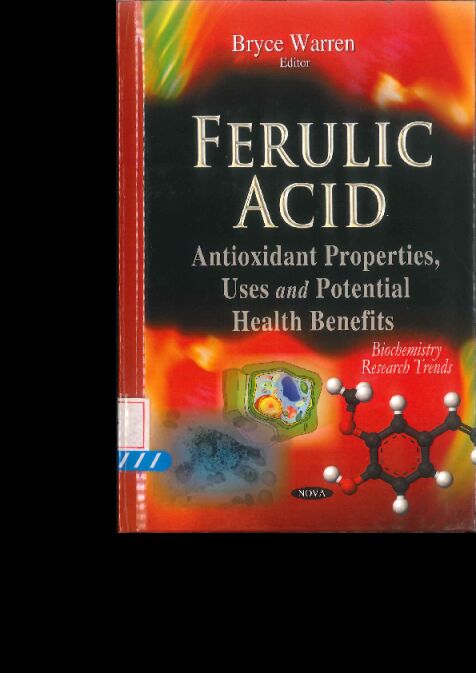
书名:Ferulic acid
出版时间:2015
出版社:Nova Science Publishers, Inc.,
前言
Ferulic acid (FA) is a ubiquitous phenolic compound widely found in plant tissues, mainly as a component of the primary cell walls. This abundant dietary antioxidant constitutes a bioactive ingredient of many foods that may offer beneficial effects against cancer, diabetes and neurodegenerative diseases, among others. This book discusses the antioxidant properties of FA and aims to cover the main aspects related to its use in the food, health and cosmetics industries, as well as to present important advances in its bioconversion into commercially valuable molecules.A\Chapter 1 - The reduced risk of chronic diseases, including, cancer, diabetes, Alzheimer's, osteoporosis, Parkinson's disease, atherosclerosis, chronic inflammation, heart disease and rheumatoid arthritis, which stand out with greater incidence and prevalence in the scenario world, have been positively associated with the consumption of fruit. This protective potential is mainly attributed to the presence of bioactive compounds that exert antioxidant activity by avoiding risks to biological systems. Studies show that one of the main forms of action of the constituents of plant foods is its recognized ability to chelate divalent metals involved in the production of reactive oxygen species (ROS), and thus prevent damage to the body and the onset of many diseases. Among the different plant sources, the baru almond (Dipteryx alata Vog.), Fruit native to the Brazilian Cerrado, has a high content of compounds known antioxidant. Recent studies have shown that daily supplementation the baru almond [Dipteryx alata Vog.] The animals tested, reduced the iron-induced oxidative stress in Wistar rats. Almonds obtained in the local market of Brasilia-DF, from three regions of the Cerrado (MT, MG and GO), were previously selected and randomly distributed into two distinct groups: raw almonds and raw almond film without film. Of these almonds was wrapped in packs of transparent polyethylene bags and stored at -80° C and the remaining almonds, with and without films, was subjected to roasting in an incubator without air circulation at 150° C / 45 minutes. The total amount of phenolic compounds was quantified spectrophotometrically using the Folin Ciocalteu method, and the individual phenolic compounds were analyzed by liquid chromatography (HPLC). Of these, the ferulic acid was detected in all samples at concentrations ranging between 3.6 and 45.4 mg / 100g. The ferulic acid belongs to the group of phenolic compounds, flavonoids no simpler, or hidroxicianamida of cinnamic acids and their derivatives, which are present in plants like wheat, rice, peanuts, walnuts, apple, tomato, corn, artichoke and coffee, with purposes of protecting and prevent lipid oxidation in these plants. This acid has anticarcinogenic action and high inhibitory activity against proliferating cells of breast, colon, liver, tongue and nervous system and, when combined with other phenolic compounds, have potential for increased action. In this study the authors observed the thermal stability of ferulic acid, due to its chemical structure, keeping unchanged the antioxidant mechanism.A\Chapter 2 - The compound 4-hydroxy-3-methoxycinnamic acid, also named ferulic acid (FA), is a ubiquitous phenolic compound widely found in plant tissues, mainly as a component of the primary cell walls. This abundant dietary antioxidant constitutes a bioactive ingredient of many foods that may offer beneficial effects against cancer, diabetes and neurodegenerative diseases, among others. This chapter will discuss the antioxidant properties of FA, establishing their relationship with biological activities already described for this natural product. In addition, it aims to cover the main aspects related to its use in the food, health and cosmetics industries, as well as to present important advances in its bioconversion into commercially valuable molecules, notably vanillin.A\Chapter 3 - Naturally, phenolic compounds coexist in several plants and foods. Ferulic acid (FA, 4-hydroxy-3-methoxycinnamic acid) is a metabolite of 5-caffeoylquinic acid found abundantly in herbs, grains and spices. Besides, it has been approved as an antioxidant additive as well as a sodium ferulate, for the treatment of cardiovascular and cerebrovascular diseases by Japan and China, respectively. Ferulic acid is a phenolic acid of low toxicity, it can be absorbed and easily metabolized in the human body and it was recovered in several organs, including the brain. FA is famous by its antioxidant activity but it has multiple biological effects such as, anti-inflammatory, anti-atherogenic, modulator of neurogenesis and neuroprotective.A\In fact, FA has been implicated in some signaling cascades, involving modulation of synaptic plasticity, neurogenesis and cell survival. Likewise with claimed benefits in prevention and treatment of disorders linked to oxidative stress and inflammation like neurodegenerative diseases. Moreover, its biological activities on the Central Nervous System (CNS) remain unclear. In recent years, there have been an increasing number of reports on the antidepressant and neuroprotective effects of FA.A\Considering the multiple biological effects of FA and the multifactorial nature of depression the aim of this review is highlight FA biological functions beyond its antioxidant effect.A\Chapter 4 - Diabetes mellitus (DM), a metabolic complex syndrome, caused by inherited or acquired deficiency of insulin is recognized as a major health problem worldwide. It is also involved in multiple vascular and renal complications including diabetic retinopathy, neuropathy and nephropathy. It is well recognized that oxidative stress and inflammation contribute to the known pathophysiologic characteristics of diabetic complications such as formation of advanced glycation end products (AGEs), activation of protein kinase C isoforms (PKC), and over-activity of the hexosamine pathway. Although diabetes compromises a patient's endogenous antioxidant defense system, dietary antioxidants could partially supplement this deficiency. Ferulic acid (FA), a hydroxycinnamic acid present in most of plant-based foods, possesses many pharmacological effects and extends therapeutic effects against diabetic complications by anti-oxidative and anti-inflammatory mechanisms. Pharmacotherapy of FA against diabetes can be related to its ability to escalate gene expression of glutathione peroxidase (GPx), superoxide dismutase (SOD) and catalase (CAT) and regeneration of pancreatic beta-cells. Furthermore, both in vitro and in vivo studies show that FA not only attenuates hyperglycemia but also modulates AGEs, PKC and reactive oxygen species (ROS). This book chapter aim at critically reviewing the anti-diabetic effects of dietary FA in alleviating oxidative stress and attenuating the hyperglycemic response associated with diabetes. This review also provides an analysis of the possible cellular mechanisms of FA in amelioration of the progression and complications of diabetes.A\Chapter 5 — Oxidative DNA damage is an inevitable consequence of cellular metabolism and antioxidant system of body prevents diseases due to free radicals. However, imbalanced overproduction of free radicals and defense mechanism end into a range of disorders such as, Parkinson and Alzheimer diseases, aging and diabetes mellitus. On the other hand, angiotensin I-converting enzyme is a vital component in blood pressure regulation. The ACE activity causes a rise in blood pressure by increasing vascular resistance and fluid volume while ACE-inhibitor compounds exert an antihypertensive action. Phenolic compounds are a widespread family of phytochemicals with diverse biological functions in plants and ferulic acid is one of the ubiquitous compounds in nature. The identification of these compounds has increased due to their recognized physiological actions in humans. The study of vegetables with antioxidant, antihypertensive, antimicrobial and other biological activities beneficial to human health is a challenge that has been taken up during the past few years. In recent years, more attentions had been paid on phenolic compounds of citrus fruits, and publications suggested they might play an important role on the antioxidant capacity of citrus fruits. The phenolic acids that exist largely in citrus fruits are hydroxycinnamics, such as caffeic, p-coumaric, ferulic and sinapic acids. In this chapter, the authors present updated findings that indicate that ferulic acid of different plant sources or derived products have beneficial properties, such as antioxidant, antihypertensive and antimicrobial activities, among others.A\Chapter 6 - Ferulated arabinoxylans (AX), the main non-starchy polysaccharide of cereal grains, are constituted of a linear backbone of p- (1—4)-linked D-xylopyranosyl units to which α-L-arabinofuranosyl substituents are attached through 0-3 and/or 0-2 positions of the xylose residues. Some of the arabinose residues are ester linked to ferulic acid (FA). AX can form gels by covalent cross-linking involving FA oxidation by either chemical or enzymatic (peroxidase/H2O2 or laccase/O2 system) free radical- generating agents. This oxidation allows the covalent coupling of AX chains through the formation of dimers and trimers of FA (di-FA, tri-FA), generating an aqueous three-dimensional network. Furthermore, there are physical interactions (hydrogen bonds) between AX chains that contribute to the stability of the network. AX gelation process and gel properties are governed by the establishment of both covalent linkages and weak interactions, which depend on AX structural characteristics such as molecular weight, arabinose- xylose ratio (A/X), as well as FA content and location. AX gels are neutral, colorless and odorless, and due to covalent linkages can withstand temperatures, ionic strength and pH changes. The meso and macroporous structure of AX gels (40-400 nm) confers their potential application as delivery systems for biomolecules or cells. In addition, it has been proposed that AX can offer health benefits including cancer reduction risk, decrease of lipid peroxidation and antioxidant activity. These benefits may be extended to AX gels as antioxidant activity of AX gels has been demonstrated. However, to the authors' knowledge the antioxidant activity of AX gels presenting different A/X values has not been reported. In the present study, the production of AX with reduced A/X value without affecting other structural characteristics was achieved by enzymatic debranching of AX from a single source. The A/X value of AX was modified from 0.69 to 0.46. These AX formed gels at 2% (w/v in AX) presenting storage modulus (G') values of 106 and 162 Pa for AX presenting A/X values of 0.69 and 0.46, respectively. The mechanical spectra of these gels were typical of viscoelastic systems. The antioxidant capacity of AX decreases by 47% when the A/X ratio decreased from 0.69 to 0.46 while this capacity increased by 14% in gels formed with reduced A/X value. These results indicates that AX and AX gels antioxidant activity can be tailored indicating their potential application as an antioxidant carrier system for biomolecules or cells.A\Chapter 7 - Dried distillers grain (DDG) is a cereal byproduct of the distillation process. Maize DDG and nejayote (a maize processing waste water) generated from tortilla-making industries in Mexico were investigated as source of ferulated arabinoxylans (AX). DDG is an important byproduct of drymill ethanol production in some countries such as the United States of America. Drymill ethanol production process uses only the starch portion of the maize, which is about 70% of the kernel. Tortilla industry is important in some Latin American countries as almost half of the total volume of consumed food is maize. Therefore, DDG and nejayote can be potential sources of added-value biomolecules such as AX. In the present investigation both byproducts were treated for these polysaccharides extraction. The polysaccharides extracted from each source showed different gelling capability. Gels were obtained from these two fractions of AX by laccase covalent cross-linking of ferulic acid (FA) leading to the formation of diferulic (di-FA) and trifemlic (tri-FA) acid. AX from DDG formed gels at 2% (w/v) while AX from nejayote formed gels at 10% (w/v). The antioxidant capacity of AX after cross-linking process decreased by 71% in AX from DDG while this capacity was reduced only by 33% in AX from nejayote. The results suggest that recuperation of AX from DDG and nejayote maize by-products could represent alternative sources of this polysaccharide which present antioxidant properties before and after gelation.
查看更多
目录
Preface vii
Chapter 1 Implications of Oxidative Stress in Chronic Diseases, Benefits of Ferulic Acid to the Health and Effect of Heat Treatment on Its Antioxidant Potential 1
Chapter 2 Uses and Potential Applications of Ferulic Acid 39
Chapter 3 Multiple Biological Effects of Ferulic Acid: Focus on Promising Antidepressant Benefits 71
Chapter 4 Anti-Diabetic Effect of Ferulic Acid and Derivatives: An Update 93
Chapter 5 Beneficial Properties of Ferulic Acid From Different Vegetable Sources 117
Chapter 6 Antioxidant Capacity of Enzymatically Modified Ferulated Arabinoxylans and Their Gels 135
Chapter 7 Ferulated Arabinoxylans Recovered from Low-Value Maize By-Products: Gelation and Antioxidant Capacity 151
Index 165
查看PDF
查看更多
馆藏单位
中国医科院医学信息研究所