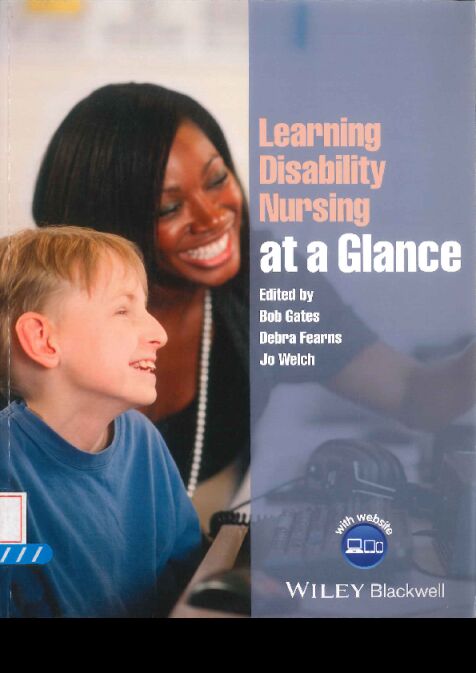
书名:Learning disability nursing at a glance
责任者:Bob Gates | Debra Fearns | Jo Welch. | Welch, Jo
出版时间:2015
出版社:John Wiley & Sons Inc.,
前言
It is with enormous pride that we offer this new and exciting book - Learning Disability Nursing at a Glance; one that is in a series of popular nursing texts. The aim of this book is to provide learning disability nursing students with user-friendly, contemporary information in relation to some of the key clinical practice issues that they may encounter when working with people with learning disabilities. At the outset we need to make clear our use of terminology in this text. Generally speaking within the UK, the term 'learning disability is used to describe people with significant developmental delay that results in arrested or incomplete achievement of the 'normal' milestones of human development. The term 'learning disabilities' is also used elsewhere throughout the world, but it holds different meanings in many other countries; paradoxically so too in the UK. It is this difference in meaning that causes confusion to, what we hope, will be an international audience of readers. Elsewhere in the world alternative terms to 'learning disability are used, such as 'mental retardation', and 'mental handicap, but these terms are felt to portray negative imagery concerning people with learning disabilities. There are more positive international terms in use, such as 'intellectual disability' and 'developmental disability' but we have decided to adopt the consistent use of a term which we believe seems most appropriate to this text, and for the readership, as well as those who this book is principally about, and that is 'learning disability. Therefore, throughout the remainder of this book we will only use the term learning disability, save where certain Acts and, or, other technical works require other terminology for accuracy.
The text has been edited using expert contributions from learning disability academic staff as well as clinicians. While there are currently a number of texts available that describe nursing practice from an adult perspective, there are few that deal with practice specifically related to people with learning disabilities. And indeed fewer still that address the needs of people with learning disabilities across the life spectrum, from children through to adolescents and on to adults and older people. Also, many of the current texts related to people with learning disabilities that are available tend to deal with the subject of learning disabilities, rather than learning disability nursing, this book does both. Uniquely, the book is aimed at health and social care students, as well as registered nurses, but will be of use to a wide range of other students from a wide variety of vocational, academic and professional backgrounds, and other fields of nursing. Principally the book is intended to provide nursing students with material that is accessible, up to date, and readily available. The text addresses the principles underpinning contemporary learning disability nursing practice that students are likely to encounter, and these are discussed in the context of maintaining health and wellbeing. And in order to reflect the contemporary field of learning disability nursing practice, the text embraces both primary and secondary care perspectives. Learning disability nurses can now be found working and supporting people in diverse care contexts, such as community learning disability teams, treatment and assessment services, outreach services, residential settings, day care and respite services, health facilitation and hospital liaison roles, mental health and, or, challenging behaviour services, special schools and specialist services for people who can be located on the spectrum of autistic conditions. Additionally, they can be found working for many different agencies and organisations, such as health, social care, education and the independent sector (this comprises the private, voluntary and not-for-profit organisations), and also alongside numerous other professional disciplines that include clinical psychologists, social workers, occupational therapists, speech and language therapists, and consultant psychiatrists in learning disabilities as well as a range of professionals within mainstream health, social services and education. Given this complexity, there is need for a text that holds an overarching aim of helping learning disability nursing students understand fundamental aspects of their practice, in order to provide safe, effective and compassionate care to people with learning disabilities in a variety of situations. From an academic perspective, there is often a lot of support available to learning disability nursing students for their academic assessment and progression. However, when in practice, learning disability nursing students may find themselves being supervised from a distance and, as such, this proposed text could accompany them in a variety of settings to assist their integration of theory and practice. This text is based upon the principles of care; a foundation text to encourage the learning disability nursing student to grow and develop.
The book has been designed to be used as a quick reference guide in either practice settings, educational establishments or at home and has been written in easy-to-understand language, drawing heavily on diagrams and pictures to support visual learners. Therefore it is not intended that you read this book from cover to cover in one sitting, rather - as its name implies - the text should be seen as an 'at a glance' guide or manual.
The book is divided into 12 parts, each containing a variable number of chapters that relate to the theme of that part. The parts of the book include: an introduction to learning disability nursing, an exploration of learning disability, childhood development, adolescence, adults with a learning disability, people with a learning disability and additional mental health needs, vulnerable adults with a learning disability, biophysical aspects of learning disability nursing, older people with a learning disability, medication, the learning disability nurse and issues of inclusion.
We hope that Learning Disability Nursing At A Glance will come to be seen as a highly regarded textbook, not only in the field of learning disabilities but also more widely, and that it will be used widely by the many professionals and students from a wide range of different professional and academic backgrounds. We believe that the excellent end product that you have before you is due, in no small part, to the excellent contributions that have been made by our many friends and colleagues across the UK and Southern Ireland, and we offer our thanks for contributing to this book. We hope that you find the book helpful and that through using it, in some small way, it assists you in supporting people with learning disabilities enjoy good health and wellbeing in their lives. Bob Gates, Debra Fearns, Jo Welch
查看更多
目录
Contributors viii
Preface xi
How to use your revision guide xiii
About the companion website xvii
Part 1 Introduction to learning disability nursing 1
1 What is learning disability nursing? 2
2 Nursing and midwifery standards 4
3 The six Cs 6
4 The student nurse perspective 7
Part 2 Exploration of learning disability 9
5 What is a learning disability? 10
6 Causes of learning disability 12
7 Chromosomal disorders 14
8 Genetic disorders 16
9 Other causes of learning disability 18
Part 3 Childhood development 21
10 Screening and genetics 22
11 Developmental milestones 24
12 Common childhood diseases 26
13 Developing communication 28
14 Learning through play 30
15 Education 32
16 Screening for autistic spectrum conditions 34
17 Safeguarding children 36
Part 4 Adolescence 39
18 Puberty 40
19 Bullying 42
20 Child and adolescent mental health services 44
21 Transitions 46
Part 5 Adults with a learning disability 49
22 Working with adults with learning disability 50
23 Communicating with people with learning disability 52
24 Sensory impairment 54
25 Living with Autistic Spectrum Conditions 56
26 Epilepsy in adults with learning disability 58
27 Management of epilepsy 60
Part 6 People with a learning disability and additional mental health needs 63
28 Managing challenging behaviour 64
29 Mental health issues 66
30 Personality disorder 68
31 Offenders with a learning disability 70
Part 7 Vulnerable adults with a learning disability 73
32 Mental Capacity Act 74
33 Human rights 76
34 Equality Act 2010 78
35 Mental Health Act 80
36 Ethics, rights and responsibilities 82
Part 8 Biophysical aspects of learning disability nursing 85
37 Biophysical aspects of learning disabilities 86
38 Common health issues 88
39 The Health Action Plan 90
40 Pain assessment and recognition 92
41 Palliative and end-of-life care 94
42 Dementia in people with Down's syndrome 96
43 Sexual health issues 98
44 Postural care 100
Part 9 Older people with a learning disability 103
45 Older people with a learning disability 104
46 Dementia care 106
47 The Mental State Examination 108
Part 10 Medication 111
48 Antidepressant and antipsychotic drugs 112
49 Antiepileptic drugs 114
50 Nurse prescribing 116
51 Drug calculations 118
Part 11 The learning disability nurse 121
52 The community learning disability nurse 122
53 Healthcare facilitators 124
54 The health liaison nurse 126
55 The assessment and treatment learning disability nurse 128
56 The prison nurse 130
Part 12 Inclusion 133
57 Person centred planning 134
58 Employment 136
59 Housing and leisure 138
60 Ethnic minorities and learning disability 140
61 Parents with a learning disability 142
62 Family perspectives 144
63 A service user's perspective 146
64 Advocacy 148
65 Health passports 150
66 Hate crime 151
67 Sex and individuals with a learning disability 152
68 Spirituality 154
69 The twenty-first century: Networking for success 155
Further reading and resources 157
Index 161
查看PDF
查看更多
馆藏单位
中国医科院医学信息研究所