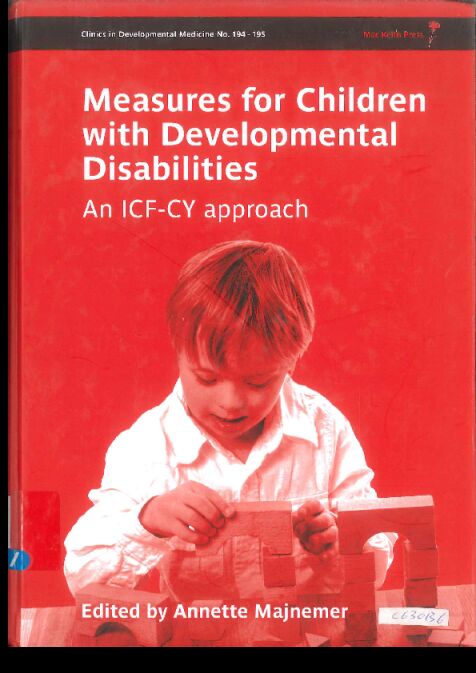
书名:Measures for children with developmental disabilities
ISBN\ISSN:1908316454,9781908316455
出版时间:2012
出版社:Mac Keith Press,
前言
This text was first conceptualized during a seemingly benign conversation with Hilary Hart, Book Editor, Mac Keith Press, at the annual meeting in 2005 of the American Academy of Cerebral Palsy and Developmental Medicine (AACPDM). Although the notion of putting together a textbook that described measures organized by the components of the International Classification of Functioning, Disability and Health (ICF) intrigued me, competing academic responsibilities and duties diverted my attention elsewhere. However, to Hilary's credit, she was quite persistent, and at each annual AACPDM meeting we would 'rediscuss'. Finally, several years later, I took on the challenge of editing this textbook.
The purpose of this text is to provide an overview of the measures that can be used with infants, children and young people who have a developmental disability. Chapter 1 guides the reader in the selection and use of measurement tools. A detailed description of the purpose and framework of this text appears in Chapter 2, and it would be helpful for readers to review this before using this textbook. The book is framed by the components within the ICF for Children and Youth (ICF-CY). A description of the measures used to evaluate the integrity of organs and systems within the body (i.e. body structures) was beyond the scope of this textbook. However, given the impressive advances in novel neuroimaging technologies that are highly relevant to the evaluation of brain structure and function in children with disabilities, a chapter on these measures was included. Furthermore, rapid advancement in genetic tools which are of relevance to our understanding of mechanisms that underlie the development and integrity of body structures and functions prompted the inclusion of a chapter on genetic testing. Chapters 5 to 16 cover body functions and describe a range of global and specific mental functions classified within the ICF as well as sensory, speech and neuromuscular functions. It was impossible to include all the components identified within each domain; however, every effort was made to emphasize the components that are most relevant to the field of childhood disability. Global measures of development (i.e. to assess developmental delays) do not readily fit within the categories of body functions or activities and participation; rather, they straddle both components and therefore appear as two chapters nestled in between these two sections. The nine domains within activities and participation each have their own chapters, with an introductory chapter describing global multidimensional measures of activities and participation (Chapters 19-28). Measures related to primary contextual factors appear in Chapters 29 to 32. Finally, the ICF-CY is meant to encapsulate an individual's health and functioning, taking into account the influence of intrinsic and extrinsic factors. Therefore, two final chapters on health status and quality of life measures were also added, although they are not technically domains within the ICF-CY.
Outlining this textbook was straightforward as the ICF-CY provided the headings to follow. However, it quickly become apparent that many of the domains within the components were diverse and complex, and finding appropriate measures suitable for the target population was often challenging. It was difficult to find content experts who were up to the challenge of synthesizing the measures that would be appropriate for a particular domain within the ICF-CY. Many of the contributors found that the constructs of the ICF-CY were not necessarily discrete. Furthermore, for the most part, measures were not developed to match a particular construct within the ICF-CY and therefore do not necessarily fit precisely within the domains of interest. However, the contributors were masterful and creative in finding the 'best fit' with respect to the measures that are currently available for use. Future research efforts linking items within standardized measures to the ICF-CY will be helpful in determining where particular measures best fit. For some areas, measures are still in the early development stage. For other areas, there are few, if any, tools available.
The chapters are meant to describe not every known measure but rather a sample of the best tools available within the domain of interest. For the most part, each chapter is organized with headings to include the construct, factors to consider when measuring this domain and an overview of recommended measures. Charts underlining the key attributes of selected measures are also included for quick reference. Some authors used a different format and the amount of information provided is variable. On occasion, a measure may be described in more than one chapter. Hopefully, readers will find it easy to navigate through this text and find the measures they are looking for.
The professional profile and expertise of the authors of these chapters reflect the nrultifaceted and specialized nature of the measures described. The authors represent a wide range of disciplines, from institutions and countries around the world. The knowledge and expertise of the authors is impressive, and I am extremely indebted to all the contributors for their significant efforts in conceptualizing and synthesizing their chapters. I recognize the difficulty of the task, and they should all be congratulated for their contributions. I also appreciate the encouragement that 1 received from contributors in putting this text together. Special thanks are due to Dr Rune Simeonsson for assembling teams to tackle some of the most complex domains.
I would like to thank my colleagues at the School of Physical and Occupational Therapy, McGill University, and especially the inquisitive graduate students I supervise. These individuals are a constant source of inspiration, reflection and encouragement. My wonderful, talented daughters, Meaghan and Allison, have always supported my career ambitions while simultaneously ensuring that I devote my energies to other vital elements of my life. Above all, 1 am so grateful to my husband Michael Shevell, who has been a valuable role model and my greatest supporter, both personally and professionally. I look forward to our adventures ahead as we continue to learn and enjoy life experiences together.
Disability is a multidimensional construct, and therefore clinicians and researchers need to consider all facets of functioning, disability and health, with reflection of the personal and environmental contextual factors that can influence disability status. As an occupational therapist, adopting this holistic view is intrinsic to my professional philosophy of practice, so that I can understand and appreciate the many factors that contribute to a child's adaptive capacity and capabilities. In searching for the most appropriate measures to evaluate all aspects of functioning, disability and health, it is difficult to find all the pieces to the puzzle. We are required to use what we have available to capture as complete a picture as possible so that we can identify strengths and address challenges. Annette Majnemer Montreal May 2012
查看更多
目录
AUTHORS' APPOINTMENTS viii
FOREWORD xii
PREFACE xiii
SECTION I OVERVIEW 1
1. SELECTION AND USE OF OUTCOME MEASURES 3
Annette Majnemer
2. THE PURPOSE AND FRAMEWORK FOR THIS TEXT 10
Annette Majnemer
SECTION II BODY STRUCTURES AND FUNCTIONS 17
3. NOVEL NEUROIMAGING TOOLS 19
Catherine Limperopoulos
4. GENETIC TESTING 27
Myriam Srour and Michael I. Shevell
5. GLOBAL MENTAL FUNCTIONS: WAKEFULNESS AND SLEEP (B110, B134) 37
Reuf Gruber, Emily B.J. Caffey and Melanie Stelmazuk
6. GLOBAL MENTAL FUNCTIONS: INTELLECTUAL (B117) 49
Kim M, Comish, Michael J. Sornberger, Marina Dupasquier and John Wilding
7. GLOBAL MENTAL FUNCTIONS: PSYCHOSOCIAL (B122) 60
Sara King and Christine T. Chambers
8. GLOBAL MENTAL FUNCTIONS: TEMPERAMENT AND PERSONALITY (B126) 75
Suzanne Woods-Groves and Dennis C. Harper
9. SPECIFIC MENTAL FUNCTIONS: ATTENTION AND EXECUTIVE FUNCTIONS (B140, B144, B164) 89
John Wilding and Kim M. Cornish
10. SPECIFIC MENTAL FUNCTIONS: EMOTIONAL FUNCTIONS, EXPERIENCE OF SELF AND TIME (B152, B180) 100
Andrea Lee
11. SPECIFIC MENTAL FUNCTIONS: PERCEPTUAL (B156) 117
Suzanne Woods-Groves and Dennis C. Harper
12. SPECIFIC MENTAL FUNCTIONS: LANGUAGE (B167) 129
Jane McCormack, Diane Jacobs and Karla Washington
13. SENSORY FUNCTIONS: GENERAL (B210-B270) 154
Erna Imperatore Blanche, Zoe Mailloux and Gustavo Reinoso
14. SENSORY FUNCTIONS: PAIN (B280-B289) 170
Tim F. Oberlander, Chantel C. Burkitt, Frank J. Symons and Celeste Johnston
15. VOICE AND SPEECH FUNCTIONS (B310-B340) 181
Elspeth McCartney
16. NEUROMUSCULOSKELETALAND MOVEMENT-RELATED FUNCTIONS (B710-B780) 192
F. Virginia Wright, Desiree B, Maltais. Heidi Marie Sanders and Patricia A. Burtner
SECTION III GLOBAL DEVELOPMENTAL FUNCTIONING - BODY FUNCTIONS, ACTIVITIES AND PARTICIPATION (NOT CLASSIFIED) 231
17. SCREENING FOR DEVELOPMENTAL AND BEHAVIOURAL PROBLEMS 233
Frances Page Glascoe and Kevin R Marks
18. GLOBAL DEVELOPMENTAL ASSESSMENTS 249
Barbara Mazer, Annette Majnemer, Noemi Dahan-Oliel and Irene Sebestyen
SECTION IV ACTIVITIES AND PARTICIPATION 265
19. ACTIVITIES AND PARTICIPATION: AN OVERVIEW OF GENERIC MEASURES 267
Christopher Morris and Annette Majnemer
20. LEARNING AND APPLYING KNOWLEDGE (D110-D179) 281
Kirsten M. Ellingsen, Andrea R. Burch and Andy V. Pham
21. GENERAL TASKS AND DEMANDS OF CHILDREN (D210-250) 303
Susana Castro, Shannon Lewis and Rune J. Simeonsson
22. COMMUNICATION (D310-D369) 312
Sharynne McLeod, Elspeth McCartney and Jane McCormack
23. MOBILITY (D410-D489) 326
Heidi Marie Sanders, F. Virginia Wright and Patricia A. Burtner
24. SELF-CARE (D510-D572) 356
Laurie M. Snider and Vasiliki Darsaklis
25. DOMESTIC LIFE (D610-D699) 369
Monica Silveira-Maia, Kylee Miller and Rune J. Simeonsson
26. INTERPERSONAL INTERACTIONS AND RELATIONSHIPS (D710-D799) 381
Sacha N. Bailey, Lucyna M. Lach and Katie Byford-Richardson
27. MAJOR LIFE AREAS: PLAY AND EDUCATION (D810-D880) 404
Margareta Adolfsson, Rune J, Simeonsson, Andrea Lee and Kirsten M. Ellingsen
28. COMMUNITY, SOCIAL AND CIVIC LIFE (D910-D950) 416
Gary Bedell, Mary A. Khetani, Wendy J. Coster, Mary Law and Martha Cousins
SECTION V CONTEXTUAL FACTORS 433
29. PERSONAL FACTORS 435
Rune J. Simeonsson, Andrea Lee and Kirsten M. Ellingsen
30. ENVIRONMENTAL FACTORS: PHYSICAL, SOCIAL AND ATTITUDINAL ENVIRONMENT (E110-E165, E210-E260, E310-E360, E410-E465, E510-E595) 440
Mary A. Khetani, Gary Bedell, Wendy J, Coster, Martha Cousins and Mary Law
31. ENVIRONMENTAL FACTORS: SUPPORT AND RELATIONSHIPS (E310-E399) 455
Aline Bogossian, Lucyna M. Lach and Michael Saini
32. HEALTH AND REHABILITATION SERVICES AND SYSTEMS (E355, E360, E510, E575, E580) 471
Debbie Feldman and Bonnie Swaine
SECTION VI HOLISTIC VIEW OF HEALTH AND WELL-BEING 485
33. HEALTH STATUS INSTRUMENTS 487
Nora Fayed, Anne Klassen and Veronica Schiariti
34. QUALITY OF LIFE OUTCOMES 503
Allan Colver
INDEX OF TESTS 515
SUBJECT INDEX 519
查看PDF
查看更多
馆藏单位
中国医科院医学信息研究所