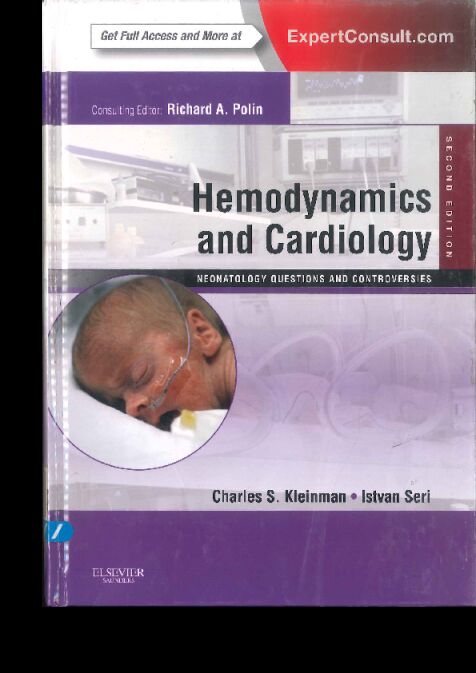
书名:Hemodynamics and cardiology
责任者:Charles S. Kleinman | Istvan Seri ; consulting | Richard A. Polin.
ISBN\ISSN:9781437727630,1437727638,9780323088435
出版时间:2012
出版社:Elsevier/Saunders,
前言
Cardiovascular compromise with or without congenital heart disease is a common finding in a large number of critically ill preterm and term neonates and is associated with a high incidence of mortality and significant short- and long-term morbidities. Therefore timely recognition and treatment of shock is of utmost importance, The diagnosis of shock is hampered by our inability to continuously assess systemic and organ blood flow in absolute numbers. As a result, treatment of cardiovascular compromise in neonates has rarely been based on a thorough understanding of the underlying cardiovascular pathophysiology Instead, many of these neonates are routinely treated with volume boluses followed by the administration of vasopres-sors and/or inotropes with little regard to the etiology phase, or pathophysiology of neonatal shock. It is not surprising therefore that there is very little evidence demonstrating that treatment of shock in neonates, especially without congenital heart disease, improves mortality or clinically meaningful short- and long-term outcomes.
However, since the publication of the first edition of Hemodynamics and Cardiology in the "Neonatology Questions and Controversies" series, some promising advances have been made in the ability to monitor neonatal hemodynamic parameters. In addition, recent studies have started to unravel some of the mysteries of the physiology and pathophysiology of cardiovascular transition to extrauterine life. The second edition of this series addresses these novel approaches and findings, making it both up-to-date and useful for the clinician and investigator who face uncertainty in clinical practice and study design and conduction.
The second edition has kept the majOT structure of the first edition and, accordingly, is divided into two parts.
The first part of this book, "Neonatal Hemodynamics," addresses the pnncipLes of developmental physiology and the pathophysiology of neonatal shock, the auto- regulation of vital and nonvital organ blood flow, and the controversies surrounding the definition of normal blood pressure in the neonatal patient population. In addition to discussions on the use of functional echocardiography, near-infrared spec-troscopy, and advanced magnetic resonance imaging, there are new chapters on available methods to assess cardiac output and microcirculation and the application of these technologies to preterm and term neonates. The ensuing section includes chapters that describe the different clinical presentations of neonatal shock with a focus on characteristic clinical features and pathophysiology Reasonable approaches to treatment are also reviewed, with an emphasis on evidence-based approaches whenever evidence is available. The final chapter in this part of the book addresses the role of hemodynamics in brain injury, focusing on the preterm neonate during the transitional period.
The second part, "Fetal and Neonatal Cardiology," begins with a discussion of embryonic and fetaf heart development. As the focus of pediatric cardiologists involved in the care of neonates with critical hemodynamic compromise has become more proactive, fetal diagnosis and management is becoming increasingly important, as has the role of fetal cardiology in the prenatal and postnatal management of neonates with congenttal heart disease. Finally, the most recent therapeutic and imaging advances in the management of neonates with congenital heart disease are discussed in detail, providing novel information and conceptual framework for the clinician and researcher involved in the management and study of neonates with congenital heart disease. Istvan Seri, MD, PhD, HonD
查看更多
目录
PART I NEONATAL HEMODYNAMICS
SECTION A Principles of Developmental Cardiovascular Physiology and Pathophysiology
CHAPTER 1 Principles of Developmental Cardiovascular Physiology and Pathophysiology 3
CHAPTER 2 Autoregulation of Vital and Nonvital Organ Blood Flow in the Preterm and Term Neonate 29
CHAPTER 3 Definition of Normal Blood Pressure Range: The Elusive Target 49
SECTION B Diagnosis of Neonatal Shock: Methods and Their Clinical Applications
CHAPTER 4 Methods to Assess Systemic and Organ Blood Flow in the Neonate 81
CHAPTER 5 Functional Echocardiography in the Neonatal Intensive Care Unit 95
CHAPTER 6 Assessment of Cardiac Output in Neonates: Techniques Using the Fick Principle, Pulse Wave Form Analysis, and Electrical Impedance 125
CHAPTER 7 Near-Infrared Spectroscopy and Its Use for the Assessment of Tissue Perfusion in the Neonate 151
CHAPTER 8 Clinical Applications of Near-Infrared Spectroscopy in Neonates 173
CHAPTER 9 Advanced Magnetic Resonance Neuroimaging Techniques in the Neonate with a Focus on Hemodynamic-Related Brain Injury 187
CHAPTER 10 Cardiovascular Magnetic Resonance in the Study of Neonatal Hemodynamics 199
CHAPTER 11 Assessment of the Microcirculation in the Neonate 215
SECTION C Clinical Presentations and Relevance of Neonatal Shock
CHAPTER 12 Clinical Presentations of Neonatal Shock: The Very Low Birth Weight Neonate During the First Postnatal Day 237
CHAPTER 13 The Very Low Birth Weight Neonate with Hemodynamically Significant Ductus Arteriosus During the First Postnatal Week 269
CHAPTER 14 The Preterm Neonate with Cardiovascular and Adrenal Insufficiency 293
CHAPTER 15 Shock in the Surgical Neonate 311
CHAPTER 16 Hemodynamics and Brain Injury in the Preterm Neonate 321
PART II FETAL AND NEONATAL CARDIOLOGY
SECTION D Embryonic and Fetal Development
CHAPTER 17 The Genetics of Fetal and Neonatal Cardiovascular Disease 343
CHAPTER 18 Human Cardiac Development in the First Trimester 377
CHAPTER 19 The Reappraisal of Normal and Abnormal Cardiac Development 391
SECTION E Fetal and Neonatal Cardiology
CHAPTER 20 New Concepts for Training the Pediatric Cardiology Workforce of the Future 417
CHAPTER 21 The Current Role of Fetal Echocardiography 431
CHAPTER 22 Clinical Evaluation of Cardiovascular Function in the Human Fetus 443
CHAPTER 23 Cardiac Surgery in the Neonate with Congenital Heart Disease 453
CHAPTER 24 Regional Blood Flow Monitoring in the Perioperative Period 473
CHAPTER 25 Mechanical Pump Support and Cardiac Transplant in the Neonate 489
CHAPTER 26 Catheter-Based Therapy in the Neonate with Congenital Heart Disease 503
CHAPTER 27 Hybrid Management Techniques in the Treatment of the Neonate with Congenital Heart Disease 521
查看PDF
查看更多
馆藏单位
中国医科院医学信息研究所