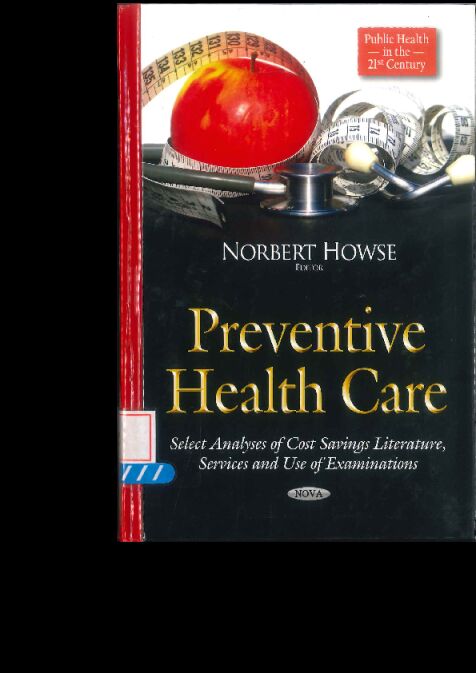
书名:Preventive health care
ISBN\ISSN:9781634634465,1634634462
出版时间:2015
出版社:Nova Biomedical,
前言
This book discusses the cost-effective strategies in recent peer-reviewed health care literature, as well as provides available information on federal spending, cost savings, and examines the effectiveness of aligning the use of preventive services with clinical recommendations.
Chapter 1 - Cost-effective preventive health services, such as immunizations and screening, may assist providers in helping patients avoid the onset or worsening of various health conditions. Services are determined to be cost-effective when they improve the benefit (e.g., health outcomes) in a less costly way than a given alternative. Some preventive services may also result in cost savings where the cost of implementing the service is less than the expected future costs to treat a disease or condition. GAO previously reported on available information about the cost-effectiveness of and cost savings from preventive health services and found that multiple factors affect these estimates, including the population targeted for a health benefit (e.g., children and high-risk populations) and assumptions about effectiveness of the service (e.g., how many years of protection a vaccine provides). Given the lack of readily available detailed information on the value of preventive services, GAO was asked for additional information on the services that may be potentially cost-effective or cost saving. In this report GAO examined recent peer-reviewed literature to identify preventive services that were shown to be cost-effective and the extent of potential cost savings of these services. GAO conducted a literature review of articles about U.S. preventive services in meta-analyses or comparative studies in peer-reviewed journals published between January 2007 and April 2014 that addressed cost-effectiveness or cost savings.
Chapter 2 - Preventive health activities have received attention for their potential to improve health outcomes or lower health care expenditures. While there is no widespread agreement on what constitutes preventive health activities, in this report they include clinical preventive services, such as immunizations provided in clinical settings, and community-oriented preventive health activities, such as health education media campaigns. A preventive health activity is considered cost saving if the activity costs less than the costs averted by it; an activity is cost-effective if it achieves benefits in a less costly way than alternatives. HHS, VA, and DOD administer programs that include preventive health activities.
GAO was asked to report on preventive health activities. This report provides available information and discusses the limitations of this information regarding (1) preventive health activities in programs administered by HHS, VA, and DOD and the departments' spending on such activities; (2) reported cost savings from and cost effectiveness of preventive health activities; and (3) U.S. spending on preventive health activities compared to that of other countries.
GAO reviewed documents from HHS, VA, and DOD; interviewed officials from those departments and researchers; conducted a literature review; and reviewed OECD data on national health spending.
HHS and VA provided technical comments on a draft of this report, which were incorporated as appropriate.
Chapter 3 - Preventive care services have the potential to improve health outcomes and lower health care expenditures. This report examines (1) whether preventive service use by Medicare fee-for-service (FFS) beneficiaries aligns with recommendations from the U.S. Preventive Services Task Force and the Advisory Committee on Immunization Practices (ACIP), (2) use of the Welcome to Medicare (WTM) exam and its association with use of preventive services, (3) preventive service use in Medicare Advantage (MA) relative to FFS, and (4) service use among MA health maintenance organizations (HMO) and efforts by high-performing HMOs to encourage preventive care. To do this, GAO selected eight preventive services that had Task Force of ACIP guidelines for the general Medicare population. GAO analyzed the most recently available data from Medicare claims, a beneficiary survey, and MA plan ratings. GAO also interviewed representatives of selected HMOs.
查看更多
目录
Preface vii
Chapter 1 Health Prevention: Cost-Effective Services in Recent Peer-Reviewed Health Care Literature 1
Chapter 2 Preventive Health Activities: Available Information on Federal Spending, Cost Savings, and International Comparisons Has Limitations 19
Chapter 3 Medicare: Use of Preventive Services Could Be Better Aligned with Clinical Recommendations 65
Index 131
查看PDF
查看更多
馆藏单位
中国医科院医学信息研究所