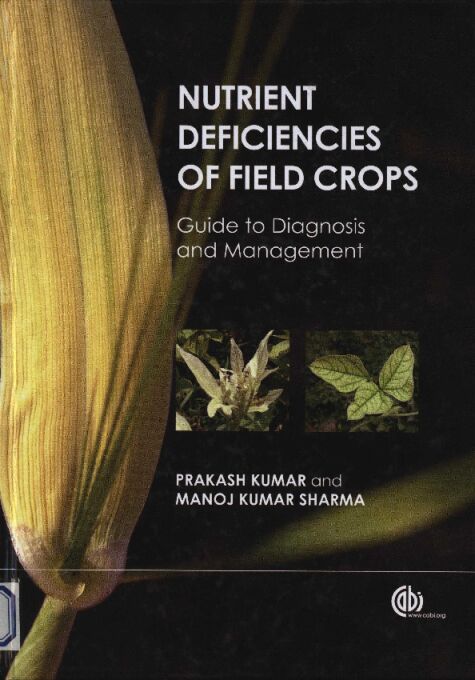
书名:Nutrient deficiencies of field crops
责任者:Prakash Kumar | Manoj Kumar Sharma.
ISBN\ISSN:9781780642789,1780642784
前言
The identification of nutrient deficiencies of crops in field conditions through visual symptoms is difficult even today. The environmental conditions, growth stages, types of plant species or varieties and many other interactions may cause variations in visual deficiency symptoms.All renowned authors on the subject from Gove Hambidge (the editor of Hunger Signs in Crops), NJ. Grundon (the author of Hungry Crops: A Guide to Nutrient Deficiencies in Field Crops) to William F. Bennet (the editor of Nutrient Deficiencies and Toxicities in Crop Plants) have rightly emphasized that the visual symptoms should not be the sole base of any con elusion when ide ntifying a nutrie nt deficiency problem in field conditions. The visual symptoms should be used with other identification tools such as plant analysis, soil analysis, etc. If treatments are given on the basis of visual diagnosis, the treatments must be applied first on a small strip of the crop to avoid any possible loss due to wrong diagnosis. Following the elders' advice, we also suggest the same. But our purpose in presenting this book is to create mass awareness among the farming community and extension functionaries about the fast emerging deficiency problems around the globe, especially in those areas where soil and plant testing facilities or other diagnostic tools are not promptly available. A segment of our work, entitled A Guide to Identifying and Managing Nutrient Deficiencies in Cereal Crops, published by the International Maize and Wheat Improvement Center (C1MMYT), Mexico and the International Plant Nutrition Institute (IPNI), Georgia, USA, was purposely released for use in mass awareness campaigns on food crops in developing countries.
The management recommendations give n in this book are quite genera Iized to suggest only a line of management. The specific nutrient management recommendations should be drawn from the local district recommendations as the input availability and methods of application may vary from place to place. We have tried our best to simplify the nutrient deficiency identification by providing developmental stages with photographs. This large collection is the result of 15 years of our hard work in field with the sole aim of bringing out this kind of compilation. With this much hard work behind us we are extremely happy to present this book.
We are highly grateful to all seniors, plant nutrient experts and friends for technical guidance and constant encouragement. We are thankful to Dr Kaushik Majumdar, Dr T. Satyanarayanaz Dr Raj Gupta, Dr M.L. Jat and Gavin D. Sulewski who edited our previous publication on nutrient deficiency.
We wish to especially thank our elders and family members, the late Professor P.C. Gupta, Smt. Chandrawati, Shri Makkhan Lal Varshney, Smt. Satyawati, Dr Pramod Kumar Gupta, Dr Brijesh Kumar, Shri SanjeevVarshney, Shri Nagesh Gupta, the late Shri Sharad Mittal, Dr Seema and Master Prakhar Ganesh on the one hand and on the other, the late Shri Amichand Sharma, the late Smt. Kasturi Devi, Shri K.P. Sharma, Smt. Saroj Sharma, R.K. Sharma, A.K. Sharma, Smt. Madhulika Sharma, Master Mudit Sharma and Master Pulkit Sharma for their best wishes and ever in creasing encourageme nt for this project.
查看更多
目录
Foreword ix
Messages xi
Preface xiii
1 An Introduction to Plant Nutrition 1
2 How to Identify Plant Nutrient Deficiencies in Field Conditions 9
PART I NUTRIENT DEFICIENCIES IN CEREAL CROPS 23
Maize (Zea mays Linn.) 25
Nitrogen deficiency 25
Phosphorus deficiency 27
Potassium deficiency 29
Calcium deficiency 31
Magnesium deficiency 33
Sulphur deficiency 35
Iron deficiency 37
Manganese deficiency 39
Zinc deficiency 41
Boron deficiency 43
Rice (Oryza sativa Linn.) 45
Nitrogen deficiency 45
Phosphorus deficiency 47
Potassium deficiency 49
Sulphur deficiency 51
Iron deficiency 53
Zinc deficiency 55
Boron deficiency 57
Sorghum (Sorghum vulgare Pers.) 59
Nitrogen deficiency 59
Phosphorus deficiency 61
Potassium deficiency 63
Calcium deficiency 65
Sulphur deficiency 67
Iron deficiency 69
Zinc deficiency 71
Manganese deficiency 73
Pearl millet (Pennisetum typhoides (Burm.f) Stapf & C.E. Hubb.) 75
Nitrogen deficiency 75
Phosphorus deficiency 77
Potassium deficiency 79
Calcium deficiency 81
Sulphur deficiency 83
Iron deficiency 85
Zinc deficiency 87
Manganese deficiency 89
Wheat (Triticum aestivum Linn.) 91
Nitrogen deficiency 91
Phosphorus deficiency 93
Potassium deficiency 95
Sulphur deficiency 97
Iron deficiency 99
Zinc deficiency 101
Copper deficiency 103
Barley (Hordeum vulgare (L.) emend. Bowden) 105
Nitrogen deficiency 105
Phosphorus deficiency 107
Potassium deficiency 109
Sulphur deficiency 111
Iron deficiency 113
Zinc deficiency 115
PART II NUTRIENT DEFICIENCIES IN PULSE CROPS 117
Pigeon pea (Cajanus cajan (L.) Millsp.) 119
Nitrogen deficiency 119
Phosphorus deficiency 121
Potassium deficiency 123
Magnesium deficiency 125
Sulphur deficiency 12 7
Iron deficiency 129
Manganese deficiency 131
Zinc deficiency 133
Copper deficiency 135
Green gram (Vigna radiata Linn.) 137
Nitrogen deficiency 13 7
Phosphorus deficiency 139
Potassium deficiency 141
Sulphur deficiency 143
Iron deficiency 145
Zinc deficiency 147
Black gram (Phaseolus mungo var. radiatus Linn.) 149
Nitrogen deficiency 149
Phosphorus deficiency 151
Potassium deficiency 153
Sulphur deficiency 155
Iron deficiency 157
Zinc deficiency 159
Cowpea (Vigna sinensis Linn.) 161
Nitrogen deficiency 161
Magnesium deficiency 163
Sulphur deficiency 165
Iron deficiency 167
Cluster bean (Cyamopsis tetragonoloba (L) Taub) 169
Nitrogen deficiency 169
Potassium deficiency 171
Magnesium deficiency 173
Sulphur deficiency 175
Iron deficiency 177
Zinc deficiency 179
Chickpea (Cicer arietinum Linn.) 181
Nitrogen deficiency 181
Phosphorus deficiency 183
Potassium deficiency 185
Sulphur deficiency 187
Iron deficiency 189
Zinc deficiency 191
Kidney bean (Phaseolus vulgaris Linn.) 193
Nitrogen deficiency 193
Magnesium deficiency 195
Sulphur deficiency 197
Iron deficiency 199
Zinc deficiency 201
Lentil (Lens culinaris Medik.) 203
Nitrogen deficiency 203
Phosphorus deficiency 205
Potassium deficiency 207
Iron deficiency 209
Pea (Pisum sativum var. arvense Linn.) 211
Nitrogen deficiency 211
Potassium deficiency 213
Magnesium deficiency 215
Sulphur deficiency 217
Iron deficiency 219
PART III NUTRIENT DEFICIENCIES IN OILSEED CROPS 221
Castor (Ricinus communis Linn.) 223
Nitrogen deficiency 223
Phosphorus deficiency 225
Potassium deficiency 227
Magnesium deficiency 229
Sulphur deficiency 231
Iron deficiency 233
Zinc deficiency 235
Manganese deficiency 237
Sesame (Sesamum indicum Linn.) 239
Nitrogen deficiency 239
Phosphorus deficiency 241
Potassium deficiency 243
Sulphur deficiency 245
Iron deficiency 247
Safflower (Carthamus tinctorius Linn.) 249
Nitrogen deficiency 249
Potassium deficiency 251
Sulphur deficiency 253
Iron deficiency 255
Sunflower (Helianthus annuus Linn.) 257
Nitrogen deficiency 257
Potassium deficiency 259
Calcium deficiency 261
Magnesium deficiency 263
Sulphur deficiency 265
Iron deficiency 267
Boron deficiency 269
Groundnut (Arachis hypogaea Linn.) 271
Nitrogen deficiency 271
Potassium deficiency 273
Magnesium deficiency 275
Sulphur deficiency 277
Iron deficiency 279
Zinc deficiency 281
Manganese deficiency 283
Soybean (Glycine max Linn.) 285
Nitrogen deficiency 285
Phosphorus deficiency 287
Potassium deficiency 289
Magnesium deficiency 291
Sulphur deficiency 293
Iron deficiency 295
Manganese deficiency 297
Mustard (Brassica campestris Linn.) 299
Nitrogen deficiency 299
Phosphorus deficiency 301
Potassium deficiency 303
Sulphur deficiency 305
Iron deficiency 307
PART IV NUTRIENT DEFICIENCIES IN CASH CROPS 309
Cotton (Gossypium hirsutum Linn.) 311
Nitrogen deficiency 311
Phosphorus deficiency 313
Potassium deficiency 315
Magnesium deficiency 317
Sulphur deficiency 319
Iron deficiency 321
Zinc deficiency 323
Sugarcane (Saccharum officinarum Linn.) 325
Nitrogen deficiency 325
Phosphorus deficiency 327
Potassium deficiency 329
Calcium deficiency 331
Sulphur deficiency 333
Iron deficiency 335
Zinc deficiency 337
PART V NUTRIENT DEFICIENCIES IN TUBER CROPS 339
Potato (Solanum tuberosum Linn.) 341
Nitrogen deficiency 341
Phosphorus deficiency 343
Potassium deficiency 345
Sulphur deficiency 347
Iron deficiency 349
Zinc deficiency 351
Manganese deficiency 353
Sweet potato (Ipomoea batatas Linn.) 355
Nitrogen deficiency 355
Phosphorus deficiency 357
Iron deficiency 359
Manganese deficiency 361
PART VI NUTRIENT DEFICIENCIES IN FODDER CROPS 363
Lucerne or Alfalfa (Medicago sativa Linn.) 365
Nitrogen deficiency 365
Potassium deficiency 367
Sulphur deficiency 369
Iron deficiency 371
Index 373
查看PDF
查看更多
馆藏单位
中国农科院农业信息研究所