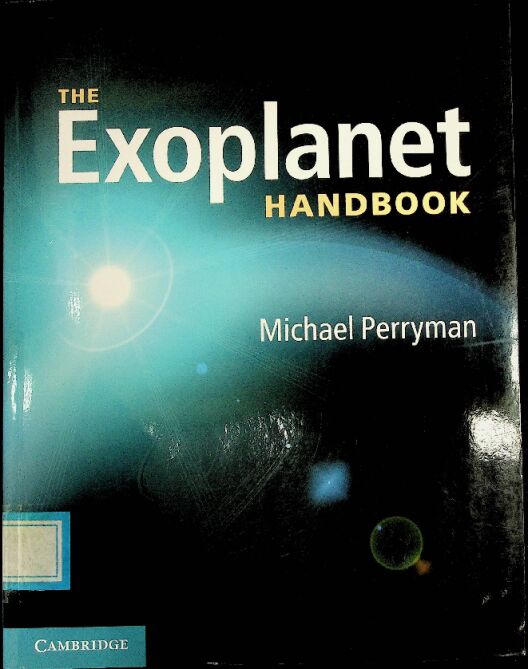
书名:The exoplanet handbook
责任者:Michael Perryman. | Perryman, M. A. C.
ISBN\ISSN:9781107668560,1107668565
出版时间:2014
出版社:Cambridge University Press,
前言
Exoplanet research is one of the most explosive subjects in astronomy today. More than 500 exoplanets are now known, and groups world-wide are actively involved in a broad range of observational and theoretical efforts. This book ties together these many avenues of investigation - from the perspectives of observation, technology and theory - to give a comprehensive, up-to-date review of the entire field. All areas of exoplanet investigation are covered, making it a unique and valuable guide for researchers in astronomy and planetary science, including those new to the field. It treats the many different techniques now available for exoplanet detection and characterisation, the broad range of underlying physics, the overlap with related topics in solar system and Earth sciences, and the concepts underpinning future developments. It emphasises the interconnection between the various fields and provides extensive references to more in-depth treatments and reviews.
查看更多
目录
Preface page xi
1 Introduction 1
1.1 The challenge 1
1.2 Discovery status 1
1.3 Outline of the treatment 3
1.3.1 Observational techniques 3
1.3.2 Host star properties and brown dwarfs 5
1.3.3 Theoretical considerations 5
1.4 Astronomical terms and units 5
1.5 Definition of a planet 7
1.6 On-line reference compilations 7
2 Radial velocities 9
2.1 Description of orbits 9
2.1.1 Orbits from radial velocity measurements 12
2.2 Measurement principles and accuracies 16
2.2.1 Introduction 16
2.2.2 Cross-correlation spectroscopy 17
2.2.3 Deriving radial velocities from Doppler shifts 17
2.2.4 Wavelength calibration 18
2.2.5 Exposuremetering 21
2.2.6 Accuracy limits 21
2.2.7 Excluding other sources of periodicity 22
2.3 Instrument programmes 23
2.3.1 State-of-the-art in échelle spectroscopy 23
2.3.2 Externally dispersed interferometry 25
2.3.3 Future developments 27
2.4 Results to date 28
2.4.1 The first radial velocity exoplanets 28
2.4.2 The present radial velocity census 28
2.4.3 On-line compilations 28
2.4.4 Main sequence stars 29
2.4.5 Evolved stars 32
2.4.6 Other star categories 34
2.5 Properties of the radial velocity planets 34
2.5.1 Frequency of massive planets 35
2.5.2 Mass distribution 35
2.5.3 Orbits 36
2.5.4 Host star dependencies 37
2.6 Multiple planet systems 37
2.6.1 General considerations 38
2.6.2 Resonances 40
2.6.3 Long-term integration and system stability 43
2.6.4 Systems with three or more giant planets 47
2.6.5 Systems in mean motion resonance 49
2.6.6 Interacting doubles 55
2.6.7 Non-interacting doubles 55
2.6.8 Super-Earth systems 55
2.6.9 Stability of habitable zone systems 55
2.7 Planets around binary and multiple stars 55
2.7.1 Configurations and stability 59
2.7.2 Present inventory 59
2.7.3 Specific examples 60
3 Astrometry 61
3.1 Introduction 61
3.2 Astrometric accuracy from ground 62
3.3 Microarcsec astrometry 64
3.4 Astrophysical limits 65
3.4.1 Surface structure jitter 65
3.5 Multiple planets and mandalas 66
3.6 Modeling planetary systems 67
3.7 Astrometric measurements from ground 68
3.8 Astrometric measurements from space 69
3.8.1 Hipparcos 69
3.8.2 HST-Fine Guidance Sensor 70
3.9 Future observations from space 71
4 Timing 75
4.1 Pulsars 75
4.1.1 PSR B1257+12 75
4.1.2 PSR B1620-26 77
4.1.3 Other considerations 78
4.2 Pulsating stars 79
4.2.1 White dwarfs 79
4.2.2 Hot subdwarfs 81
4.3 Eclipsing binaries 81
4.3.1 Confirmed planets 81
4.3.2 Unconfirmed planets 93
5 Microlensing 83
5.1 Introduction 83
5.2 Description 84
5.3 Caustics and critical curves 87
5.4 Other light curve effects 90
5.5 Microlens parallax and lens mass 92
5.6 Astrometric microlensing 94
5.7 Other configurations 95
5.8 Microlensing observations in practice 96
5.9 Exoplanet results 98
5.9.1 Individual objects 98
5.9.2 Statistical results 100
5.10 Summary of limitations and strengths 100
5.11 Future developments 102
6 Transits 103
6.1 Introduction 103
6.2 Transit searches 104
6.2.1 Large-field searches from the ground 105
6.2.2 Other searches from the ground 108
6.2.3 Searches in open and globular clusters 109
6.2.4 Future searches from the ground 110
6.2.5 Searches from space 110
6.2.6 Follow-up observations from space 112
6.2.7 Future observations from space 114
6.2.8 Searches around specific stellar types 114
6.3 Noise limits 115
6.4 Transit light curves 117
6.4.1 Observables 117
6.4.2 Theoretical light curves 117
6.4.3 Circular orbits 119
6.4.4 Eccentric orbits 121
6.4.5 Physical quantities 123
6.4.6 Interferometric observations 123
6.4.7 Reflected light 124
6.4.8 Doppler variability 126
6.4.9 Polarisation 126
6.4.10 Secondary eclipse 126
6.4.11 Rossiter-McLaughlin effect 127
6.4.12 Higher-order photometric effects 130
6.4.13 Higher-order timing effects 132
6.4.14 Higher-order spectroscopic effects 136
6.5 Transmission and emission spectroscopy 137
6.5.1 Background 137
6.5.2 Observations 139
6.6 Properties of transiting planets 143
6.6.1 Mass-radius relation 143
6.6.2 Observed correlations 146
7 Imaging 149
7.1 Introduction 149
7.2 Techniques 150
7.2.1 Active optics 150
7.2.2 Adaptive optics 150
7.2.3 Coronagraphic masks 152
7.2.4 Speckle noise 157
7.3 Ground-based imaging instruments 158
7.3.1 Extreme adaptive optics instruments 158
7.3.2 Extremely large telescopes 159
7.3.3 Imaging from the Antarctic 161
7.3.4 Ground-based interferometry 162
7.4 Space-based imaging 162
7.4.1 Existing telescopes 162
7.4.2 Space interferometry 163
7.4.3 The future: resolved imaging 167
7.5 Imaging results 169
7.5.1 Searches around nearby stars 170
7.5.2 Searches around exoplanet host stars 170
7.5.3 Searches in systems with debris disks 171
7.5.4 Searches around white dwarfs 172
7.6 Observations at radio wavelengths 173
7.6.1 Astrometry 173
7.6.2 Direct imaging 173
7.7 Observations at mm/sub-mm wavelength 177
7.8 Miscellaneous signatures 177
7.8.1 Planetary and proto-planet collisions 177
7.8.2 Collisional debris 178
7.8.3 Accretion onto the central star 178
7.8.4 Gravitational wave modulation 179
8 Host stars 181
8.1 Knowledge from astrometry 181
8.1.1 Hipparcos distances and proper motions 181
8.1.2 Nearby star census 181
8.1.3 Galactic coordinates 183
8.2 Photometry and spectroscopy 184
8.3 Evolutionary models 186
8.4 Element abundances 188
8.4.1 Metallicity 188
8.4.2 Possible biases 191
8.4.3 Origin of the metallicity difference 191
8.4.4 Refractory and volatile elements 194
8.4.5 The r- and s-process elements 198
8.4.6 The alpha elements 198
8.4.7 Lithium 199
8.4.8 Beryllium 201
8.5 Asteroseismology 201
8.5.1 Principles 201
8.5.2 Application to exoplanet host stars 203
8.6 Activity and X-ray emission 205
8.6.1 Magnetic and chromospheric activity 205
8.6.2 X-ray emission 206
8.7 Stellar multiplicity 206
9 Brown dwarfs and free-floating planets 209
9.1 Brown dwarfs 209
9.1.1 The role of fusion 209
9.1.2 Detection 209
9.1.3 Luminosity and age 211
9.1.4 Classification 212
9.1.5 Recognising brown dwarfs 212
9.1.6 Other properties 213
9.1.7 Formation 214
9.2 Free-floating objects of planetary mass 215
10 Formation and evolution 217
10.1 Overview 217
10.2 Star formation 217
10.3 Disk formation 218
10.3.1 Initial collapse 218
10.3.2 Young stellar objects 219
10.3.3 Protoplanetary disks 220
10.3.4 Debris disks 222
10.4 Terrestrial planet formation 224
10.4.1 The context 224
10.4.2 Stages in the formation of terrestrial planets 225
10.5 Size, shape, and internal structure 230
10.6 Giant planet formation 231
10.6.1 Formation by core accretion 231
10.6.2 Formation by gravitational disk instability 235
10.7 Formation of planetary satellites 237
10.8 Orbital migration 237
10.8.1 Evidence for migration 237
10.8.2 Gas disk migration 238
10.8.3 Planetesimal disk migration 243
10.8.4 Planet-planet scattering 243
10.9 Tidal effects 244
10.9.1 Tidal evolution of close-in planets 244
10.9.2 Orbital evolution 245
10.9.3 Spin-up of host stars 248
10.9.4 Tidal heating 249
10.9.5 Tidal heating and habitability 250
10.10 Population synthesis 251
11 Interiors and atmospheres 255
11.1 Introduction 255
11.2 Planetary constituents 255
11.2.1 Gas, rock, and ice 255
11.2.2 Chemical composition and condensation 257
11.3 Models of giant planet interiors 260
11.3.1 Equations of state 261
11.3.2 Hydrogen and water 261
11.3.3 Structural models 263
11.4 Predictions of interior models 265
11.4.1 Dependence on composition 265
11.4.2 H/He dominated gas giants 266
11.5 Super-Earths 267
11.5.1 General models 267
11.5.2 Ocean planets 269
11.6 Diagnostics from rotation 270
11.7 Atmospheres of gas giants 271
11.8 Atmospheres of terrestrial planets 278
11.8.1 Atmospheric formation 278
11.8.2 Atmospheric erosion 279
11.8.3 Atmospheres of ejected planets 281
11.9 Habitability 282
11.9.1 The habitable zone 283
11.9.2 Exoplanets in the habitable zone 286
11.9.3 Spectroscopic indicators of life 287
11.9.4 SETI 290
12 The solar system 293
12.1 Birth in clusters 293
12.2 The solar system giants 293
12.3 Minor bodies in the solar system 295
12.4 Solar nebula abundances 295
12.5 Constraints on formation 296
12.6 Orbit considerations 299
12.7 Planetesimal migration in the solar system 302
12.8 Atmosphere of the Earth 305
Appendix A. Numerical quantities 309
Appendix B. Notation 313
Appendix C. Radial velocity planets 317
Appendix D. Transiting planets 325
References 329
Subject Index 403
查看PDF
查看更多
馆藏单位
中科院文献情报中心