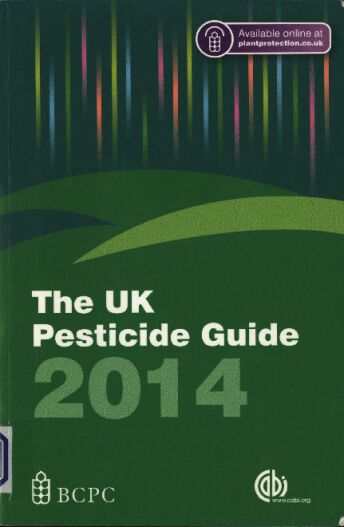
书名:The UK pesticide guide 2014
责任者:ed Martin A. Lainsbury.
出版时间:2014
出版社:CABI Publishing,
前言
Purpose
The primary aim of this book is to provide a practical handbook of pesticides, plant growth regulators and adjuvants that the farmer or grower can realistically and legally obtain in the UK and to identify the purposes for which they can be used. It is designed to help in the identification of products appropriate to a particular problem. In addition to uses recommended on product labels, details are provided of those uses which do not appear on product labels but which have been granted Extension of Authorisation for Minor Use (EAMUs) - previously known as SOLAs. As well as identifying the products available, the book provides guidance on how to use them safely and effectively but without giving details of doses, volumes, spray schedules or approved tank mixtures. Sections 5 and 6 provide essential background information on a wide range of pesticide-related issues including: legislation, biodiversity, codes of practice, poisons and treatment of poisoning, products for use in special situations and weed and crop growth stage keys.
While we have tried to cover all other importa nt factors, this book does not provide a full statement of product recommendations. Before using any pesticide product it is essential that the user should read the label carefully and comply strictly with the instructions it contains. This Guide does not substitute for the product label.
Scope
The Guide is con fined to pesticides registered in the UK for use in arable agriculture, horticulture (incuding amenity use), forestry and areas in or near water. Within these fields of use there are about 2,800 products in the UK with current approval. The Guide is a reference for virtually all of them given in two sections. Section 2 gives full details of the products notified to the editor as available on the market. Products are in eluded in this section only if requested by the supplier and supported by evidence of approval. Section 3 gives brief details of all other registered products with extant approval.
Section 2 lists some 450 in dividual active ingredie nts and mixtures. For each entry a list is shown of the available approved products together with the name of the supplier from whom each may be obtained. All types of pesticide covered by Control of Pesticides Regulations or Plant Protection Products Regulations are included. This embraces acaricides, algicides, herbicides, fungicides, insecticides, lumbricides, molluscicides, nematacides and rodenticides together with plant growth regulators used as straw shorteners, sprout inhibitors and for various horticultural purposes. The total number of products in eluded in section 2 (i.e. available in the market in 2014) is about 1,520.
The Guide also gives information (in section 4) on around 175 authorised adjuvants which, although not active pesticides themselves, may be added to pesticide products to improve their effectiveness. The Guide does not include products solely approved for amateur, home and garden, domestic, food storage, public or animal health uses.
Sources of Information
The information in this edition has been drawn from these authoritative sources:• approved labels and product manuals received from suppliers of pesticides up to October 2013 • websites of the Chemicals Regulation Directorate (CRD, www.pesticides.gov.uk) and the Health and Safety Executive (HSE, www.hse.gov.uk).
Criteria for Inclusion
To be in eluded, a pesticide must meet the following con ditions:• it must have extant approval under UK pesticides legislation • information on the approved uses must have been provided by the supplier • it must be expected to be on the UK market during the currency of this edition.
When a company changes its name, whether by merger, takeover or joint venture, it is obliged to re-register its products in the name of the new company, and new MAPP numbers are normally assigned. Where stocks of the previously registered product remain legally available, both old and new identities are included in the Guide and remain until approval of the former lapses or stocks are notified as exhausted.
Products that have been withdrawn from the market and whose approval will finally lapse during 2014 are identified in each profile. After the indicated date, sale, storage or use of the product bearing that approval number becomes illegal. Where there is a direct replacement product, this is indicated.
The Voluntary Initiative
The Voluntary Initiative (VI) is a programme of measures, agreed by the crop protection industry and related orga nisations with Government, to minimise the environ mental impacts of crop protection products. The programme has provided a framework of practices and principles to help Government achieve its objective of protect!on of water quality and enhancement of farmland biodiversity. Many of the environmental protect!on schemes launched under the VI represent current best practice.
The first five-year phase of the programme formally con eluded in March 2006, but it is continuing with a rolling two-year review of proposals and targets; current proposals include a new online crop protection management plan and greater involvement in catchment-sensitive farming (see below).
A key element of the VI has been the provision of environmental information on crop protection products. Members of the Crop Protection Association (CPA) have committed to do this by producing Envi「onmentai Information Sheets (EISs) for all their marketed professional products.
EISs reinforce and supplement information on a product label by giving specific environmental impact information in a standardised format. They highlight any situations where risk management is essential to ensure environmental protection. Their purpose is to provide user-friendly information to advisers (including those in the amenity sector), farmers and growers on the environmental impact of crop protection products, to allow planning with a better understanding of the practical implications.
Links are provided to give users rapid access to EISs on the VI website: www. voluntaryin itiative.org.uk.
Catchment-sensitive Farming
Catchment-sensitive Farming (CSF) is the government's response to climate change and the new European Water Directive. Rainfall events are likely to become heavier, with a greater risk of soil, nutrients and pesticides ending up in the waterways. The CSF programme is investigating the effects of specific targeted advice on 20 catchment areas perceived as being at risk, and new entries in this Guide can help identify the pesticides that pose the greatest risk of water contamination (see Environmental Safety).
查看更多
目录
Disclaimer v
Editor's Note vi
Changes Since 2013 Edition vii
Introduction x
Notes on Contents and Layout xii
SECTION 1 CROP/PEST GUIDE 1
Crop/Pest Guide Index 3
Crop/Pest Guide 5
SECTION 2 PESTICIDE PROFILES 89
SECTION 3 PRODUCTS ALSO REGISTERED 607
SECTION 4 ADJUVANTS 643
SECTION 5 USEFUL INFORMATION 671
Pesticide Legislation 673
Regulation 1107/2009 - The Replacement for EU 91/414 673
The Water Framework Directive 673
Classification, Labelling and Packaging (CLP) Regulation 673
The Food and Environment Protection Act 1986 (FEPA) 674
Dangerous Preparations Directive (1999/45/EC) 674
The Review Programme 674
Control of Substances Hazardous to Health Regulations 1988 (COSHH) 675
Biocidal Products Regulations 675
Certificates of Competence 一 the roles of BASIS and NPTC 675
Maximum Residue Levels 677
Approval (On-label and Off-label) 678
Statutory Conditions of Use 678
Types of Approval 678
Withdrawal of Approval 678
Off-label Extension of Use 679
Using Crop Protection Chemicals 680
Use of Herbicides In or Near Water 680
Use of Pesticides in Forestry 681
Pesticides Used as Seed Treatments 683
Aerial Application of Pesticides 686
Resistance Man agement 688
Preparation in advanee 688
Using crop protection products 688
International Action Committees 689
Poisons and Poisoning 690
Chemicals Subject to the Poison Law 690
Part I Poisons 690
Part II Poisons 690
Occupational Exposure Limits 690
First Aid Measures 691
General Measures 691
Reporting of Pesticide Poisoning 691
Additional Information 691
Environmental Protection 693
Environmental land management: 8 steps for arable farmers 693
Protection of Bees 694
Honeybees 694
Wild bees 694
The Campaign Against Illegal Poisoning of Wildlife 694
Water Quality 695
Where to get information 695
Protecting surface waters 696
Local Environmental Risk Assessment for Pesticides (LERAPs) 696
Groundwater Regulations 697
Integrated Farm Management (IFM) 697
Campaign for the Farmed Environment 698
SECTION 6 APPENDICES 699
Appendix 1 Suppliers of Pesticides and Adjuvants 701
Appendix 2 Useful Contacts 710
Appendix 3 Keys to Crop and Weed Growth Stages 713
Appendix 4 Key to Hazard Classifications and Safety Precautions 721
Appendix 5 Key to Abbreviations and Acronyms 728
Appendix 6 Definitions 731
Appendix 7 References 733
INDEX OF PROPRIETARY NAMES OF PRODUCTS 735
查看PDF
查看更多
馆藏单位
中国农科院农业信息研究所