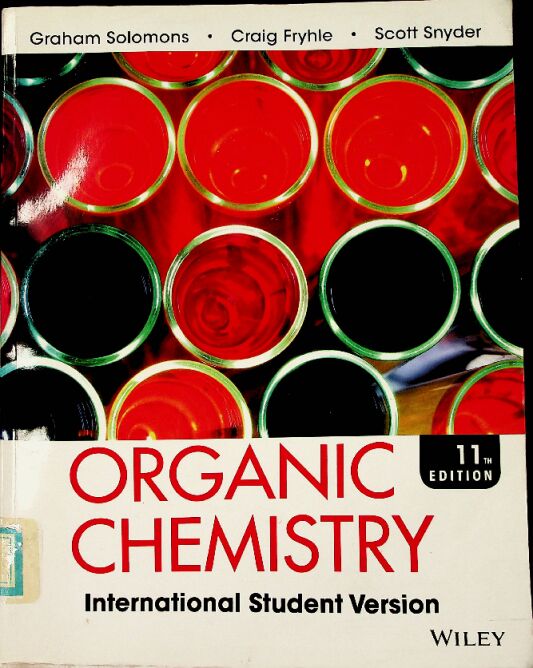
书名:Organic chemistry
责任者:T.W. Graham Solomons | Craig B. Fryhle | Scott A. Snyder
出版时间:2014
出版社:John Wiley & Sons
分类号:化学
版次:11th ed
页数:xxxvi, 1139, [54] p
摘要
An emphasis on problem solving and critical thinking, key to helping students successfully meet the science and technology needs of the future.Coverage of topics in green chemistry, nanotechnology, and biochemistry to introduce students to exciting and important frontiers of organic chemistry.
查看更多
目录
1 The Basics
BONDING AND MOLECULAR STRUCTURE 1
1.1 Life and the Chemistry of Carbon Compounds-We are Stardust 2
THE CHEMISTRY OF...Natural Products 3
1.2 Atomic Structure 3
1.3 Chemical Bonds:The Octet Rule 5
1.4 HOW TO Write Lewis Structures 7
1.5 Formal Charges and HOW TO Calculate Them 12
1.6 Isomers: Different Compounds that Have the Same Molecular Formula 14
1.7 HOW TO Write and Interpret Structural Formulas 15
1.8 Resonance 丁heory 22
1.9 Quantum Mechanics and Atomic Structure 27
1.10 Atomic Orbitals and Electron Configuration 28
1.11 Molecular Orbitals 30
1.12 The Structure of Methane and Ethane: sp3 Hybridization 32
THE CHEMISTRY OF... Calculated Molecular Models: Electron Density Surfaces 36
1.13 The Structure of Ethene (Ethylene): sp2 Hybridization 36
1.14 The Structure of Ethyne (Acetylene): sp Hybridizat ion 40
1.15 A Summary of Important Concepts That Come from Quantum ·Mechanics 43
1.16 HOW TO Predict Molecular Geometry:The Valence Shell Electron Pair Repulsion Model 44
1.17 Applicat ions of Basic Principles 47
[ WHY D THESE TOPICS MATTER? ] 48
2 Families of Carbon Compounds
FUNCTIONAL GROUPS, INTERMOLECULAR FORCES, AND INFRARED (IR) SPECTROSCOPY 55
2.1 Hydrocarbons : Representative Alkanes, Alkenes, Alkynes, and Aromatic Compounds 56
2.2 Polar Covalent Bonds 59
2.3 Polar and Nonpolar Molecules 61
2.4 Functional Groups 64
2.5 AlkyI Halides Or Haloalkanes 65
2.6 Alcohols and Phenols 67
2.7 Ethers 69
THE CHEMISTRY OF... Ethers as General Anesthetics 69
2.8 Amines 70
2.9 Aldehydes and Ketones 71
2.10 Carboxylic Acids, Esters, and Amides 73
2.11 Nitriles 75
2.12 Summary of lmportant Families of Organic Compounds 76
2.13 Physical Properties and Molecular Structure 77
THECHEMISTRY OF... Fluorocarbons and Teflon 82
2.14 Summary of Attractive Electric Forces 85
THE CHEMISTRY OF... Organic Templates Engineered to Mimic Bone Growth 86
2.15 lnfrared Spectroscopy: An Instrumental Method for Detecting Functional Groups 86
2.16 Interpreting IR Spectra 90
2.17 Applications of Basic Principles 97
[ VJHV DO T ESE TOPICS MATTER? ] 97
3 Acids and Bases
AN INTRODUCTION TO ORGANIC REACTIONS AND THEIR MECHANISMS 104
3.1 Acid-Base Reactions 105
3.2 HOW TO Use Curved Arrows in Illustrating Reactions 107
[ A MECHANISM F R THE REACTI ” ] Reaction of Water with Hydrogen Chloride: The Use of Curved Arrows 107
3.3 Lewis Acids and Bases 109
3.4 Heterolysis of Bonds to Carbon: Carbocations and Carbanions 111
3.5 The Strength of Br0nsted-Lowry Acids and Bases: Ka and pK8 113
3.6 HOW TO Predict the Outcome of Acid-Base Reactions 118
3.7 Relationships Between Structure and Acidity 120
3.8 Energy Changes 123
3.9 The Relationship Between the Equilib「ium Constant and the Standard Free-Energy Change, t.G。125
3.10 Acidity: Carboxylic Acids versus Alcohols 126
3.11 The Effect of the Solvent on Ac idity 130
3.12 Organic Compounds as Bases 130
3.13 A Mechanism for an Organic Reaction 132
[ A MECHANISM F R T”E REACTI ” ] Reaction of tert-Buty l Alcohol with Concentrated Aqueous HCI 132
3.14 Acids and Bases in Nonaqueous Solutions 133
3.15 Acid-Base Reactions and the Synthesis of Deute「ium- and T「itium-Labeled Compounds 134
3.16 Applications of Basic Principles 135
[ WHY DO THESE T PICS MATTER?】 136
4 Nomenclature and Confrmatins of Alkanes and Cycloalkanes 142
4.1 Introduction to Alkanes and Cycloalkanes 143
THE CHEMISTRY OF... Petroleum Refining 143
4.2 Shapes of Alkanes 144
4.3 HOW TO Name Alkanes, Alkyl Halides, and Alcohols: The IUPAC System 146
4.4 HOW TO Name Cycloalkanes 153
4.5 HOW TO Name Alkenes and Cycloalkenes 156
4.6 HOW TO Name Alkynes 158
4.7 Physical Properties of Alkanes and Cycloalkanes 159
THE CHEMISTRY OF ... Pheromones: Communication by Means of Chemicals 161
4.8 Sigma Bonds and Bond Rotation 162
4.9 Conformational Analysis of Butane 164
THE CHEMISTRY OF ... Muscle Action 166
4.10 The Relative Stabilities of Cyc loalkanes: Ring Strain 167
4.11 Conformations of Cyclohexane: The Chair and the Boat 168
THE CHEMISTRY ... Nanoscale Motors and Molecular Switches 170
4.12 Substituted Cyclohexanes : Axial and Equatorial Hydrogen Groups 171
4.13 Disubstituted Cycloalkanes: Cis-Trans Isomerism 175
4.14 Bicyclic and Polycyclic Alkanes 179
4.15 Chemical Reactions of Alkanes 180
4.16 Synthesis of Alkanes and Cycloalkanes 180
4.17 HOW TO Gain Structural Information from Molecular Formulas and the Index of Hydrogen Deficiency 182
4.18 Applications of Basic Principles 184
[ WHY DO THESE T PICS MATTER? ] 185
See SPECIAL TOPIC A:13C NMR Spectroscopy-A Practical Introduction in WileyPLUS
5 Stereochemistry
CHIRAL MOLECULES 191
5.1 Chirality and Stereochemistry 192
5.2 Isomerism: Constitutional Isomers and Stereoisomers 193
5.3 Enantiomers and Chiral Molecules 195
5.4 Molecules Having One Chirality Center are Chiral 196
5.5 More about the Biological Importance of Chirality 199
5.6 .HOW TO Test for Chirality: Planes of Symmetry 201
5.7 Naming Enantiomers: The R’S-System 202
5.8 Properties of Enantiomers: Optical Activity 206
5.9 The Origin of Optical Activity 211
5.10 The Synthesis of Chiral Molecules 213
5.11 Chiral Drugs 215
THE CHEMISTRY OF...Selective Binding of Drug Enantiomers to Left- and Right-Handed Coiled DNA 217
5.12 Molecules with More than One Chirality Center 217
5.13 Fischer Projection Formulas 223
5.14 Stereoisomerism of Cyclic Compounds 225
5.15 Relating Configurations through Reactions in which No Bonds to the Chirality Center Are Broken 227
5.16 Separation of Enantiomers: Resolution 231
5.17 Compounds with Chirality Centers Other than Carbon 232
5.18 Chiral Molecules That Do Not Possess a Chirality Center 232
[ WHY DO THESE TOPICS MATTER? ] 233
6 Ionic Reactionsel
NUCLEOPHILIC
SUBSTITUTION AND ELIMINATION REACTIONS OF A LKYL HALIDES 239
6.1 Alkyl Halides 240
6.2 Nucleophilic Substitution Reactions 241
6.3 Nucleophiles 243
6.4 Leaving Groups 245
6.5 Kinetics of a Nucleophilic Substitution Reaction: An SN2 Reaction 245
6.6 A Mechanism for the SN2 Reaction 246
[ A MECHANISM F R THE REACTION ] Mechanism for the SN2 Reaction 247
6.7 Transition State Theory: Free-Energy Diagrams 248
6.8 The Stereochemistry of SN2 Reactions 251
[ A MECHANISM F THE REACTION 】 The Stereochemistry of an SN2 Reaction 253
6.9 The Reaction of Tert-Butyl Chloride with Water:An SN1 Reaction 253
6.10 A Mechanism for the SN1 Reaction 254
[ A MECHANISM FOR THE REACTION ] Mechanism for the SN1 Reaction 255
6.11 Carbocations 256
6.12 The Stereochemistry of SN1 Reactions 258
[ A MECHANISM F R THE REACTION ] The Stereochemistry of an SN1 Reaction 259
6.13 Factors Affecting the Rates of SN1 and SN2 Reactions 261
6.14 Organic Synthesis: Functional Group Transformations Using SN2 Reactions 271
THE CHEMISTRY OF... Biological Methylation: A Biological Nucleophilic Substitution Reaction 273
6.15 Elimination Reactions of Alkyl Halides 275
6.16 The E2 Reaction 276
[ A MECHANISM FOR THE REACTION ] Mechanism for the E2 Reaction 277
6.17 The E1 Reaction 278
[ A MECHANISM FOR THE REACTION ] Mechanism for the E1 Reaction 279
6.18 HOW TO Determine Whether Substitution or Elimination Is Favored 280
6.19 Overall Summary 282
[ WYD THESE TOPICS MATTER? ] 283
7 Alkenes and Alkynes I
PROPERTIES AND SYNTHESIS. ELIMINATION EACTIONS OF ALK YL HALIDES 291
7.1 Introduction 292
7.2 The (E)-(Z) System for Designating Alkene Diastereomers 292
7.3 Relative Stabilities of Alkenes 293
7.4 Cycloalkenes 296
7.5 Synthesis of Alkenes via Elimination Reactions 296
7.6 Dehydrohalogenation of Alkyl Halides 297
[ A MECHANISM F R THE REACTION ] E2 Elimination
Where There Are Two Axial f3 Hydrogens 302
[ A MECHANISM FOR T”E REACTION ] E2 Elimination Where the Only Axial f3 Hydrogen Is from a Less Stable Conformer 302
7.7 Acid-Catalyzed Dehydration of Alcohols 303
[ A MECHANISM F THE REACTIN ] Acid-Catalyzed Dehydration of Secondary or Tertiary Alcohols: An E1 Reaction 307
[ A MECHANISM FOR THE R巨ACTION ] Dehydration of a Primary Alcohol: An E2 Reaction 308
7.8 Carbocation Stability and the Occurrence of Molecular Rearrar1gements 309
[ A MECHANISM FOR THE REACTION ]Formation of a Rearranged Alkene During Dehydration of a Primary Alcohol 312
7.9 The Acidity of Terminal Alkynes 313
7.10 Synthesis of Alkynes by Elimination Reactions 314
[ A MEC”ANISMFR THE REACTI ”]
Dehydrohalogenation of vic-Dibromides to Form Alkynes 315
7.11 Terminal Alkynes Can Be Converted to Nucleophiles for Carbon-Carbon Bond Formation 316 to Alkenes 359
7.12 Hydrogenation of Alkenes 318
THE CHEMISTRY OF... Hydrogenation in the Food industry 310
7.13 Hydrogenation:The Function of the Catalyst 320
7.14 Hydrogenation of Alkynes 321
[ A MECANISM FOR THE REACTION ] The Dissolving Metal Reduction of an Alkyne 322
7.15 An Introduction to Organic Synthesis 323
THE CHEMISTRY OF... From the Inorganic to the Organic 325
[ WHY DO THESE TOPICS MATTER? ] 327
8 Alkenes and Alkynes II
A DDITION R EAC丁IONS 337
8.1 Addition Reactions of Alkenes 338
8.2 Electrophilic Addition of Hydrogen Halides to Alkenes: Mechanism and Markovnikov’s Rule 340
[ A MECHANISM FOR THE REACTI ” ] Addition of a Hydrogen Halide to an Alkene 341
[ A MECHANISM F R THE REACTI N ] Addition of HBr to 2-Methylpropene 343
8.3 Stereochemistry of the Ionic Addition to an Alkene 345
[ THE STEREOCHEMISTRY OF THE REACTION... ] Ionic Addition to an Alkene 345
8.4 Addition of Water to Alkenes: Acid-Catalyzed Hydration 346
[ A MECHANISM F R THE REACT,N ] Acid-Catalyzed Hydration of an Alkene 346
8.5 Alcohols from Alkenes through Oxymercuration- Demercuration: Markovnikov Addition 349
[ A MECHANISMFR THE REACTION ]
Oxymercuration 351
8.6 Alcoho ls from Alkenes through Hydroboration- Oxidation: Anti-Markovnikov Syn Hydration 352
8.7 Hydroboration:Synthesis of Alkylboranes 353
[ A MECHANISM FOR THE REACTION ]
Hydrboration 354
8.8 Oxidation and Hydrolysis of Alkylboranes 355
[ A MECHANISM FOR THE REACTION ] Oxidation of Trialkylboranes 356
8.9 Summary of Alkene Hydration Methods 358
8.10 Protonolysis of Alkylboranes 359
8.11 Electrophilic Addition of Bromine and Chlorine to Alenes 359
[ A MECHANISM FOR THE REACTION ] Addition of Bromine to an Alkene 361
THE CHEMISTRY OF... The Sea: A Treasury of Biologically Active Natural Products 362
8.12 Stereospecific Reactions 363
[THE STEREOCHEMISTRY OF THE REACTION...]
Addition of Bromine to cis- and trans-2-Butene 364
8.13 Halohydrin Formation 364
[ A MECHANISM FOR THE REACTION ] Halohydrin Formation from an Alkene 365
THE CHEMISTRY OF...Citrus-Flavored Soft Drinks 366
8.14 Divalent Carbon Compounds: Carbenes 366
8.15 Oxidation of Alkenes : Syn 1,2-Dihydroxylation 368
THE CHEMISTRY OF...Catalytic Asymmetric Dihydroxylation 370
8.16 Oxidative Cleavage of Alkenes 371
[ A MECHANISM FOR THE REACTION ] Ozonolysis of an Alkene 373
8.17 Electrophilic Addition of Bromine and Chlorine to Alkynes 374
8.18 Addition of Hydrogen Halides to Alkynes 374
8.19 Oxidative Cleavage of Alkynes 375
8.20 HOW TO Plan a Synthesis: Some Approaches and Examples 376
[ WHY DO THESE TOPICS MATTER? ] 381
9 Nuclear Magnetic Res nance and Mass Spectrometry
TOOLS FOR S丁RUCTURE DETERMINA丁ION 391
9.1 Introduction 392
9.2 Nuclear Magnetic Resonance (NMR) Spectroscopy 392
9.3 HOW TO Interpret Proton NMR Spectra 398
9.4 Nuclear Spin:The Origin of the Signal 401
9.5 Detecting the Signal:Fourier Transform NMR Spectrometers 403
9.6 The Chemical Shift 405
9.7 Shielding and Deshielding of Protons 406
9.8 Chemical Shift Equivalent and Nonequivalent Protons 408
9.9 Signal Splitting: Spin-Spin Coupling 411
9.10 Proton NMR Spectra and Rate Processes 420
9.11 Carbon-13 NMR Spectroscopy 422
9.12 Two-Dimensional (20) NMR Techniques 428
THE CHEMISTRY F...Magnetic Resonance Imaging 1n Medicine 431
9.13 An Introduction to Mass Spectrometry 431
9.14 Formation of Ions: Electron Impact Ionization 432
9.15 Depicting the Molecular Ion 432
9.16 Fragmentation 433
9.17 Isotopes in Mass Spectra 440
9.18 GC/MS Analysis 443
9.19 Mass Spectrometry of Biomolecules 444
[ WHY DO THESE TOPICS MATTER? ] 444
10 Radical Reactions 457
10.1 Introduction: How Radicals Form and How They React 458
[ A MECHANISM FOR THE REACTI N ] Hydrogen Atom Abstraction 459
[ A MECHANISM FOR THE REACTION ] Radical Addition to a π Bond 459
THE CHEMISTRY OF Acne Medications 459
10.2 Homolytic Bond Dissociation Energies (DH0) 460
10.3 Reactions of Alkanes with Halogens 463
10.4 Chlorination of Methane: Mechanism of Reaction 465
[ A MECHAN.ISM FOR THE REACTION ] Radical Chlorination of Methane 465
10.5 Halogenation of Higher Alkanes 468
[ A MECHAN SM FOR THE REACTION ] Radical Halogenation of Ethane 468
10.6 The Geometry of Alkyl Radicals 471
10.7 Reactions That Generate Tetrahedral Chirality Centers 471
[ A MECHANISM F R THE REACTION ] The
Stereochemistry of Chlorination at C2 of Pentane 472
{ A MECHANISM F R THE REACT!”] The Stereochernistry of Chlorination at c3 of (S)-2-Chloropentane 473
10.8 A.llylic Substitution and A.llylic Radicals 475
10.9 Benzylic Substitution and Benzylic Radicals 478
10.10 Radical Addition to Alkenes: The Anti-Markovnikov Addition of Hydrogen Bromide 481
[ A MECHANISM FOR THE REACTION ] Anti-Markovnikov Addition of HBr 481
10.11 Radical Polymerization of Alkenes: Chain-Growth Polymers 483
[ A MECHANISM FOR THE REACTION ] Radical Polymerization of Ethene (Ethylene) 484
10.12 Other Important Radical Reactions 487
THE CHEMISTRY OF...Antiox idants 489
THE CHEMISTRY OF...Ozone Depletion and Chlorofluorocarbons (CFCs) 490
[ WHY DO THESE TOPICS MATTER? ] 491
See SPECIAL TOPIC B: Chain-Growth Polymers in WileyPLUS
11 AlcohoIs and Ethers
SYNT HESIS AND REACTIONS 498
11.1 Structure and Nomenclature 499
11.2 Physical Proper飞ies of Alcohols and Ethers 501
11.3 Important Alcohols and Ethers 503
THE CHEMISTRY F... Ethanol as a Biofuel 504
THE CHEMISTRY F... Choleste ol and Heart Disease 505
11.4 Synthesis of Alcohols from Alkenes 505
11.5 Reactions of Alcohols 507
11.6 Alcohols as Acids 509
11.7 Conversion of Alcohols into Alkyl Halides 510
11.8 Alkyl Halides from the Reaction of Alcohols with Hydrogen Halides 510
11.9 Alkyl Halides from the Reaction of Alcohols with PBr3 or SOCl2 513
11.10 Tosylates, Mesylates, and Triflates: Leaving Group Derivatives of Alcohols 514
[ A MECHAN SM FOR THE REACTION ] Conversion of an Alcohol into a Mesylate (an Alkyl Methanesulfonate) 516
11.11 Synthesis of Ethers 517
[ A MECHANISM FOR THE REACTION ] Intermolecular Dehydration of Alcohols to Form an Ether 517
[ A MEC”A NISM FOR THE REACTION ] The Williamson Ether Synthesis 518
11.12 Reactions of Ethers 522
[ A MECANISM FOR T E REACTION J Ether Cleavage by Strong Acids 522
11.13 Epoxides 523
[ A MECHANISM F R THE REACTI ” ] Alkene Epoxidation 524
THE CHEM STRY OF...The Sharpless Asymmetric Epoxidation 524
11.14 Reactions of Epoxides 525
[ A MECHANISM FOR THE REACT,” ] Acid-Catalyzed Ring Opening of an Epoxide 525
[ A MECHAN’SM F R T”E REACTION ] Base-Catalyzed Ring Opening of an Epoxide 526
11.15 Anti 1,2-Dihydroxylation of Alkenes via Epoxides 528
THE CHEMISTRY OF... Environmentally Friendly Alkene Oxidation Methods 530
11.16 Crown Ethers 531
THE CHEMISTRY OF...Transport Antibiotics and Crown Ethers 532
11.17 Summary of Reactions of Alkenes, Alcohols, and Ethers 532
[ WY D THESE T PICS MATTER? ] 534
12 Alcohols from Carbonyl Compounds
OXIDATION- EDUCTION AND ORGANOMETALLIC COMPOUNDS 542
12.1 Structure of the Carbonyl Group 543
12.2 Oxidation-Reduction Reactions in Organic Chemistry 544
12.3 Alcohols by Reduction of Carbonyl Compounds 546
[ A MECHANISM F R THE REACTION ] Reduction of Aldehydes and Ketones by Hydride Transfer 548
TEC EMISTRY OF... Alcohol Dehydrogenase-A Biochemical Hydride Reagent 548
THE CHEMISTRY F... Stereoselective Reductions of Carbonyl Groups 550
12.4 Oxidation of Alcohols 551
[ A MECHANISM F R THE REACTI N ] The Swem Oxidation 552
[ A MECHANISM F THE REACTI N ] Chromic Acid Oxidation 554
12.5 Organometallic Compounds 556
12.6 Prepatatio of Organolithium and Organomagnesium Compounds 557
12.7 Reactions of Organolithium and Organomagnesium Compounds 558
[ A MECHANISM FOR THE REACTION ] The Grignard Reaction 561
12.8 Alcohols from Grignard Reagents 561
12.9 Protecting Groups 570
[ WHY DO THESE TOPICS MATTER? ] 571
See First Review Problem Set in WileyPLUS
13 Conjugated Unsaturated Systems 581
13.1 Introduction 582
13.2 The Stability of the Allyl Radical 582
13.3 The Allyl Cation 586
13.4 Resonance Theory Revisited 587
13.5 Alkadienes and Polyunsaturated Hydrocarbons 591
13.6 1,3-Butadiene: Electron Delocalization 592
13.7 The Stability of Conjugated Dienes 595
13.8 Ultraviolet-Visible Spectroscopy 596
13.9 Electrophilic Attack on c njugated Dienes: A1,4-Addition 604
13.10 The Diels-Alder Reaction: A 1,4-Cycloaddition Reaction of Dienes 608
THE CHEMISTRY OF... Molecules with the Nobel Prize in Their Synthetic Lineage 617
[ WHY DO THESE TOPICS MATTER? ] 617
14 Aromatic Compounds 626
14.1 The Discovery of Benzene 627
14.2 Nomenclature of Benzene Derivatives 628
14.3 Reactions of Benzene 630
14.4 The Kekule Structure for Benzene 631
14.5 The Thermodynamic Stability of Benzene 632
14.6 Modern Theories of the Structure of Benzene 634
14.7 Huckel's Rule:The 4n + 2 τ Electron Rule 637
14.8 Other Aromatic Compounds 645
THE CHEMISTRY OF...Nanotubes 648
14.9 Heterocyclic Aromatic Compounds 648
14.10 Aromatic Compounds in Biochemistry 650
14.11 Spectroscopy of Aromatic Compounds 652
THE CHEMISTRY OF...Sunscreens (Catching the Sun’s Rays and What Happens to Them) 656
15 Reactions of Aromatic Compounds 669
15.1 Electrophilic Aromatic Substitution Reactions 670
15.2 A General Mechanism for Electrophilic Aromatic Substitution 671
15.3 Halogenation of Benzene 673
[ A MEC ANISM FOR THE REACTION ] Electrophilic Aromatic Bromination 673
15.4 Nitration of Benzene 674
[ A MECHANISM FOR THE REACTION ]Nitration of Benzene 675
15.5 Sulfonation of Benzene 675
[ A MECHA NISM FOR THE REACTION ] Sulfonation of Benzene 676
15.6 Friedel-Crafts Alkylation 676
[ A MECHANISM FOR THE REACTION ] Friedel-Crafts Alkylation 677
15.7 Friedel-Crafts Acylation 678
[ A MECHANISM FOR THE REACTION ] Friedel-Crafts Acylation 680
15.8 Limitations of Friedel-Crafts Reactions 680
15.9 Synthetic Applications of Friedel-Crafts Acylations:The Clemmensen and Wolff-Kishner Reduction 83
15.10 Substituents Can Affect Both the Reactivity of the Ring and the Orientation of the Incoming Group 685
15.11 How Substituents Affect Electrophilic Aromatic Substitution: A Closer Look 690
15.12 Reactions of the Side Chain of Alkylbenzenes 699
THE CHEMISTRY OF... Industrial Styrene Synthesis 701
[ A MECHANISM FOR THE REACTION ] Benzylic Halogenation 701
15.13 Alkenylbenzenes 702
15.14 Synthetic Applications 704
15.15 Allylic and Benzylic Halides in Nucleophilic Substitution Reactions 708
15.16 Reduction of Aromatic Compounds 710
[ A MECHANISM FOR THE REACTION ] Birch Reduction 710
[ WHY DO THESE TOPICS MATTER? ] 711
16 Aldehydes and Ketones
NUCLEOPHILIC ADDITION TO THE CARBONYL GROUP 720
16.1 Introduction 721
16.2 Nomenclature of Aldehydes and Ketones 721
16.3 Physical Properties 723
THE CHEMISTRY OF... Aldehydes and Ketones in Perfumes 724
16.4 Synthesis of Aldehydes 724
[ A MECHANISM FOR THE REACTION ] Reduction of an
Acyl Chloride to an Aldehyde 727
[ A MECHANISM FOR THE REACTION ] Reduction of an Ester to an Aldehyde 728
[ A MECHANISM FOR THE REACTION ] Reduction of a Nitrile to an Aldehyde 728
16.5 Synthesis of Ketones 729
16.6 Nucleophilic Addition to the Carbon-Oxygen Double Bond 732
[ A MECHANISM FOR THE REACTION ] Addition of a Strong Nucleophile to an Aldehyde or Ketone 733
[ A MECHANISM FOR THE REACTION ] Acid-Catalyzed Nucleophilic Addition to an Aldehyde or Ketone 733
16.7 The Addition of Alcohols: Hemiacetals and Acetals 735
[ A MECHANISM FOR THE REACTION ] Hemiacetal Formation 735
[ A MECHANISM FOR THE REACTION ] Acid-Catalyzed Hemiacetal Formation 736
[ A MECHANISM FOR THE REACTION ] Base-Catalyzed Hemiacetal Formation 736
[ A MECHANISM FOR THE REACTION ] Hydrate Formation 737
[ A MECHANISM FOR THE REACTION ] Acid-Catalyzed Acetal Formation 738
16.8 The Addition of Primary and Secondary Amines 741
[ A MECHANISM FOR THE REACTION ] Imine Formation 742
[ A MECHANISM FOR THE REACTION ] The Wolff-Kishner Reduction 743
THE CHEMISTRY OF...A Very Versatile Vitamin, Pyridoxine (Vitamin B6) 744
[ A MECHANISM FOR THE REACTION ] Enamine Formation 745
16.9 The Addition of Hydrogen Cyanide: Cyanohydrins 746
[ A MECHANISM FOR THE REACTION ] Cyanohydrin Formation 746
16.10 The Addition of YIides: The Wittig Reaction 747
[ A MECHANISM FOR THE REACTION ] The Wittig Reaction 749
16.11 Oxidation of Aldehydes 751
16.12 The Baeyer-Villiger Oxidation 751
[ A MECHANISM FOR THE REACTION ] The Baeyer-Villiger Oxidation 752
16.13 Chemical Analyses for Aldehydes and Ketones 753
16.14 Spectroscopic Prope「ties of Aldehydes and Ketones 753
16.15 Summa「y of Aldehyde and Ketone Addition Reactions 756
[ WHY DO THESE TOPICS MATTER? ] 757
17 Carboxylic Acids and Their Derivatives
NUCLEOPHILIC ADDITION-ELIMINATION AT THE ACYL CARBON 771
17.1 Introduction 772
17.2 Nomenclature and Physical Properties 772
17.3 Preparation of Carboxylic Acids 781
17.4 Acyl Substitution: Nucleophilic Addition-Elimination at the Acyl Carbon 784
[ A MECHANISM FOR THE REACTION ] Acyl Substitution by Nucleophilic Addition-Elimination 784
17.5 Acyl Chlorides 786
[ A MECHANISM FOR THE REACTION ] Synthesis of Acyl Chlorides Using Thionyl Chloride 787
17.6 Carboxylic Acid Anhydrides 788
17.7 Esters 789
[ A MECHANISM FOR THE REACTION ] Acid-Catalyzed Esterification 790
[ A MECHANISM FOR THE REACTION ] Base-Promoted Hydrolysis of an Ester 793
17.8 Amides 796
[ A MECHANISM FOR THE REACTION ] DCC-Promnoted Amide Synthesis 798
[ A MECHANISM FOR THE REACTION ] Acidic Hydrolysis of an Amide 799
[ A MECHANISM FOR THE REACTION ] Basic Hydrolysis of an Amide 799
[ A MECHANISM FOR THE REACTION ] Acidic Hydrolysis of a Nitrile 801
[ A MECHANISM FOR THE REACTION ] Basic Hydrolysis of a Nitrile 801
17.9 Derivatives of Carbonic Acid 802
17.10 Decarboxylation of Carboxylic Acids 805
17.11 Chemical Tests for Acyl Compounds 807
17.12 Polyesters and Polyamides: Step-Growth Polymers 807
17.13 Summary of the Reactions of Carboxylic Acids and Their Derivatives 809
[ WHY DO THESE TOPICS MATTER? ] 812
18 Reactions at the α Carbon of Carbonyl Compounds
ENOLS AND ENOLATES 821
18.1 The Acidity of the a Hydrogens of Carbonyl Compounds: Enolate Anions 822
18.2 Keto and Enol Tautomers 823
18.3 Reactions via Enols and Enolates 825
[ A MECHANISM FOR THE REACTION ] Base-Catalyzed Enolization 825
[ A MECHANISM FOR THE REACTION ] Acid-Catalyzed Enolization 826
[ A MECHANISM FOR THE REACTION ] Base-Promoted Halogenation of Aldehydes and Ketones 827
[ A MECHANISM FOR THE REACTION ] Acid-Catalyzed Halogenation of Aldehydes and Ketones 828
[ A MECHANISM FOR THE REACTION ] The Haloform Reaction 829
THE CHEMISTRY OF... Chloroform in Drinking Water 829
18.4 Lithium Enolates 831
18.5 Enolates of β Dicarbonyl Compounds 834
18.6 Synthesis of Methyl Ketones:The Acetoacetic Ester Synthesis 835
18.7 Synthesis of Subst ituted Acetic Acids: The Malonic Ester Synthesis 840
[ A MECHANISM FOR THE REACTION ] The Malonic Ester Synthesis of Substituted Acetic Acids 840
18.8 Further Reactions of Active Hydrogen Compounds 844
18.9 Synthesis of Enamines:Stork Enamine Reactions 844
18.10 Summary of Enolate Chemistry 847
[ WHY DO TOPICS MATTER? ] 849
See SPECIAL TOPIC C:Step-Growth Polymers in WileyPLUS
19 Condensation and Conjugate Addition Reactions of Carbonyl Compounds
MORE CHEMIS丁RY OF ENOLATES 858
19.1 Introduction 859
19.2 The Claisen Condensation:A Synthesis of β Keto Esters 859
[ A MECHANISM FOR THE REACTION ] The Claisen Condensation 860
[ A MECHANISM FOR THE REACTION ] The Dieckmann Condensation 862
19.3 β Dicarbonyl Compounds by Acylation of Ketone Enolates 864
19.4 Aldol Reactions:Addition of Enolates and Enols to Aldehydes and Ketones 865
[ A MECHANISM FOR THE REACTION ] The Aldol Addition 866
[ A MECHANISM FOR THE REACTION ] Dehydration of the Aldol Addition Product 867
[ A MECHANISM FOR THE REACTION ] The AcidCatalyzed A ldo/ React on 867
[ A MECHANISM F R THE REACTI ” J
19.6 Cyclizations via Aldol Condensations 876
[ A MECHANISM FOR THE REACTION ] The Aldol Cychlization 877
19.7 Additions to a β Unsaturated Aldehydes and Ketones 877
[ A MECHANISM FOR THE REACTION ] The Conjugate Addition of HCN 879
[ A MECHANISM FOR THE REACTION ] The Conjugate Addit ion of an Amine 879
[ A MECHANISM FOR THE REACTION ] The Michael Addition 880
THE CHEMISTRY OF...Conjugate Additions to Activate Drugs 881
19.8 The Mannich Reaction 882
[ A MECHANISM FOR THE REACTION ] Reaction 882
THE CHEMISTRY OF... A Suicide Enzyme Substrate 883
19.9 Summary of Important Reactions 884
[ WHY DO THESE TOPICS MATTER? ] 885
See SPECIAL TOPIC D: Thiols, Sulfur Ylides, and Disulfides in WileyPLUS
See SPECIAL TOPIC E: Thiol Esters and Lipid
20 Amines 897
20.1 Nomenclature 898
20.2 Physical Properties and Structure of Amines 899
20.3 Basicity of Amines: Amine Salts 901
THE CHEMISTRY OF... Biologically Important Amines 906
20.4 Preparation of Amines 908
[ A MECHANISM FOR THE REACTION ] A lkylatron of NH3 909
[ A MECHANISM FOR THE REACTION ] Reductive Amination 912
[ A MECHANISM FOR THE REACTION ] The Hofmann Rearrangement 915
20.5 Reactions of Amines 917
20.6 Reactions of Amines with Nitrous Ac id 918
[ A MECHANISM FOR THE REACTION ]Diazotization 919
THE CHEMISTRY OF... N-Nitrosoamines 919
20.7 Replacement Reactions of Arenediazonium Salts 920
20.8 Coupling Reactions of Arenediazonium Salts 924
20.9 Reactions of Amines with Sulfonyl Chlorides 926
THE CHEMISTRY OF... Essential Nutrients and Antimetabolites 927
20.10 Synthesis of Sulfa Drugs 928
20.11 Analysis of Amines 929
20.12 Eliminations Involving Ammonium Compounds 931
20.13 Summary of Preparations and Reactions of Amines 932
[ WHY DO THESE TOPICS MATTER? ] 934
See SPECIAι TOPIC F:Alkaloids in WileyPLUS
21 Phenols and Aryl Halides
NUCLEOPHILIC AROMATIC SUBSTITUTION 944
21.1 Structure and Nomenclature of Phenols 945
21.2 Naturally Occurring Phenols 946
21.3 Physical Properties of Phenols 947
21.4 Synthesis of Phenols 947
21.5 Reactions of Phenols as Acids 949
21.6 Other Reactions of the 0-H Group of Phenols 952
21.7 Cleavage of Alkyl Aryl Ethers 952
21.8 Reactions of the Benzene Ring of Phenols 953
THE CHEMISTRY OF... Polyketide Anticancer Antibiotic Biosynthesis 954
21.9 The Claisen Rear「angement 956
21.10 Quinones 957
THE CHEMISTRY OF...The Bombardier Beetle’s Noxious Spray 958
21.11 Aryl Halides and Nucleophilic Aromatic Substitution 959
[ A MECHANISM FOR THE REACTION ] The SNAr Mechanism 960
THE CHEMISTRY OF... Bacterial Dehalogenation of a PCB Derivative 961
[ A MECHANISM FOR THE REACTION ] The Benzyne Elimination-Addition Mechanism 962
21.12 Spectroscopic Analysis of Phenols and Aryl Halides 966
THE CHEMISTRY OF...Aryl Halides: Their Uses and Environmental Concerns 967
[ WHY DO THESE T PICS MATTER? ] 969
See Second Review Problem Set in WileyPLUS
SPECIAL T PIC G:Carbon-Carbon Bond-Forming and Other Reactions of Transition Metal Organometallic Compounds ONLINE
See SPECIAL TOPIC H: Electrocyclic and Cycloaddition Reactions in WileyPLUS
22 Carbohydrates 979
22.1 Introduction 980
22.2 Monosaccharides 982
22.3 Mutarotation 987
22.4 Glycoside Formation 988
[ A MECHANISM FOR THE REACTION ] Formation of a Glycoside 988
[ A MECHANISM FOR THE REACTION ] Hydrolysis of a Glycoside 989
22.5 Other Reactions of Monosacchar ides 990
22.6 Oxidation Reactions of Monosaccharides 994
22.7 Reduction of M nosaccharides: Alditols 999
22.8 Reactions of Monosaccharides with Phenylhydrazine:Osazones 999
[ A MECHANISM FOR THE REACTION ] Phenylosazone Formation 1000
22.9 Synthesis and Degradation of Monosaccharides 1000
22.10 The o Family of Aldoses 1002
22.11 Fischer's Proof of the configuration of o-(+)-Glucose 1003
22.12 Disaccharides 1005
THE CHEMISTRY OF...Artificial Sweeteners (How Sweet It Is) 1008
22.13 Polysaccharides 1009
22.14 Other Biologically Important Sugars 1013
22.15 Sugars That Contain Nitrogen 1014
22.16 Glycolipids and Glycoproteins of the Cell Surface: Cell Recognition and the Immune System 1016
THE CHEMISTRY OF... Patroling Leukocytes and Sialyl Lewis" Acids 1018
22.17 Carbohydrate Antibiotics 1018
22.18 Summary of Reactions of Carbohydrates 1019
[ WY DO THESE TOPICS MATTER? ] 1020
23 Lipids 1021
23.1 Introduction 1028
23.2 Fatty Acids and Triacylglycerols 1028
THE CHEMISTRY OF... Olestra and Other Fat Substitutes 1032
THE CHEMISTRY OF... Self-Assembled Monolayers Lipids in Materials Science and Bioengineering 1036
23.3 Terpenes and Terpenoids 1037
23.4 Steroids 1040
THE CHEMISTRY OF... The Enzyme Aromatase 1046
23.5 Prostaglandins 1049
23.6 Phospholipids and Cell Membranes 1050
THE CHEMISTRY OF... STEALTH® Liposomes for Drug Delivery 1053
23.7 Waxes 1054
[ WHY DO THESE TOPICS MATTER? ] 1054
24 Amino Acids and Proteins 1060
24.1 Introduction 1061
24.2 Amino Acids 1062
24.3 Synthesis of a-Amino Acids 1068
[ A MECHANISM FOR THE REACTION ] Formation of an a-Aminonitrile during the Strecker Synthesis 1069
24.4 Polypeptides and Proteins 1070
24.5 Primary Structure of Polypeptides and Proteins 1073
24.6 Examples of Polypeptide and Protein Primary Structure 1077
THE CHEMISTRY OF... Sickle-Cell Anemia 1079
24.7 Polypeptide and Protein Synthesis 1080
24.8 Secondary, Tertiary, and Quaternary Structures of Proteins 1086
24.9 lntroduction to Enzymes 1090
24.10 Lysozyme: Mode of Action of an Enzyme 1092
THE CHEMISTRY OF... Carbonic Anhydrase: Shuttling the Protons 1094
24.11 Serine Proteases 1094
24.12 Hemoglobin: A Conjugated Protein 1096
THE CHEMISTRY OF... Some Catalytic Antibodies 1096
24.13 Purification and Analysis of Polypeptides and Proteins 1098
24.14 Proteomics 1100
[ WHY DO THESE TOPICS MATTER? ] 1102
25 Nucleic Acids and Protein Synthesis 1105
25.1 Introduction 1106
25.2 Nucleotides and Nucleosides 1107
25.3 Laboratory Synthesis of Nucleosides and Nucleotides 1110
25.4 Deoxyribonucleic Acid: DNA 1113 25.5 RNA and Protein Synthesis 1120
25.6 Determining the Base Sequence of DNA: The Chain-Terminating (Oideoxynucleotide) Method 1128
25.7 Laboratory Synthesis of Oligonucleotides 1131
25.8 The Polymerase Chain Reaction 1133
25.9 Sequencing of the Human Genome: An Instruction Book for the Molecules of Life 1135
[ WHY DO THESE T PICS MATTER? ] 1136
ANSWERS TO SELECTED PROBLEMS A-1
GLOSSARY GL-1INDEX I-1
查看更多
作者简介
SCOTT A. SNYDER is Associate Professor of Chemisrry at Columbia Universiry. He grew up in the suburbs of Buffalo NY and was an undergraduate at Williams College, where he graduated summa cum laude in 1999, before pursuing his doccoral studies ar The Scripps Research lnsciruce under the rutelege of K. C. Nicolaou as an NSF, Pfizer, and Bristol-Myers-Squibb predocroraJ fellow. While there, he co-authored the graduate textbook Classics in Total Synthesis II with his doctoral mentor. Scott was then an NIH postdoctoral fellow in the laborarories of E.J. Corey at Harvard University before assuming his cur-rent posicion in 2006. His research inrerests lie in the arena f natural products total synthesis, especially in the realm of unique polyphenols and halogenared materials, and to date he has trained more than 60 srudencs at the high school, undergraduate, graduate, and postdoctoral levels and co-authored more than 40 research and review articles. Scott has received a number of awards and honors,including a Camille and Henry Dreyfus New Faculty Award, Amgen New Faculty and Young Investigator Awards, Eli Lilly New Faculty and Granree Awards, a Bristol-Myers Squibb Unrestricted Grant Award, an NSF CAREER Award, an Alfred P. Sloan Foundation Fellowship, a DuPont Young Professor Award, and an Arthur C. Cope Scholar Award from the American Chemical Society. He has also received recognition for his teaching through a Corrrell Schobr Award from the Research Corporarion for Science Advancement and a Columbia Presidential Teaching Award. He is a member of the international advisory board for The Chemicrtl Record and the edirorial board of Chimlity. He lives north of New York City with his wife Cathy where he enjoys gardening, cooking, and watching movies.
查看更多
馆藏单位
中科院文献情报中心