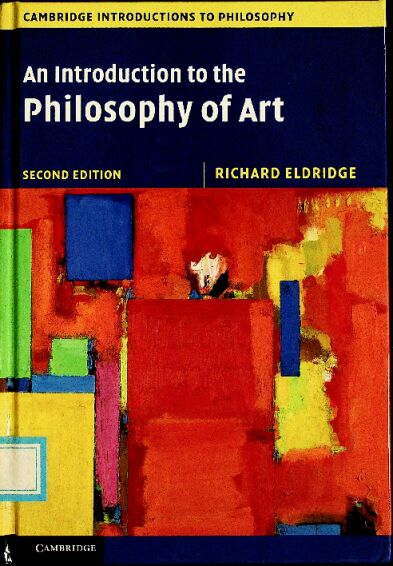
书名:An introduction to the philosophy of art
责任者:Richard Eldridge | Swarthmore College | Pennsylvania.
ISBN\ISSN:9781107041691,9781107614444
出版时间:2014
出版社:Cambridge University Press,
前言
Once again I am grateful to Hilary Gaskin, this time for proposing this revised and expanded edition and for seeing it through production.
The past ten years or so have seen a wide variety of important new work in aesthetics that is of very high quality. While the overall structure and argument of this book are unaltered in this new, expanded edition, I am pleased to have been able now to take substantial notice of the following significant (mostly) recent work: on the theory of pictorial depiction (Robert Hopkins, John Hyman, Dominic Lopes, Michael Newell), on demonstrative attention (John Spackman), on artistic form (Robert Kaufman, Martin Seel), on expression (Stephen Davies, Mitchell Green, Jerrold Levinson, Jenefer Robinson), on Hegel (Annemarie Gethmann-Siefert, Benjamin Rutter), on imagination (Gregory Currie, Kirk Pillow, Richard Moran, Martin Seel), on interpretation (Rita Felski, Alexander Nehamas), on emotion (Gregory Currie, Deborah Knight, Ted Cohen, Jenefer Robinson), on art and morality (Ted Cohen, Berys Gaut, Alexander Nehamas), and on contemporary art (Peter Bürger, Daniel Herwitz, Gregg Horowitz, Dominic Lopes, Sianne Ngai, Peter Osborne). I am also pleased to have been able to incorporate at least brief reference, which may be useful to some readers, to Denis Dutton and Stephen Davies on art and evolution, to Frederick Beiser on Schiller, and to Carolyn Korsmeyer and Aaron Meskin and colleagues on the theory of taste, among others. I have also taken the opportunity of a new edition to improve the clarity and precision of certain wordings where I could.
For roughly the past ten years, I have regularly discussed in detail most of the new work mentioned above with the members of the Philadelphia Area Aesthetics Reading Group: almost always including Noël Carroll, Paul Guyer, Susan Feagin and either Espen Hammer or Kristin Gjesdal, plus at various times Emily Brady, John Carvalho, Liz Camp, Lara Ostaric, Kirk Pillow, Nola Semczyszyn, and Mary Wiseman. The group has been mostly organized and most regularly hosted by Susan Feagin; we are all indebted to her for her efficiency and extraordinary hospitality. I cannot imagine a better setting than this reading group in which to think continuously, productively, and pleasurably about contemporary developments in aesthetics. Its life has been a model for me of collegiality and mutual interest coupled with sharpness of engagement, and this new edition would certainly not be what it is without it.
Finally, I am grateful to my seminar students in the philosophy of art at Swarthmore, this time for having had the patience and goodwill over the last ten years to work with the first edition of this book and to talk with me imaginatively and critically about what art is and how it matters to them.
查看更多
目录
Acknowledgments page viii
Preface to the second edition xi
1 The situation and tasks of the philosophy of art 1
Who needs a theory of art? 1
Philosophy as articulation 4
Art as a natural social practice 5
Action, gesture, and expressive freedom 7
Schiller on art, life, and modernity 12
Identification versus elucidation 17
What may we hope for from the philosophy of art? 21
2 Representation, imitation, and resemblance 25
Representation and aboutness 25
Aristotle on imitation 26
Visual depiction, resemblance, and game-playing 31
Contemporary theories of depiction 38
Representing as natural, human, world-responsive activity 44
Distinctive functions of artistic representation 47
3 Beauty and form 53
Beauty, absorption, and pleasure 53
Kant on natural and artistic beauty 57
General versus individual form 62
Beardsley's theory of individual form 63
Criticisms of formalist-aesthetic theories of art 67
Defenses of the aesthetic interest of art 70
4 Expression 75
Feelings about subject matters in life: Wordsworth, Tolstoy, and Collingwood 75
What is expressed in art? Hegel versus Danto 82
How is artistic expression achieved? 92
Collingwood's psychodynamic theory 93
Physiognomic similarity theories 98
"Working-through" theories 103
Emotions and contemporary psychology 104
Why does artistic expression matter? 109
5 Originality and imagination 115
Genius and the pursuit of the new: Kant 115
Hegel's criticisms of subjectivism 120
Why originality matters: Adorno on free meaning-making 122
Criticisms of the pursuit of originality: postmodernism and feminism 127
Originality and imagination within common life 132
Creativity: Scruton and Coleridge on artistic imagination 135
6 Understanding art 142
Six strategies for understanding art 142
The natures of thought and action: Hegel, Baxandall, and others 145
Pluralism and constraint in interpretation: Abrams, Fish, and Derrida 150
The special importance of the elucidation of formal-semantic elements 156
Nehamas and Felski on what calls for elucidatory interpretation 160
The possibility of agreement in understanding 163
7 Identifying and evaluating art 167
Why we go on arguing about which works are good 167
Subjectivism and the sociology of taste: Smith and Bourdieu 170
Dickie's institutional theory 173
Historical and narrative identifications: Levinson and Carroll 176
Objectivism: Mothersill and Savile 178
Hume on feeling and judgment 182
Kant on feeling and judgment 187
Personal and/versus discussable: Isenberg, Scruton, and Cohen on taste 196
8 Art and emotion 200
Some varieties of emotional response 200
The paradox of fiction 202
Hume on tragedy: denying (1) 204
Making-believe and quasi-emotions: Walton, Levinson, and Feagin 207
Robinson on affective appraisals: denying (3) 213
Danto and Cohen on powers of attentive involvement 214
Aristotle on catharsis 218
Artistic making and the "working through" of emotion 221
9 Art and morality 225
Some controversial cases: Mapplethorpe, Serrano, Finley, and others 225
Autonomism and experimentalism 227
Moralism and the clarification of thought and feeling 234
Clarificationism and responding to complexity 237
Art, propaganda, advertising, and cliché 244
Ethical understanding and working through puzzlement 247
10 Art and society: some contemporary practices of art 253
The reproduction of social life vis-à-vis "infinite satisfaction" 253
Art and modernity: Schiller and others 255
Lukács, Marcuse, and Adorno 261
Structuralism and structural opposition in social life: Lévi Strauss and Althusser 263
Foster's postmodern sociocultural criticism 267
Avant-gardism and contemporary art 268
Can artistic beauty still matter? What about fun? 271
Art and social aspiration 272
Some contemporary practices of art: primitivism, vernacularism, avant-gardism, and constructivism 274
11 Epilogue: the evidence of things not seen 284
Bibliography 289
Index 304
查看PDF
查看更多
馆藏单位
中科院文献情报中心