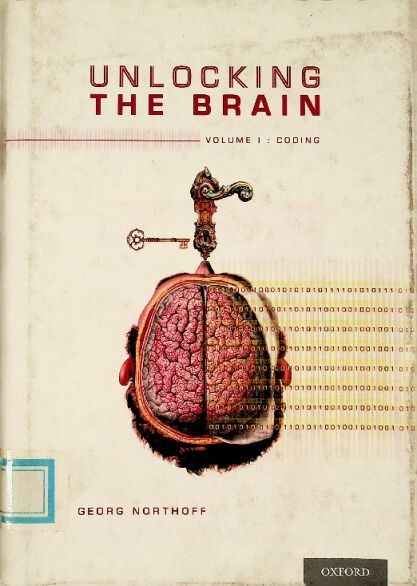
书名:Unlocking the brain. Volume 1, Coding
ISBN\ISSN:9780199826988,0199826986
出版时间:2014
出版社:Oxford University Press,
前言
What is the brain? Though many answers havebeen suggested, we simply do not know at thispoint in time. Let's compare the situation withother organs. We know what the heart is; theheart is an organ that pumps blood. We knowwhat the stomach is; it is a digestive organ thatextracts the relevant nutrients from food. Andone could expand that list to other organs.
Let's compare the current situation in neu-roscience to the following imaginary scenarioabout the heart. Imagine that we do not knowyet that the heart is a pumping organ. All weknow is that the heart is a muscle, that it usesmuch energy to run that muscle, and that plentyof blood is accumulated periodically in the heart.But—and this is essential—we cannot yet ascribeany purpose to all of this; we know plenty ofthe details, but we cannot make sense of them.We do not know, for instance, why the heartis designed as muscle and why it accumulatesblood periodically.
Even more important, this lack of insight intothe heart's purpose may prevent us from havingnot only a better understanding of the heart'soverall purpose and role in the organism, butalso a more detailed insight into its physiologi-cal processes. For instance, we do not investigatethe rhythmic nature of the heart's contractionsand its underlying electrophysiological activity;that makes sense only if we know that the heartis continuously contracting in order to maintainits pumping function. Accordingly, the lack of ananswer to the "what" question may be not onlyphilosophically but also empirically relevant,and thus physiologically relevant, in order to geta better grip on the heart's "how."
I now argue that current neuroscience is inexactly the same state with regard to the brain asjust stated in the thought experiment about theheart. We currently know a lot about the brain'sregions, its networks and their metabolic, hor-monal, and immunological processes, and theirgenetic regulation. In contrast, we do not knowwhy these neuronal processes and various mech-anisms take place in the way they do and thuswhat overall purpose they serve.
Accordingly, we currently have plenty ofknowledge about the "how ' of the brain but stilllack an answer to the "what" of the brain. Wethus remain blind to its main and overarchingpurpose. Once we get a tighter grip of the brain'smain and overarching purpose, the "what," wemay also be able to more specifically tailor ourexperimental designs to better investigate itsvarious functions—the "how."
My starting point in this book is the brainitself: what the brain is, and, even more impor-tant, what the brain does. I postulate that, inorder to understand what the brain does, we needto investigate the features that define the brain asbrain. Ihese intrinsic features include the brain'sneural code and its intrinsic activity, as I suggest.This volume is about the brain's intrinsic featuresand more specifically how the brain's neural codeand its intrinsic activity operate and impact thesubsequent neural processing of extrinsic stimuli Neuros from body and environment. Why do I put suchemphasis on the intrinsic features of the brain,its resting-state activity and neural code, here inVolume I? Only by revealing the brain's intrinsicfeatures will we be able to understand what thebrain is and why and how the brain does whatit does.
What is analogous to the heart's pumping ofblood in the case of the brain? I suppose that theheart's pumping of blood may find its analogueon the brain's side in its ability to associate itsown neural activity with consciousness. That willbe the focus in Volume II. To understand that,though, we first need to understand the brainitself and how it encodes its neural activity. Thisis the focus in this volume. Accordingly, VolumeII complements the neuronal groundwork laidin Volume I by showing how the brain and itsintrinsic features predispose the generation ofconsciousness.
I want to thank several people. First and fore-most, I want to thank Catharine Carlin fromOxford University Press, who supported mevery much in the early stages by giving excellentadvice. Her editorial role was taken over laterby Joan Bossert, who was extremely support-ive of this rather complex project. Many thanksto Joan and her excellent help and advice! Herassistants, Jennifer Milton and Miles Osgaard,provided excellent support and encouragementin the later stages. A big thank-you to all of youfor making possible such a complex project withtwo volumes.
Several anonymous reviewers also need tobe thanked for providing very thoughtful com-ments, with one of them even suggesting I splitmy ideas into two volumes. My institution, theInstitute of Mental Health Research in Ottawa,Canada, and its generous director, Zul Merali,shall also be thanked for the freedom and men-tal space they provide me to tackle such a com-plex organ as the brain in such extensive ways.I also want to explicitly thank Xuchu Weng andhis Center for Cognition and Brain Disordersat Hangzhou Normal University/China for thegenerous support and the many inspirations.A great thank you also goes to Dr Xuehai Wei inShanghai who introduced me to the clinical phe-nomenology of vegetative state patients whichserved as basis for several ongoing collaborative studies on the loss of consciousness. The samegenerosity was also made possible in Bolognaand Dr Marina Farinelli where we conduct EEGstudies on vegetative state patients.
My friend and dear colleague Jaak Pankseppshould also be thanked. I cherish my discus-sions with him, his out-of-the-box thinking and his excellent ideas and understanding.Thank-you, Jaak. The members of my researchgroup also deserve a big thank-you for theirwonderful discussion of my ideas in their oftenwild and immature gestalt; hence, my specialthanks go to Pengmin Qin, David Hayes, NiallDuncan, Takashi Nakao, Christine Wiebking,Zirui Huang, and Chao-Yi. Others who must bethanked are Timothy Lane, Alexander Heinzel,Simone Grimm, Alexander Sartorius, JianfengZang, Shihui Han, and Fan Yan.
For excellent support in some editorial work,my thanks goes to Giles Holland, my researchcoordinator, who took pains to go through theproofs with me and to make suggestions for fur-ther improvement. For financial support, I haveto thank the Canada Institute of Health Research(CIHR) and the Michael Smith Foundation,who granted me two endowed chairs. Further,I have to thank the Hope of Depression ResearchFoundation (HDRF) for financial support.Finally, I need to give a big thank-you to mypartner, John Sarkissian. He has to endure myrather frequent mental (and physical) absencewhen my own brain's intrinsic activity "prefers"to drift away from the outer world and let memuse about the inner world of the brain by asso-ciating its own purely neuronal states with a phe-nomenal state; that is, consciousness.
查看更多
目录
List of Figures vii
Preface xi
Introduction xiii
PART I: ENCODING EXTRINSIC STIMULI 1
1.Sparse Coding and Natural Statistics 3
2.Sparse Coding and Neural Inhibition 25
3.Sparse Coding on a Regional Level 44
PART II: ENCODING INTRINSIC ACTIVITY 69
4.Spatial Structure of Intrinsic Activity 73
5.Temporal Structure of Intrinsic Activity 98
6.Sparse Coding of Intrinsic Activity 119
PART III: ENCODING PREDICTIONS 143
7.Predictive Coding and Difference-Based Coding 145
8.Predictive Coding and Social and Vegetative Statistics 161
9.Predictive Coding and the Brain's Neuronal Statistics 179
PART IV: ENCODING EXTRINSIC ACTIVITY 203
10.Stimulus—Stimulus Interaction and Neural Coding 207
11.Rest—Stimulus Interaction and Difference-Based Coding 230
12.Rest—Stimulus Interaction and GABA-ergic Neural Inhibition 256
查看更多
馆藏单位
中科院文献情报中心