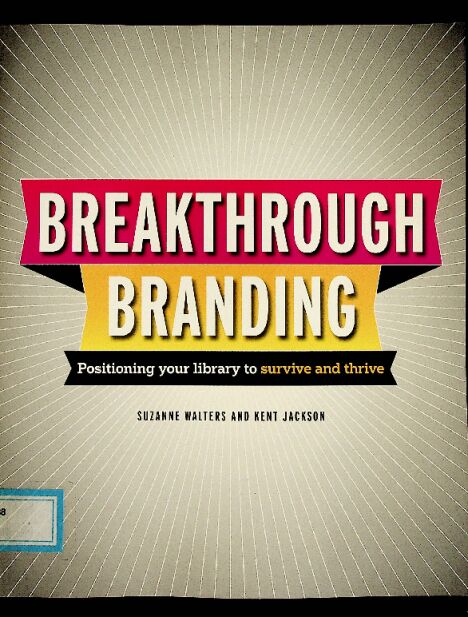
书名:Breakthrough branding
责任者:Suzanne Walters and Kent Jackson. | Jackson, Kent,
ISBN\ISSN:9781555707668,1555707661
出版时间:2013
出版社:Neal-Schuman, an imprint of the American Library Association,
摘要
Breakthrough Branding: Positioning Your Library to Survive and Thrive shows how to mesh your library’s brand deeply and seamlessly within your internal culture, to leverage and better position your brand for the audiences you serve, and develop and implement promotional strategies and tactics consistent with your objectives.
查看更多
目录
List of Illustrations xiii
Preface xv
Acknowledgments xxi
SECTION I: BRANDING
Chapter 1 What Is a Brand? 3
Knowing a Brand Means Experiencing a Brand 4
What Good Brands Have in Common 5
The Concept of Brands and Branding Is Evolving 5
Branding—An Idea Whose Time Has Come 6
Branding Inspires Action 6
It Begins with the Basics 7
The Readily Observable Elements of a Brand 7
The Tangible Elements of a Brand 8
Experiential Elements of a Brand 8
The Origin of Intentional Elements of a Brand 9
Advanced Branding and the World of Libraries 9
The Three Dimensions of Branding 10
Application to Libraries 10
Summary 15
References 15
Chapter 2 Assessing Your Library Brand 17
Start with Your Own Intuition 18
Power of the Brand Story 18 Revisit the Bubble Room 19
Ask Customers, Colleagues, and Community Leaders 20
The Nexus—Forging a Purpose and Focusing Your Library 20
Taking Stock of Your Library Brand 21
Start with Mission and Values—Why You Are Here 22
Consider Your Vision—Where You Are Going 23
Assessing Your Situation with SWOT 23
Internal Strengths and Weaknesses 24
External Opportunities and Threats 26
Team Involvement 26
Using Market Research 27
What Constitutes Market Research? 28
Understanding the Competitive Market 32
Assessing Market Share and Mind Share 33
Assessing Brand Equity 34
Implications for Planning and the Formulation of Strategy 35
Summary 35
References 36
Chapter 3 Developing Your Library Brand 39
Your Brand Is a Living Thing 40
A Path to Follow 40
Who Should Be Involved in the Process? 41
Use of Outside Experts 41
Relating the Branding Process to Planning 42
People, Protocol, and Process 43
A Disciplined Approach 45
Step 1—Brand Assessment 45
Step 2—Brand Discovery 45
Step 3—Brand Creative 46
Step 4—Brand Plan 47
Step 5—Brand Implementation 48
Internalizing Your Brand 49
Brand Management 51
Building Brand Equity 52
Summary 52
References 53
SECTION II: POSITIONING
Chapter 4 Defining a Positioning Strategy Why Is It Important to Your Library? 57
What Is Positioning? What Is a Positioning Strategy? 58
Secrets of Positioning: Identifying Target Markets and the Competition 58
Using Positioning to Differentiate Your Library in the Marketplace 59
Positioning Differentiates Your Products and Services 60
Examples of Positioning within the Commercial Marketplace 61
Your Library Has a Position in the Marketplace 62
Conducting Market Research to Understand Your Position within the Community 63
Market Research Methodology 63
The Integration of Branding and Positioning 64
Brand Loyalty 64
Brands Evoke Feelings and Emotional Attachment 65
Positioning and Branding 65
Is the Branding Process Necessary to Position the Library? 67
Strategic Planning and Strategic Positioning 67
Summary 69
References 69
Chapter 5 Understanding Segmentation Selecting Your Target Markets 71
Using Market Research to Understand Target Markets 72
Getting the Market Research Assistance You Need 73
Using Professional Market Research Teams 74
Using Primacy and Secondary Resources 74
Understanding Qualitative and Quantitative Research 75
Understanding Segmentation Analysis and Targeting Your Audience 78
Cluster Systems: PRIZM and VALS 81
Selecting Your Target Markets 82
Criteria for Evaluating Your Target Market 82
Selecting Your Target Markets (Market Segmentation) 84
Choosing the Approach for Your Library 86
Successful Market Segmentation Research—Columbus Metropolitan Library 86
Summary 90
References 91
Chapter 6 Crafting a Desired Positioning Strategy Achieving a Distinctive Difference 93
Understanding Positioning as It Relates to the Brand 95
Behavior-Focused Positioning 95
Barrier-Focused Positioning 95
Benefit-Focused Positioning 95
Competition-Focused Positioning 96
Focus on Repositioning 96
Determining How to Position Your Brand 97
The Positioning Statement 97
Positioning Drives the Creative Process 97
Crafting a Positioning Statement 98
Value Propositions 99
Value Propositions and Taglines 99
Where to Begin 100
Relationship of the Positioning Statement and the Unique Value Proposition 101
Developing Goals and Objectives for Target Audiences 104
Summary 104
References 106
SECTION III: PROMOTION
Chapter 7 Positioning and Marketing Strategies Introduction to Positioning and the Marketing Mix 109
What Is the Marketing Mix? 110
Marketing Mix, Branding, and Positioning 111
Selecting the Right Marketing Mix for Your Library 111
Product/Service-The First "P" 111
The Core Product 112
The Actual Product 113
The Augmented Product 113
The Potential Product 113
The Product Life Cycle 114
Place Strategies 115
Distribution Channels as Place Strategies 117
Objectives for Place Strategies 118
Price Strategies 119
Pricing Strategies and Value 119
How Organizations Decide on Pricing Strategies 120
Libraries and the Common Positioning Premise—"Free" for All 121
Enhancing the Brand through Pricing 122
Monetary and Nonmonetary Costs 123
Competitive Behavior and Pricing 123
Pricing Strategies Built on the Brand and Positioning Statement 124
Pricing Strategy Based on Product or Service 124
People Strategies—The Fifth "P" for Consideration 125
The Customer Life Cycle 126
Summary 127
References 129
Chapter 8 Promoting Your Brand 131
Concept of Promotion 131
Brand Architecture and Promotion 132
Developing Your Brand Architecture 133
Applications to New and Existing Brands 134
Revisiting Brand Architecture to Bring Clarity and Focus to the Brand 135
Investing in Brand Identity 135
Brand Architecture in Summary 143
Developing Your Promotional Plan 144
Developing a Creative Brief 145
Messages and Messengers 145
Creative Strategy 146
Selecting Communication Channels 146
Varieties of Communication Channels and Media Vehicles 146
The Website 150
Facilities and Physical Environments as Communication Tools 150
Public Relations 151
Public Relations Tools 151
Public Relations and Libraries 153
Nontraditional and New Media Channels 154
Social Media 154
Evaluation—You Get What You Measure 155
Building Brand Champions 157
Using Internal and External Design Teams 158
Developing Brand Standards and Guidebooks 158
Managing Consistency and Integrity of the Brand 158
Summary 159
References 161
Chapter 9 Advocating for Libraries 163
OCLC Study From Awareness to Funding 165
Columbus Metropolitan Library 166
Queens Library: Positioning through Advocacy 168
Anythink Libraries and Advocacy 169
Wyoming State Library: Forging Strong Community Grassroots Advocacy Programs 169
Turning Adversity into Advantage 170
Using Adversity to Reposition Your Library 171
The Rebirth of the Grand County Library District 172
Positioning the Library within the Brand of a University 174
A Final Word about Leadership 175
Summary 179
References 180
About the Authors 183
Index 185
查看PDF
查看更多
作者简介
Suzanne Walters was the director of marketing and development for the Den-ver Public Library during the successful bond election and capital campaign to build the new central library building as well as to remodel and build branches through-out the city of Denver. She previously served as the director of marketing for the Regional Transportation District of Denver, responsible for the implementation of the 16th Street Mall. Suzanne also developed nationwide programs of aluminum recycling for Adolph Coors Golden Recycling Corporation and was a statewide coor-dinator of volunteers and events for the PBS station KRMA. Currently, she is the president of Walters & Associates Consultants and conducts marketing workshops and seminars for libraries both nationally and internationally. She also serves on the graduate faculty of Regis University, facilitating courses in social marketing. Her BA in biology comes from Wichita State University, while her MBA comes from the Daniels College of Business at the University of Denver. PA\Kent Jackson, PhD, CPCU, owner of Jackson Research, Strategy, Solution, LLC, provides consulting services for a variety of for-profit and nonprofit enterprises, induding education, professional associations, medical and human service provid-ers, homebuilders and developers, insurers, and professional service firms. In asso-ciation with other qualified firms and individuals specializing in graphic and web design, copywriting, advertising, public relations, and market research, Jackson has developed refined methodologies and services that enable clients to better research, strategically position, and sell through their distinctive value advantage. Jackson's more than forty-year career uniquely qualifies him to address custom market research, branding strategy, and solution challenges for business-to-business and business-to-consumer enterprises and initiatives. For nearly a decade, he was a principal and director of research for a graphic design and branding company. He currently serves on Regis University's graduate faculty, teaching social marketing and organizational leadership, and as a resource consultant to DiscoveryOnstage, a Los Angeles—based theatrical education and performance company. Jackson earned bachelor's and master's degrees from the University of Northern Colorado and a PhD from Oregon State University. He is recognized for his work on behalf of busi-ness and community organizations and is a frequent speaker and author/coauthor of articles in his areas of expertise.
查看更多
馆藏单位
中科院文献情报中心