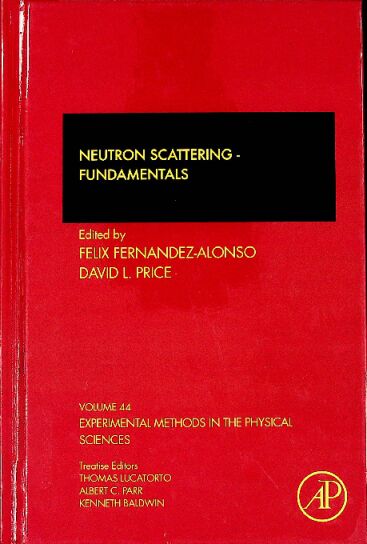
书名:Neutron scattering
责任者:Felix Frenandez-Alonso | David L. Price.
ISBN\ISSN:9780123983749,0123983746
出版时间:2013
出版社:Academic Press,
前言
Just over 80 years ago,a brief letter from James Chadwick to Naure[1,2] presented conclusive experimental evidence unveiling the existence of a neutral particle(nearly)isobaric with the proton. The discovery of the henceforth- to-be-known-as"neutron"had profound consequences for both scientific research and the destiny of humankind,as it led to the unleashing of the might of nuclear power in less than a decade [3].
The first use of these"neutral protons"to probe the microscopic underpinnings of the materials world around us also dates back to those early years, with pioneering neutron-diffraction experiments at Oak Ridge National Laboratory (USA)in the mid 1940s, and the subsequent development of neutron spectroscopy at Chalk River(Canada)in the 1950s. Since then, neutron- scattering techniques have matured into a robust and increasingly versatile toolkit for physicists, chemists, biologists, materials scientists, engineers, or technologists. At the turn of the last century,the 1994 Nobel Prize in Physics awarded to C.G. Shull and B.N. Brockhouse recognized their ground-breaking efforts toward the development and consolidation of neutron science as a discipline in its own right [4]. This milestone also served to define neutron scattering as the technique par excellence to investigate where atoms are(structure)and what atoms do(dynamics), a popular motto across generations of neutron-scattering practitioners.
Sustained and continued developments in experimental methods over the past few decades have greatly increased the sensitivity and range of applica- tions of neutron scattering. While early measurements probed distances on the order of interatomic spacings(fractions of a nm)and characteristic times associated with lattice vibrations (ps), contemporary neutron-scattering experiments can cover length scales from less than 0.01 to 1000s of nan- ometers, and timescales from the attosecond to the microsecond. These advances have been made possible via a significant expansion of the range of neutron energies available to the experimenter, from microelectron-volts(particularly at cold sources in research reactors) to hundreds of electron-volts(at pulsed spallation sources), as well as by unabated progress in the imple- mentation of a variety of novel and ingenious ideas such as position- and polarization-sensitive detection or backscattering and spin-labeling methods. As a result, neutron science has grown beyond traditional research areas,from the conventional determination of crystal structures and lattice dynamics of half-a-century ago(not to forget their magnetic analogs), to high-resolution structural studies of disordered thin films, liquid interfaces, biological structures, macromolecular and supramolecular architectures and devices,or the unraveling of the dynamics and energy-level structure of complex molec- ular solids, nanostructured materials and surfaces,or magnetic clusters and novel superconductors. Along with these scientific and technical develop- ments, the community of neutron scientists has also expanded and diversified beyond recognition. Whereas the early stages of neutron scattering had its roots in condensed-matter physics and crystallography, present-day users of central neutron-scattering facilities include chemists, biologists, ceramicists, and metallurgists, to name a few,as well as physicists with an increasingly diverse range of transdisciplinary interests, from the foundations of quantum mechanics to soft matter,food science,biology,geology, or archeometry. The present and subsequent volumes in this series seek to cover in some detail the production and use of neutrons across the aforementioned disci- plines, with a particular emphasis on technical and scientific developments over the past two decades. As such, it necessarily builds upon an earlier and very successful three-volume set edited by K. Sköld and D.L. Price, published in the 1980s by Academic Press as part of Methods of Experimental Physics(currently Experimental Methods in the Physical Sciences).Furthermore, with the third-generation spallation sources recently constructed in the United States and Japan,or in the advanced construction or planning stage in China and Europe,there has been an increasing interest in time-of-flight and broad- band neutron-scattering techniques. Correspondingly,the improved perfor- mance of cold moderators at both reactors and spallation sources has extended long-wavelength capabilities to such an extent that a sharp distinc- tion between fission- and accelerator-driven neutron sources may no longer be of relevance to the future of the discipline.
On a more practical front,the chapters that follow are meant to enable you to identify aspects of your work in which neutron-scattering techniques might contribute, conceive the important experiments to be done, assess what is required to carry them out, write a successful proposal to a user facility, and perform these experiments under the guidance and support of the appropriate facility-based scientist. The presentation is aimed at professionals at all levels, from early-career researchers to mature scientists who may be insufficiently aware or up to date with the breadth of opportunities provided by neutron techniques in their area of specialty.In this spirit,it does not aim to present a systematic and detailed development of the underlying theory, which may be found in superbly written texts such as those of Lovesey[5] or Squires [6]. Likewise,it is not a detailed hands-on manual of experimental methods, which in our opinion is best obtained directly from experienced practitioners or,alternatively, by attending practical training courses at the neutron facilities. As an intermediate(and highly advisable) step, we also note the existence of neutron-focused thematic schools,particularlythose at Grenoble[7] and Oxford[8], both of which have been running on a regular basis since the 1990s. With these primary objectives in mind, each chapter focuses on well-defined areas.
查看更多
目录
Contributors xi
Volumes in Series xiii
Preface Xvii
Symbols XXi
1. An Introduction to Neutron Scattering DavidL.Price and Felix Fernandez-Alonso 1
1.1 Fundamentals 2
1.1.1 Why Are Neutrons so Unique 2
1.1.2 Thermal Neutrons for Condensed Matter Research 5
1.1.3 Conservation Laws 11
1.1.4 The Structure of Materials 11
1.1.5 Adding Motion: Dynamics and Spectroscopy 16
1.2 Scattering Foundations 22
1.2.1 The Master Formula and Fermi's Golden Rule 22
1.2.2 Nuclear Scattering 25
1.2.3 The Double Differential Cross Section in the Time Domain 26
1.2.4 Farewell to Nuclear Physics 27
1.2.5 Coherent and Incoherent Scattering 28
1.2.6 Scattering Functions 30
1.3 Canonical Solids 1
1.3.1 Normal Modes of Vibration 31
1.3.2 Scattering Under the Harmonic Approximation 32
1.3.3 Purely Elastic Events 33
1.3.4 Inelastic (One-Phonon) Scattering 35
1.3.5 Multiphonon Scattering 39
1.3.6 Beyond Harmonic Vibrations 41
1.4 Beyond Canonical Solids 42
1.4.1 Space-Time(Van Hove) Correlation Functions 42
1.4.2 Pair Distribution Functions 43
1.4.3 Properties of the Dynamic Structure Factor 47
1.4.4 From Order to Disorder: Diffuse Scattering 58
1.4.5 Stochastic Diffusion 61
1.4.6 Beyond Atoms and Molecules: Large-Scale Structures 75
1.5 Magnetic Structure and Polarized Neutrons 82
1.5.1 Basic Principles 82
1.5.2 Polarized Neutrons 88
1.5.3 Magnetic Bragg Scattering 95
1.5.4 Diffuse Scattering from Magnetic Disorder 97
1.5.5 Large-Scale Magnetic Structures 101
1.6 Spin Dynamics 106
1.6.1 Generalized Susceptibility 106
1.6.2 Spin Waves 18
1.6.3 Crystal Fields and Magnetic Clusters 111
1.6.4 Spin Fluctuations 114
1.6.5 Interband Transitions 115
1.6.6 Critical Scattering 117
1.7 Nuclear Spin: Order and Disorder 120
1.7.1 A Closer Look at Nuclear Spins 121
1.7.2 Scattering Cross Sections 121
1.7.3 Uncorrelated and Correlated Spin Ensembles 123
1.8 Outlook 125
References 127
2. Neutron Sources 137
Francisco J.Bermejo and Fernando Sordo
2.1 Scope 18
2.2 Useful Neutron Production Reactions 140
2.2.1 Fission 141
2.2.2 Direct and Stripping Reactions 142
2.2.3 Bremsstrahlung 144
2.2.4 Spallation Reactions 146
2.3 Neutron Slowing Down and Moderators 153
2.3.1 Moderators 158
2.4 Basic Building Blocks of Accelerators to Drive Neutron Sources 166
2.4.1 Beam Injectors 167
2.4.2 Targets 178
2.5 Accelerator-Driven Sources: Some Predecessors 197
2.6 State-of-the-Art Accelerator Drivers for Neutron Sources 199
2.6.1 Last-Generation Megawatt-Range Sources 199
2.6.2 Medium-Power (100 kW) Sources 205
2.6.3 Compact, Accelerator-Driven Sources 209
2.7 Research Reactors 212
2.7.1 Core Designs 213
2.7.2 Reactor Vessel 217
2.8 Future Prospects 219
2.8.1 Accelerators 219
2.8.2 Hybrid Systems 225
2.8.3 Reactors 226
2.9 Nonneutron-Scattering Uses of Neutron Sources 227
2.9.1 Isotope Production, In-Vessel Irradiation, Y-Radiation,and Neutron Activation Analysis 228
2.9.2 Nuclear Physics and Engineering: Astroparticle Physics, Nuclear Structure and Reactions, and Transmutation of Nuclear Waste 228
2.9.3 Hadron Physics: Neutrino-Related Phenomena 229
2.9.4 Fundamental Physics: Foundations of Quantum Mechanics, Effects of Gravity on Isolated Particles, Search for Dark Matter Using Ultracold Neutrons, Tests, and Validations of the Standard Model of Particle Physics 230
2.9.5 Use of Muon Beams for Condensed Matter and Fusion Research 231
Acknowledgments 231
Appendix A Some Basic Relationships 232
Appendix B The Transport Equation for Neutrons 234
References 237
3. Experimental Techniques 245
Masatoshi Arai
3.1 Introduction 246
3.2 Scattering Measurements 247
3.2.1 Cross Section 247
3.2.2 Integrated Intensity and the Lorentz Factor 249
3.3 Useful Neutrons for Condensed Matter Science 254
3.3.1 Neutron Flux from Moderators 254
3.3.2 Pulse Peak Structure 255
3.3.3 Pulse Peak Width 257
3.3.4 Choice of Parameters in Spallation Sources 257
3.3.5 High-Energy Neutron Background 259
3.4 Diffraction Techniques 261
3.4.1 Powder Diffraction 262
3.4.2 Single-Crystal Diffractometers 271
3.5 Inelastic Scattering Techniques 275
3.5.1 Triple-Axis Spectrometer 275
3.5.2 Chopper Instruments 277
3.5.3 Inverted-Geometry Instrument 288
3.6 Instruments for Semi-Macroscopic Structures 293
3.6.1 Small-Angle Neutron Scattering Instruments 293
3.6.2 Neutron Spin-Echo Spectrometers 296
3.7 Neutron Detectors 300
3.7.1 3He-Gas Detectors 301
3.7.2 Scintillation Detectors 301
3.8 Beam Transport and Tailoring 305
3.8.1 Neutron Optics 305
3.8.2 Choppers 313
References 318
4. Structure of Complex Materials 321
Silvia C. Capelli
4.1 Introduction 321
4.2 Useful Properties of Neutrons 324
4.2.1 Neutron Scattering Length 324
4.2.2 A Particle with a Mass 324
4.3 What can be Learnt from Neutron Diffraction Experiments? 326
4.3.1 Hydrogen Bonding 326
4.3.2 Proton Migration 329
4.3.3 Transition Metal Hydrides 332
4.3.4 Porous Materials 333
4.3.5 Diffuse Scattering 335
4.4 Outlook 339
4.4.1 Neutron Sources 339
4.4.2 Neutron Optics 340
4.4.3 Detectors 341
4.4.4 Samples and Sample Environment 342
4.4.5 Software 347
4.5 Conclusions 348
References 349
5.Large-Scale Structures 353
Jeffrey Penfold and lan M.Tucker
5.1 Introduction 353
5.2 Experimental Details 356
5.2.1 Fundamentals of Neutron Reflectivity 356
5.2.2 Fundamentals of Small-Angle Neutron Scattering 358
5.2.3 Experimental Details for Neutron Reflection 361
5.2.4 Experimental Details for SANS 363
5.3 Thin Films,Interfaces, and Solutions 365
5.3.1 Adsorption at the Air-Solution Interface 365
5.3.2 Adsorption at the Liquid-Solid Interface 374
5.3.3 Structure of Biological Membranes 378
5.3.4 Micelles 382
5.3.5 Lamellar Phases and Vesicles 385
5.3.6 Colloidal Particles 392
5.3.7 Polymers in Solution, Melt, and Thin Films 394
5.3.8 Proteins and Biomacromolecules in Solution and at Interfaces 404
5.4 Summary and Future Prospects 409
References 409
6. Dynamics of Atoms and Molecules 415
Mark R.Johnson and CordonJ.Kearley
6.1 Introduction 416
6.2 Brief Review of Theoretical Concepts 418
6.3 Modeling 419
6.3.1 Mapping Potential Energy Surfaces 419
6.3.2 Molecular Dynamics Simulation 420
6.3.3 Empirical and Ab Initio Energy Calculation 420
6.4 Instrumentation 422
6.4.1 Three-Axis Spectrometers 422
6.4.2 Time of Flight 422
6.4.3 Neutron Compton Scattering Spectrometers 423
6.4.4 Molecular Spectrometers 424
6.4.5 Backscattering Spectrometers 425
6.4.6 Neutron Spin-echo Instruments 426
6.4.7 The Measured Neutron-Scattering Signal 427
6.5 Oscillatory Motion, Incoherent Scattering 427
6.5.1 Molecular Vibrations of Benzene 429
6.5.2 Hydrogen-Bonded Systems 430
6.5.3 Complex Hydrides 431
6.5.4 Polymers 433
6.6 Oscillatory Motion, Coherent Scattering 434
6.6.1 Classic Phonons and Soft Modes in SrTiO3 435
6.6.2 Negative Thermal Expansion 435
6.6.3 Nanostructured Materials 438
6.6.4 Oxygen-lon Conductors—Brownmillerites 439
6.6.5 Thermoelectrics—Skutterudites 441
6.6.6 Pnictides 442
6.6.7 Strontium Gallium Oxides 443
6.6.8 Deoxyribonucleic acid 445
6.7 Tunneling 446
6.7.1 Rotational Tunneling 446
6.7.2 Translational Tunneling 453
6.8 Stochastic Relaxation/Dynamics 453
6.8.1 Complex Diffusion 455
6.8.2 Ligand Water Rotation 456
6.8.3 Coherent QENS, Rotation 456
6.8.4 Dynamical Transitions from Elastic Scans 457
6.8.5 Diffusion of Coherent Scatterer CO2 459
6.8.6 Water and Complex Diffusion 460
6.8.7 lonic Liquids 463
6.9 Conclusion and Perspectives 464
References 466
Appendix: Neutron Scattering Lengths and Cross Sections 471
Javier Dawidowski,José R. Granada, Javier R. Santisteban, Florencia Cantargi, and Luis A. Rodriguez Palomino
A.1 Introduction 471
A.2 Theoretical Background 472
A.2.1 Scattering Length 472
A.2.2 Spin-Dependent Scattering Lengths 476
A.2.3 Neutron-Atom Interactions 477
A.3 Methods of Measurement of Scattering Lengths 482
A.3.1 Transmission 482
A.3.2 Bragg Diffraction 484
A.3.3 Dynamical Diffraction 486
A.3.4Prism Refraction 488
A.3.5 Christiansen Filter 489
A.3.6 Neutron Gravity Refractometer 490
A.3.7 Neutron Interferometry 491
A.3.8 Small-Angle Scattering 492
A.3.9 Total Reflection 493
A.3.10 Pseudo magnetic Method 493
A.3.11 High-Energy Experiments 494
A. 4 Tables of Neutron Scattering Lengths and Cross Sections 495
References 527
Index 529
查看PDF
查看更多
馆藏单位
中科院文献情报中心