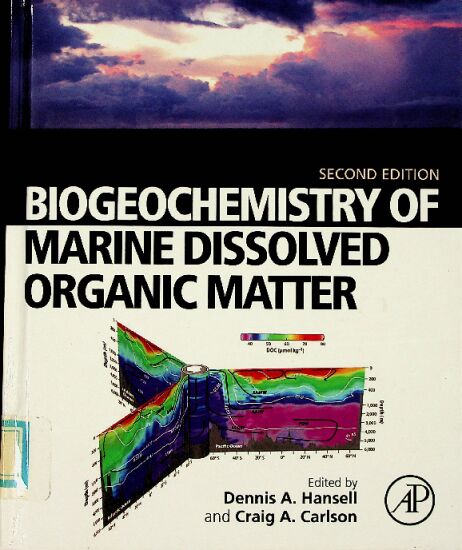
书名:Biogeochemistry of marine dissolved organic matter
责任者:Dennis A. Hansell | Rosenstiel School of Marine and Atmospheric Science University of Miami Miami | Florida and Craig A. Carlson | Deparment of Ecology Evolution And Marine Biology University of California Santa Barbara | California.
ISBN\ISSN:9780124059405,0124059406
出版时间:2015
出版社:Elsevier, AP, Academic Press is an imprint of Elsevier,
分类号:天文学、地球科学
版次:second edition.
摘要
Marine dissolved organic matter (DOM) is a complex mixture of molecules found throughout the world's oceans. It plays a key role in the export, distribution, and sequestration of carbon in the oceanic water column, posited to be a source of atmospheric climate regulation. Biogeochemistry of Marine Dissolved Organic Matter, Second Edition, focuses on the chemical constituents of DOM and its biogeochemical, biological, and ecological significance in the global ocean, and provides a single, unique source for the references, information, and informed judgments of the community of marine biogeochemists. Presented by some of the world's leading scientists, this revised edition reports on the major advances in this area and includes new chapters covering the role of DOM in ancient ocean carbon cycles, the long term stability of marine DOM, the biophysical dynamics of DOM, fluvial DOM qualities and fate, and the Mediterranean Sea. Biogeochemistry of Marine Dissolved Organic Matter, Second Edition, is an extremely useful resource that helps people interested in the largest pool of active carbon on the planet (DOC) get a firm grounding on the general paradigms and many of the relevant references on this topic.
查看更多
目录
List of Contributors xi
Foreword xiii
Preface xvii
1.Why Dissolved Organics Matter:DOC in Ancient Oceans and Past Climate Change
I Overview I
II Marine Carbon Cycling 2
IlI Interpreting the Geological Past 8
IV Implications for Future Global Change?16
Acknowledgments 17
References 18
2.Chemical Characterization and Cycling of Dissolved Organic Matter
I Introduction 22
II Isolation of DOM from Seawater 23
IlI Chemical Characterization of DOM 26
IV Links Between DOM Composition and Cycling 47
V Future Research 55
Acknowledgments 58
References 58
3.DOM Sources,Sinks,Reactivity and Budgets
I Introduction 66
Il DOM Production Processes 68
Ill DOM Removal Processes 82
IV DOM Accumulation 90
V DOM Reactivity 97
VI The Priming Effect 103
VII Microbial Community Structure and DOM Utilization 104
VIlI DOC in the Ocean Carbon Budget 105
IX Summary 108
Acknowledgments 109
References 109
4.Dynamics of Dissolved Organic Nitrogen
I Introduction 128
Il DON Concentrations in Aquatic Environments 128
IlI Composition of the DON Pool 143
IV Sources of DON to the Water Column 162
V Sinks for DON 183
VI Summary 211
Acknowledgments 212
References 213
5.Dynamics of Dissolved Organic Phosphorus
I Introduction 234
II Terms,Definitions,and Concentration Units 238
Ill The Early Years of Pelagic Marine P-Cycle Research (1884-1955)241
IV The Pelagic Marine P.Cycle:Key Pools and Processes 244
V Sampling.Incubation,Storage,and Analytical Considerations 247
VI DOP in the Sea:Variations in Space 258
VII DOP in the Sea:Variations in Time 271
VIll DOP Pool Characterization 280
IX DOP Production,Utilization,and Remineralization 304
X Conclusions and Prospectus 317
Acknowledgments 318
References 318
6.The Carbon Isotopic Composition of Marine DOC
I Introduction 335
ll Carbon Isotope Geochemistry Primer 336
IlI DOC Isotope Ratio Methods 341
IV Isotopic Composition of Bulk Marine DOC 345
V Isotopic Composition of DOM Constituents 357
VI Summary and Conclusions 363
Acknowledgments 364
References 364
7.Reasons Behind the Long-Term Stability of Dissolved Organic Matter
I Introduction:The Paradox of DOM Persistence 369
lI The Environment Hypothesis 372
Ill The Intrinsic Stability Hypothesis 376
IV The Molecular Diversity Hypothesis 381
V Concluding Remarks 385
Acknowledgments 385
References 385
8.Marine Photochemistry of Organic Matter: Processes and Impacts
I Introduction 390
II Impact of Photochemistry on Elemental Cycles 391
Ill DOM Photolability Spectrum and Fate of Terrestrial DOM in the Sea 417
IV Impact of Photochemistry on Other Marine Processes 422
V Modeling Photochemical Rates and Impact on Marine Carbon Cycling 428
VI Future Directions 430
Acknowledgments 433
References 433
9.Marine Microgels
I Introduction 451
II What Are Polymer Gels?454
Ill Structure,Properties,and Dynamics of Marine Polymer Gels 454
IV Phase Transition 464
V Marine Gels in the Atmosphere and Their Relevance for Cloud Formation 467
Acknowledgments 471
References 472
10.The Optical Properties of DOM in the Ocean
I Introduction 481
II UV-Visible Spectroscopy of DOM 483
Ill Sources of CDOM to the Marine Environment 492
IV Removal of CDOM in the Marine Environment 498
V Distribution 501
VI Conclusions and Future Research Needs 502
Acknowledgments 502
References 503
11.Riverine DOM
I Introduction 509
IⅡLand Transport51l
IlI Riverine DOM Composition 517
IV Anthropogenic Influences 522
Acknowledgments 525
References 525
12.Sediment Pore Waters
I Preface 536
II Introduction 536
IlI Composition and Dynamics of Bulk Pore Water DOM 542
IV Composition and Dynamics of DOM at the Compound and Compound-Class Levels 550
V Modeling DOC Cycling in Marine Sediments 555
VI Controls on DOC Concentrations in Sediments 559
VII The Role of Benthic DOM Fluxes in the Ocean Carbon and Nitrogen Cycles 565
VIlI Concluding Thoughts 569
Acknowledgments 569
References 569
13.DOC in the Mediterranean Sea
I Introduction 579
II DOC Distribution at Basin Scale 583
IlI The Role of DOC in Carbon Export 595
IV DOC Inventory and Fluxes 596
V DOM Stoichiometry 601
VI DOC Dynamics in the Med Sea,a Comparison with the Oceans 602
VII Summary 604
VIII Open Questions 604
Acknowledgments 605
References 605
14.DOM in the Arctic Ocean
I Introduction 609
II Composition of DOC Within the Arctic Ocean 620
III Distribution and Mass Balance of DOM 625
Acknowledgments 630
References 630
15.Modeling DOM Biogeochemistry
I Introduction 635
II Modeling Approaches 637
IlI Modeling the Role of DOM in Ocean Biogeochemistry 648
IV Lability in Focus:Concepts and Definitions 653
V Discussion 656
Acknowledgments 661
References 661
Index 669
查看更多
作者简介
Carlson grew up in New England and received his Bachelor’s degree from Colby College (Waterville, ME) in 1986 and his Ph.D. from University of Maryland’s Horn Point Laboratory in Cambridge MD in 1994. His graduate research focused on microbial ecology and how microbes process dissolved organic matter in open ocean systems. Much of his graduate work was conducted in the Sargasso Sea in conjunction with the Bermuda Atlantic Time-series Study (BATS) site. He moved to the Bermuda Institute for Ocean Science (BIOS) in 1994 for his post doctoral work where he focused on the focused on the biogeochemistry of dissolved organic matter in the oceanic systems of the Southern Ocean and the North Atlantic Subtropical Gyre. In 1996 he joined the faculty of BIOS where he initiated programs in microbial oceanography. In 2001 Carlson accepted a faculty position at the University of California, Santa Barbara where he is now a full professor.
查看更多
馆藏单位
中科院文献情报中心