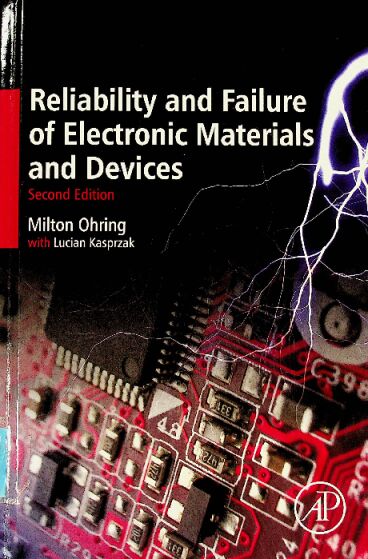
书名:Reliability and failure of electronic materials and devices
责任者:Milton Ohring with Lucian Kasprzak. | Kasprzak, Lucian.
ISBN\ISSN:9780120885749,0120885743
出版时间:2015
出版社:Academic Press,
分类号:无线电电子学、电信技术
版次:2nd ed.
摘要
Reliability and Failure of Electronic Materials and Devices is a well-established and well-regarded reference work offering unique, single-source coverage of most major topics related to the performance and failure of materials used in electronic devices and electronics packaging. With a focus on statistically predicting failure and product yields, this book can help the design engineer, manufacturing engineer, and quality control engineer all better understand the common mechanisms that lead to electronics materials failures, including dielectric breakdown, hot-electron effects, and radiation damage. This new edition adds cutting-edge knowledge gained both in research labs and on the manufacturing floor, with new sections on plastics and other new packaging materials, new testing procedures, and new coverage of MEMS devices.
Key Features
Covers all major types of electronics materials degradation and their causes, including dielectric breakdown, hot-electron effects, electrostatic discharge, corrosion, and failure of contacts and solder joints
New updated sections on "failure physics," on mass transport-induced failure in copper and low-k dielectrics, and on reliability of lead-free/reduced-lead solder connections
New chapter on testing procedures, sample handling and sample selection, and experimental design
Coverage of new packaging materials, including plastics and composites
查看更多
前言
PREFACE TO THE SECOND EDITION
The first edition is a classic in form, content, and execution. The form of each chapter takes the reader on a trip through a basic phenomena and its application to failure in electronics (from simple physics to the complicated math often involved). The content of the book covers all the relevant disciplines necessary to do a thorough job of discovery of the true cause of failure. The execution includes relevant examples from the macroscopic to the microscopic to the atomic, where necessary. The book is truly a masterpiece—due in large part to Milt's knowledge and experience in physics, chemistry, electronics, materials, and most of all his unique ability to frame difficult problems in the appropriate mathematics.
As such then, only changes were made where necessary, to keep the book current and useful to the reader (a researcher struggling to determine the true cause of failure so that it can be remedied and never happen again). By the way that is what has made this industry so successful—failure analysis to true root cause.
L. Kasprzak
PREFACE TO THE FIRST EDITION
Reliablity is an important attribute of all engineering endeavors that conjures up notions of dependability, trustworthiness, and confidence. It spells out a prescription for competitiveness in manufacturing, because the lack of reliability means service failures that often result in inconvenience, personal injury, and financial loss. More pointedly, our survival in a high-tech future increasingly hinges on products based on microelectronics and optoelectronics where reliability and related manufacturing concerns of defects, quality, and yield are of critical interest. Despite their unquestioned importance, these subjects are largely ignored in engineering curricula. Industry compensates for this educational neglect through on-the-job training. In the process, scientists and engineers of all backgrounds are recast into reliability “specialists”with many different attitudes toward reliability problems, and varied skills in solving them. The reliability practitioner must additionally be a detective, a statistician, and a judge capable of dis-tinguishing between often-conflicting data and strongly held opinions. This book attempts to systematically weave together those strands that compose the fabric of the training and practice of reliability engineers.
The multifaceted issues surrounding the reliability and failure of elec-tronic materials and devices lie at the confluence of a large number of disciplinary streams that include materials science, physics, electrical engi-neering, chemistry, and mechanical engineering, as well as probablity and statistics. I have tried to integrate the derivative subject matter of these disciplines in a coherent order and in the right proportions to usefully serve the following audiences:
advanced undergraduate and first year graduate engineering and science students who are being introduced to the field,
reliability professionals and technicians who may find it a useful refer-ence and guide to the literature on the subject, and
technical personnel undergoing a career change.
While the emphasis of the book is on silicon microelectronics tech-nology, reliability issues in compound semiconductor and electro-optical devices, optical fibers, and associated components are also addressed. The book starts with an introductory chapter that briefly defines the subject of semiconductor reliability, its concerns, and historical evolution. Chapter 2 introduces electronic materials and devices, the way they are processed, how they are expected to be have, and the way they sometimes malfunc-tion. The important subjects of intrinsic and manufacturing defects, contamination, and product yield are the focus of Chapter 3.
Without Chapter 4 on the mathematics of reliability it is doubtful that the book title could include the word reliablity. Historically, reliability has been inextricably intertwined with statitics and probability theory. Even today a large segment of there liabity literature bears a strong hereditary relationship to these mathematcal and philosophical antecedents. Never-the less, “The failure of devices occurs due to natural laws of change, not to the finger of fate landing at random on one of group of devices and commanding fail" (R. G. Stewart, IEEE Transactions on Reliablity, R-15, No. 3, 95 (1966)). In a less charitable vein, R. A. Evans has pointed out that probability and statistical inference help us "quantify our ignorance" of failure mechanisms. Uncovering truth should be the objective instead. That is why the primary focus of the book and most of its contents deal with the physics of failure as refracted through the lenses of physical and materials science. With this understanding, our treatment of reliablity mathematics is largely limited to the elementary statitical handling of failure data and the simple implications that flow from such analyses. Nevertheless, reliability mathematics permeates the book since failure data are normally presented in these terms.
The midsection of the book spanning Chapters 5 through 10 is devoted to a treatment of the specific ways materials and devices degrade and fail both on the chip and packaging levels. Failure mechanisms discussed and modeled include those due to mass and electron transport, environmental and corrosion degradation, mechanical stress, and optical as well as nuclear radiation damage. Most failures occurring within interconnections, die-lectrics and insulation, contacts, semiconductor junctions, solders, and packaging materials can be sorted into one of these categories. Grouping according to operative failure mechanism, rather than specific device, material, or circuit element, underscores the fundamental generic approach taken.
Important practical concerns regarding characterizing electronic mate-rials and devices in the laboratory, in order to expose defects and elucidate failure mechanisms, is the subject of Chapter 11. Finally, the last chapter speculates about the future through a dicussion of device-shrinkage trends and limits and their reliability implications.
Due to continual and rapid advances in semiconductor technology, the shelf life of any particular product is very short, thus raising the question of how to convey information that maybe quickly outdated. Because con-cepts are more powerful than facts, I have tried to stress fundamentals and a physical approach that may have applicability to new generations of devices. Within this approach the dilemma arose whether to emphasize breadth or depth of subject matter. Breadth is a sensible direction for an audience having varied academic backgrounds desirous of a comprehensive but qualitative treatment; on the other hand, depth isnecessary to enable practitioners to confront specific challenges within the evolving electronics industries. As a compromise I have attempted to present a balanced treat-ment incorporating both attributes and sincerely hope neither audience will be disappointed by the outcome. Nevertheless, space limitations often preclude development of a given subject from its most elementary foundations.
I assume readers of this book are familiar with introductory aspects of electronic materials and possess a cultural knowledge of such subjects as modern physics, thermodynamics, mass transport, solid mechanics, and statistics. If not, the tutorial treatment of subject matter hopefully will ease your understanding of these subjects. Questions and problems have been included at the end of each chapter in an attempt to create a true textbook.
If this book contributes to popularizing this neglected subiect and faclitates the assimilation of willing as well as unconvinced converts into the field of reliability, it will have succeeded in its purpose.
M. Ohring
查看更多
目录
Preface to the Second Edition xvii
Preface to the First Edition xix
Acknowledgments xxiii
1 An Overview of Electronic Devices and Their Reliability 1
1.1 Electronic Products 1
1.1.1 Historical Perspective 1
1.1.2 Solid-State Devices 4
1.1.3 Integrated Circuits 5
1.1.4 Yield of Electronic Products 11
1.2 Reliability, Other "…Ilities," and Definitions 15
1.2.1 Reliability 15
1.2.2 A Brief History of Reliability 16
1.2.3 Military Handbook 217 17
1.2.4 Long-term Nonoperating Reliability 18
1.2.5 Availability, Maintainabity, and Survivability 19
1.3 Failure Physics 19
1.3.1 Failure Modes and Mechanisms, Reliable and Failed States 19
1.3.2 Conditions for Change 20
1.3.3 Atom Movements and Driving Forces 23
1.3.4 Failure Times and the Acceleration Factor 26
1.3.5 Load-Strength Interference 28
1.3.6 Semiconductor Device Degradation and Failure 29
1.3.7 Failure Frequency 31
1.3.8 The Bathtub Curve and Failure 32
1.4 Summary and Perspective 34
Exercises 35
References 38
2 Electronic Devices: How They Operate and Are Fabricated 39
2.1 Introduction 39
2.2 Electronic Materials 40
2.2.1 Introduction 40
2.2.2 Semiconductors 44
2.2.3 Conductors 52
2.2.4 Insulators 54
2.3 Diodes 55
2.3.1 Thep-n Junction 55
2.3.2 Contacts 57
2.3.3 Deviations from Ideal Junction Behavior 60
2.4 Bipolar Transistors 61
2.4.1 Transistors in General 61
2.4.2 Bipolar Junction Transistors 62
2.5 Field Effect Transistors 65
2.5.1 Introduction 65
2.5.2 The MOS Capacitor 66
2.5.3 MOS Field Effect Transistor 68
2.5.4 CMOS Devices 70
2.5.5 MOSFET Instabilities and Malfunction 72
2.5.6 Bipolar versus CMOS 74
2.5.7 Junction Field Effect Transistor 75
2.6 Memories 75
2.6.1 Types of Memories 75
2.6.2 Memories Are Made of This! 78
2.6.3 Reliablity Problems in Memories 81
2.7 GaAs Devices 81
2.7.1 Why Compound Semiconductor Devices? 81
2.7.2 Microwave Applications 82
2.7.3 The GaAs MESFET 83
2.7.4 High Electron Mobility Transistor 84
2.7.5 GaAs Integrated Circuits 85
2.8 Electro-Optical Devices 86
2.8.1 Introduction 86
2.8.2 Solar Cells 86
2.8.3 PIN and Avalanche Photodiodes 87
2.8.4 Light Emitting Diodes 88
2.8.5 Semiconductor Lasers 90
2.9 Processing—The Chip Level 94
2.9.1 Introduction 94
2.9.2 Silicon Crystal Growth 95
2.9.3 Epitaxy 96
2.9.4 lon Implantation 97
2.9.5 GrownGate, Field, and Isolation Oxide 98
2.9.6 Polysilicon and Metal Gates 99
2.9.7 Deposited and Etched Dielectric Films 99
2.9.8 Metallization 100
2.9.9 Plasma Etching 102
2.9.10 Lithography 103
2.10.Microelectromechanical Systems 105
2.10.1 Microelectromechanical Systems 105
Exercises 105
References 108
3 Defects, Contaminants, and Yield 111
3.1 Scope 111
3.2 Defects in Crystalline Solids and Semiconductors 112
3.2.1 General Considerations 112
3.2.2 Point Defects 114
3.2.3 Dislocations 121
3.2.4 Grain Boundaries 126
3.2.5 Dislocation Defects in DRAMs—A Case Study 129
3.3 Processing Defects 129
3.3.1 Scope 129
3.3.2 Stress and Defects 131
3.3.3 Step Coverage 143
3.4 Contamination 145
3.4.1 Introduction 145
3.4.2 Process-Induced Contamination 148
3.4.3 Introduction to Particle Science 153
3.4.4 Combating Contamination 159
3.5 Yield 162
3.5.1 Definitions and Scope 162
3.5.2 Statistical Basis for Yield 164
3.5.3 Yield Modeling 166
3.5.4 Comparison with Experience 168
3.5.5 Yield and Reliabiity一What Is the Link? 170
3.5.6 Conclusion 174
Exercises 174
References 178
4 The Mathematics of Failure and Reliability 181
4.1 Introduction 181
4.2 Statistics and Definitions 183
4.2.1 Normal Distribution Function 183
4.2.2 Statistical Process Control, Cpk, and "SixSigma" 186
4.2.3 Accuracy and Precision 190
4.2.4 Failure Rates 192
4.3 All About Exponential, Lognormal, and Weibull Distributions 194
4.3.1 Exponential Distribution Function 194
4.3.2 Lognormal Distribution 199
4.3.3 Weibull Distribution 203
4.3.4 Lognormal versus Weibull 205
4.3.5 Plotting Prob ablity Functions as Straight Lines 207
4.3.6 Freak Behavior 212
4.4 System Reliability 212
4.4.1 Introduction 212
4.4.2 Redundancy in a Two-Laser System 215
4.4.3 How MIL-HDBK-217 Treats System Reliability 217
4.5 On the Physical Significance of Failure Distribution Functions 218
4.5.1 Introduction 218
4.5.2 The Weakest Link 218
4.5.3 The Weibull Distribution: Is There a Weak Link to the Avrami Equation? 219
4.5.4 Physics of the Lognormal Distribution 222
4.5.5 Acceleration Factor 222
4.5.6 The Arrhenius Model 224
4.5.7 The Eyring Model 225
4.5.8 Is Arrhenius Erroneous? 228
4.5.9 The Bathtub Curve Revisited 230
4.6 Prediction Confidence and Assessing Risk 232
4.6.1 Introduction 232
4.6.2 Conf dence Limits 233
4.6.3 Risky Reliability Modeling 235
4.6.4 Freak Failures 238
4.6.5 Minimizing Freak Failures 239
4.7 A Skeptical and Irreverent Summary 240
Statistics and Ignorance 241
Superstition, Witchcraft, Prediction 241
Statistics versus Physics 241
Where Do I Begin? 241
Reliability Prediction and MIL-HDBK-217 241
4.8 Epilogue—Final Comment 242
Exercises 243
References 247
5 Mass Transport-Induced Failure 249
5.1 Introduction 249
5.2 Diffusion and Atom Movements in Solids 250
5.2.1 Mathematics of Diffusion 250
5.2.2 Diffusion Coefficients and Microstructure 252
5.3 Binary Diffusion and Compound Formation 254
5.3.1 Interdiffusion and the Phase Diagram 254
5.3.2 Compound Formation 256
5.3.3 The Kirkendall Effect 257
5.3.4 The Purple Plague 259
5.4 Reactions at Metal–Semiconductor Contacts 260
5.4.1 Introduction to Contacts 260
5.4.2 Al-Si Contacts 261
5.4.3 Metal Silicide Contacts to Silicon 264
5.4.4 Contacts to GaAs Devices 265
5.5 EM Physics and Damage Models 270
5.5.1 Introduction 270
5.5.2 Physical Description of EM 274
5.5.3 Temperature Distribution in Powered Conductors 276
5.5.4 Role of Stress 278
5.5.5 Structural Models for EM Damage 280
5.6 EM in Practice 285
5.6.1 Manifestations of EM Damage 285
5.6.2 EM in Interconnects: Current and Temperature Dependence 287
5.6.3 Effect of Conductor Geometry and Grain Structure on EM 291
5.6.4 EM Lifetime Distributions 293
5.6.5 EM Testing 293
5.6.6 Combating EM 296
5.7 Stress Voiding 296
5.7.1 Introduction 296
5.7.2 Origin of Stress in Metallizations 298
5.7.3 Vacancies, Stresses, Voids, and Failure 300
5.7.4 Role of Creep in SV Failure 303
5.7.5 SV at Vias 304
5.8 Multilevel Copper Metallurgy—EM and SV 305
5.8.1 Introduction 305
5.8.2 Technology 306
5.8.3 Copper Processing 308
5.8.4 Manufacturing 308
5.8.5 Copper EM and SV 311
5.8.6 Future Technologies 315
5.9 Failure of Incandescent Lamps 316
Exercises 318
References 323
6 Electronic Charge-Induced Damage 327
6.1 Introduction 327
6.2 Aspects of Conduction in Insulators 328
6.2.1 Current-Voltage Relationships 328
6.2.2 Leakage Current 332
6.2.3 SiO2一Electrons, Holes, lons, and Traps 332
6.2.4 Consequences of Charge in SiO2-In stabi ity and Breakdown 334
6.3 Dielectric Breakdown 335
6.3.1 Introduction 335
6.3.2 A Brief History of Dielectric Breakdown Theories 336
6.3.3 Current Dielectric Breakdown Theories 338
6.3.4 Dielectric Breakdown Testing: Ramp Voltage 342
6.3.5 Dielectric Breakdown Testing: Constant Voltage 345
6.3.6 Ramp-Voltage and Constant-Voltage Tests: Is There a Connection? 347
6.3.7 Electric Field and Temperature-Acceleration Factors 349
6.3.8 Plasma Charging Damage to Gate Oxides 350
6.3.9 Analogy between Dielectric and Mechanical Breakdown of Solids 352
6.3.10 Discharges and Water Trees 354
6.4 Hot-Carrier Effects 355
6.4.1 Introduction 355
6.4.2 Hot Carriers 356
6.4.3 Hot Carrier Characteristics in MOSFET Devices 356
6.4.4 Models for Hot-Carrier Degradation 357
6.4.5 Hot-Carrier Damage in Other Devices 362
6.4.6 Combating Hot-Carrier Damage 364
6.5 Electrical Overstress and Electrostatic Discharge 364
6.5.1 Introduction 364
6.5.2 ESD Models 366
6.5.3 Thermal Analysis of ESD Failures 369
6.5.4 ESD Failure Mechanisms 373
6.5.5 Latent Failures 376
6.5.6 Guarding against ESD 377
6.5.7 Some Common Myths about ESD 378
6.6 Bias Temperature Effects 379
6.6.1 Negative-Bias Temperature Instability 379
6.6.2 Positive-Bias Temperature Instability 380
Exercises 380
References 383
7 Environmental Damage to Electronic Products 387
7.1 Introduction 387
7.2 Atmospheric Contamination and Moisture 388
7.2.1 Sources of Airborne Contamination 388
7.2.2 Moisture Damage 390
7.3 Corrosion of Metals 394
7.3.1 Introduction 394
7.3.2 Pourbaix Diagrams 396
7.3.3 Corrosion Rates 398
7.3.4 Damage Manifestations 399
7.4 Corrosion in Electronics 402
7.4.1 Overview 402
7.4.2 Accelerated Corrosion Testing 404
7.4.3 Corrosion of Specific Metals 405
7.4.4 Modeling Corrosion Damage 411
7.5 Metal Migration 414
7.5.1 Introduction 414
7.5.2 Metal Migration on Porous Substrates 415
7.5.3 Metal Migration on Ceramic Substrates 417
7.5.4 Mobilelon Contamination in CMOS Circuits 419
7.6 Radiation Damage to Electronic Materials and Devices 420
7.6.1 A Historical Footnote 420
7.6.2 SomeDefnitions 421
7.6.3 Radiation Environments 422
7.6.4 Interaction of Radiation with Matter 423
7.6.5 Device Degradation Due to lo nizing Radiation 425
7.6.6 Soft Errors 429
7.6.7 Radiation Hardening of Devices 436
Exercises 437
References 439
8 Packaging Materials, Processes, and Stresses 443
8.1 Introduction 443
8.2 IC Chip Packaging Processes and Effects 447
8.2.1 Scope 447
8.2.2 First-Level Electrical Interconnection 450
8.2.3 Chip Encapsulation 459
8.3 Solders and Their Reactions 467
8.3.1 Introduction 467
8.3.2 Solder Properties 469
8.3.3 Metal-Solder Reactions 471
8.4 Second-Level Packaging Technologies 478
8.4.1 Introduction 478
8.4.2 Through Hole and Surface Mounting 479
8.4.3 BallGrid Arrays 480
8.4.4 Reflow and Wave Soldering Processes 481
8.4.5 Defects in Solder Joints 481
8.5 Thermal Stresses in Package Structures 485
8.5.1 Introduction 485
8.5.2 Chips Bonded to Substrates 485
8.5.3 Thermal Stress in Other Structures 492
Exercises 498
References 501
9 Degradation of Contacts and Package Interconnections 505
9.1 Introduction 505
9.2 The Nature of Contacts 506
9.2.1 Scope 506
9.2.2 Constriction Resistance 507
9.2.3 Heating Effects 508
9.2.4 Mass Transport Effects at Contacts 509
9.2.5 Contact Force 511
9.3 Degradation of Contacts and Connectors 512
9.3.1 Introduction 512
9.3.2 Mechanics of Spring Contacts 512
9.3.3 Normal Force Reduction in Contact Springs 514
9.3.4 Tribology 517
9.3.5 Fretting Wear Phenomena 519
9.3.6 Modeling Fretting Corrosion Damage 521
9.4 Creep and Fatigue of Solder 522
9.4.1 Introduction 522
9.4.2 Creep-An Overview 522
9.4.3 Constitutive Equations of Creep 523
9.4.4 SolderCreep 525
9.4.5 Fatigue―An Overview 528
9.4.6 Isothermal Fatigue of Solder 533
9.5 Reliability and Failure of Solder Joints 536
9.5.1 Introduction to Thermal Cycling Effects 536
9.5.2 Thermal-Stress Cycling of Surface-Mount Solder Joints 540
9.5.3 Acceleration Factor for Solder Fatigue 544
9.5.4 Fracture of Solder Joints 545
9.6 Dynamic Loading Effects in Electronic Equipment 554
9.6.1 Introduction 554
9.6.2 Vibration of Electronic Equipment 554
Exercises 559
References 563
10 Degradation and Failure of Electro-Optical Materials and Devices 565
10.1 Introduction 565
10.2 Failure and Reliability of Lasers and Light-Emitting Diodes 566
10.2.1 A Bit of History 566
10.2.2 Reliability Testing of Lasers and LEDs 567
10.2.3 Microscopic Mechanisms of Laser Damage 571
10.2.4 Electrostatic Discharge Damage to Lasers 579
10.2.5 Contact and Bonding Reliability 581
10.3 Thermal Degradation of Lasers and Optical Components 583
10.3.1 Introduction 583
10.3.2 Thermal Analysis of Heating 585
10.3.3 Laser-Induced Damage to Optical Coatings 586
10.3.4 Thermal Damage to Lasers 587
10.4 Reliability of Optical Fibers 592
10.4.1 Introduction 592
10.4.2 Optical Fiber Strength 594
10.4.3 Static Fatigue-Crack Growth and Fracture 598
10.4.4 Environmental Degradation of Optical Fiber 602
Exercises 606
References 609
11 Characterization and Failure Analysis of Materials and Devices 611
11.1 Overview of Testing and Failure Analysis 611
11.1.1 Scope 611
11.1.2 Characterization Tools and Methods 615
11.2 Nondestructive Examination and Decapsulation 616
11.2.1 Radiography 616
11.2.2 Scanning Acoustic Microscopy 619
11.2.3 Analysis of Particle Impact Noise Detection Particles 622
11.2.4 Decapsulation 623
11.3 Structural Characterization 627
11.3.1 Optical Microscopy 627
11.3.2 Electron Microscopy 629
11.3.3 Transmission Electron Microscopy 635
11.3.4 Focused lon Beams 637
11.4 Chemical Characterization 637
11.4.1 Introduction 637
11.4.2 Making Use of Core-Electron Transitions 638
11.4.3 Chemical Analysis by Means of lons 644
11.5 Examining Devices under Electrical Stress 646
11.5.1 Introduction 646
11.5.2 Emission Microscopy 646
11.5.3 Voltage Contrast Techniques 650
11.5.4 Thermography 655
11.5.5 Trends in Failure Analysis 657
Exercises 659
References 662
12 Future Directions and Reliability Issues 665
12.1 Introduction 665
12.2 Integrated Circuit Technology Trends 666
12.2.1 Introduction 666
12.2.2 IC Chip Trends 667
12.2.3 Contamination Trends 677
12.2.4 Lithography 678
12.2.5 Packaging 679
12.3 Scaling 682
12.3.1 Introduction 682
12.3.2 Implications of Device Scaling 683
12.4 Fundamental Limits 686
12.4.1 Introduction 686
12.4.2 Physical Limits 686
12.4.3 Material Limits 687
12.4.4 Device Limits 688
12.4.5 Circuit Limits 690
12.5 Improving Reliability 690
12.5.1 Reliability Growth 691
12.5.2 Failure Prediction: Stressor-Susceptibility Interactions 692
12.5.3 Building-In Reliability 694
Exercises 697
References 699
Appendix 701
Acronyms 703
Index 705
查看更多
作者简介
Dr. Milton Ohring, author of two previously acclaimed Academic Press books,The Materials Science of Thin Films (l992) and Engineering Materials Science (1995), has taught courses on reliability and failure in electronics at Bell Laboratories (AT&T and Lucent Technologies). PA\In 1988, Dr Lucian Kasprzak became an IEEE Fellow "For contributions to very-large-scale-integrated devices through the integration of reliability physics with process development." He discovered the hot-electron effect in short channel field-effect transistors, while at IBM in 1973. From 1992 to 1996, he was Associate Professor of Physics and Engineering Science at Franciscan University. He retired from IBM in 1995 after 30 years. In 1996, he joined Sterling Diagnostic Imaging as Reliability Manager for the Direct Radiography Program. He became Director of Reliability at Direct Radiography Corp. in 1997. Early in 2001 he became an independent Reliability Consultant.
查看更多
馆藏单位
中科院文献情报中心