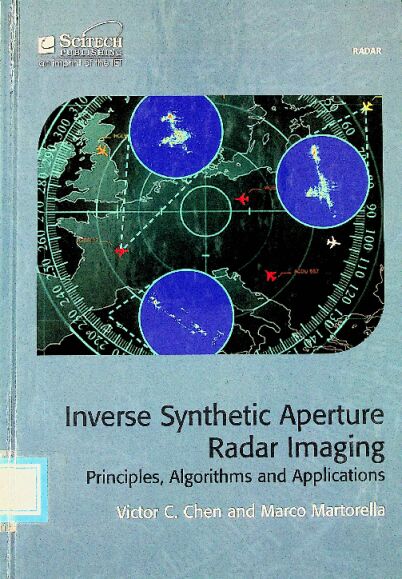
书名:Inverse synthetic aperture radar imaging
责任者:Victor C. Chen | Marco Martorella.
ISBN\ISSN:9781613530139,1613530137
出版时间:2014
出版社:SciTech Publishing Inc.,
摘要
Based on the authors' 20 years' research work on Inverse Synthetic Aperture Radar (ISAR) imaging of moving targets and non-cooperative target recognition, this book provides readers with knowledge of various algorithms of ISAR imaging of targets and implementation with MATLAB. It introduces basic principles of radar backscattering, radar imaging, and signal analysis. It describes the characteristics of radar returns from targets, how to produce well-focused ISAR images of moving targets, and what features that can extracted from ISAR images. Also introduced are several important algorithms for ISAR image formation, ISAR image auto-focusing, and applications of ISAR imaging to air targets, sea vessels and ground moving targets. Examples of ISAR imaging of ground moving targets, air targets, and sea vessels are discussed in detail.
查看更多
前言
Inverse synthetic aperture radar (ISAR) imaging has been the focus of many researchers and operational users in the last few decades. Starting from the 1970s, researchers began to investigate radar imaging of a target on a rotating turntable, and then a concept of inverse SAR (ISAR) imaging was proposed. Shortly after that, ISAR systems were built, and ISAR imaging of ships and aircraft was successfully demonstrated. The main idea behind the concept of ISAR imaging is to exploit Doppler information induced by the rotation of tar-gets, which allows for echoes returned from different parts of the target to be distinguished from each other. This makes ISAR systems different from other imaging systems, including direct synthetic aperture radar (SAR) systems. Although SAR and ISAR share the same underlying concept of forming a synthetic aperture, they are substantially different in the way they process the radar received signal and generate a focused image of a target. The importance of ISAR is its potential to form radar images of targets without knowing their motion parameters. Such targets are generally referred to as noncooperative targets. Thus, ISAR is able to handle a class of scenarios that conventional SAR can not.
Because of the nature of ISAR, most early works were of military interests and classi-fied. Since late1980s, some books that include ISAR topics have been published[1, 2] , and more and more publications on ISAR topics have begun to appear in conferences and journals.
This book is based on our 20 years' research work on ISAR imaging of moving targets and noncooperative target recognition. The goal of this book is to provide readers with a basic concept of the principles of ISAR imaging of noncooperative targets and a working knowledge of various algorithms of ISAR imaging formation and autofocus. Therefore, a large part of this book is devoted to the basic concepts and mathematical models of ISAR imaging, basic algorithms for motion compensation, ISAR image formation, and image autofocusing. Chapter 1isan introduction to the concept of ISAR imaging. Chapter 2 dis-cusses the basic principles of ISAR imaging, including ISAR scattering model, signal waveforms, pointspread function, image projection plane, cross-range focus processing, and bistatic ISAR. Chapters 3 through 5 are dedicated to detailed algorithms of ISAR image formation, motion compensation, and autofocus.
The second part of the book discusses more recent research work on ISAR imaging. Details about ISAR signal processing issues are included in Chapter 6, whereas Chapter 7 deals with feature extraction. Chapter 8 describes a new technique of refocusing moving targets inSAR images. Chapter 9 discusses frequency modulated continuous wave (FMCW) ISAR imaging. Chapters 10 and 11 introduce applications of bistatic and polarimetric ISAR imaging, respectively. Finally, Chapter 12 includes five case studies of ISAR imaging applications.
MATLAB source codes are also provided and can be used to simulate and process ISAR data and to test some of the algorithms provided in the book. These source codes are given on an as-is basis, and no warranties are claimed. The contributors of the source codes will not beheld liable for any damage caused. To request the supplementary files contact books@theiet.org.
We would like to express our sincere thanks to Dr. Elisa Giusti of the University of Pisa for developing part of the MATLAB source codes provided in this book. We would also like to thank Prof. Gang Li of Tsinghua University, Beijing, China, for his contribution to keystone method in Section 5.5 and related MATLAB source codes. We especially thank Prof. Anton Lazarov of the Burgas Free University, Bulgaria, for allowing us to introduce his interesting work on entropy-based ISAR imaging formation and related figures in Section 5.4. We are also grateful to the Italian Space Agency, the University of Adelaide, the Australian Defence Science and Technology Organisation, particularly Dr. Brett Haywood and Dr. Bevan Bates, the ON ERA, French Aerospace Laboratory, particularly Dr. Luc Vignaud, the FHR-Fraunhofer Institute, specifically Stefan Brisk en, and the South African Council for Scientific and Industrial Research, with special mention to Willie Nel, for pro-viding the real data used in this book to show examples of ISAR images. We wish to express our thanks to Dr. Mark Davis for his constructive suggestions for improving this book and Ms Petrina Kapper for helping with English usage. We are grateful to the staff of IET/Scitech Publishing for their interest and support in the publication of this book.
References [1] D.R. Whener, High Resolution Radar, 3d ed., Arthech House, 1995. [2] D.L. Mensa, High Resolution Radar Imaging, Artech House, 1981.
查看更多
目录
Preface ix
List of Abbreviations and Symbols xi
1 Introduction to ISAR Imaging 1
1.1 SAR and ISAR Concepts at a Glance 2
1.2 Brief Historical Overview of SAR and ISAR 5
1.3 Fundamentals of ISAR Imaging 6
1.4 ISAR Image Resolution 15
1.5 Main Differences between ISAR and Optical Images 16
1.6 Conclusions 18
References 19
2 Basic Principles of ISAR Imaging 21
2.1 ISAR Scattering Model 21
2.2 ISAR Signal Waveforms 25
2.3 Radar Ambiguity Function 37
2.4 Matched Filter 39
2.5 Point Spread Function in ISAR Imaging 41
2.6 ISAR Image Projection Plane 43
2.7 ISAR Image Processing 47
2.8 Bistatic ISAR 51
References 55
3 ISAR Image Formation 57
3.1 ISAR Range-Doppler Image Formation 57
3.2 Time-Frequency-Based Image Formation 67
3.3 Display 2-D ISAR Imagery - Windowing and Zero Padding for Sidelobe Suppression 74
References 75
4 ISAR Motion Compensation 77
4.1 Translational Motion Compensation 77
4.2 Rotational Motion Compensation 94
References 102
5 ISAR Autofocus Algorithms 105
5.1 Prominent Point Processing Autofocus 105
5.2 Phase Gradient Autofocus Algorithm 114
5.3 Image Contrast-Based Autofocus 116
5.4 Entropy Minimization-Based Autofocus 124
5.5 Keystone Transform in ISAR 126
References 131
6 Signal Processing Issues in ISAR Imaging 133
6.1 ISAR Imaging in the Presence of Target's Complex Motion 133
6.2 ISAR Imaging in the Presence of Strong Noise and Clutter 138
6.3 Sidelobes and Their Reduction and Cancellation in ISAR Imaging 150
References 159
7 ISAR Target Feature Extraction 161
7.1 Feature Extraction from 2-D ISAR Imagery 163
7.2 Extraction of Micro-Doppler Features from ISAR Data 166
7.3 Summary 174
References 175
8 ISAR Imaging for Refocusing Moving Targets in SAR Images 177
8.1 Review of Spotlight SAR Algorithms 179
8.2 Projection of SAR Image onto Wavenumber Domain - Inversion Mapping 185
8.3 Examples 188
References 196
9 FMCW ISAR 199
9.1 FMCW Radar for SAR and ISAR Imaging 199
9.2 FMCW ISAR Received Signal Model 201
9.3 FMCW ISAR Processing 203
9.4 Example of FMCW ISAR Autofocusing 210
References 213
10 Bistatic ISAR 215
10.1 Basics of ISAR Imaging 215
10.2 Geometry and Modeling 217
10.3 Bistatically Equivalent Monostatic ISAR Geometry 218
10.4 Bistatic ISAR Image Formation 219
10.5 Bistatic ISAR Image Interpretation 222
10.6 The Effect of Synchronization Errors on B-ISAR Imaging 224
10.7 Examples 232
10.8 Multistatic ISAR 241
References 245
11 Polarimetric ISAR 247
11.1 Signal Model 248
11.2 Image Formation and Point Spread Function 250
11.3 Polarimetric ISAR Image Autofocus 251
11.4 Polarimetric ISAR Image Interpretation 255
References 258
12 Applications of ISAR Imaging 261
12.1 Case Study 1: Ground-Based ISAR Images of a Noncooperative Sailing Ship 262
12.2 Case Study 2: Airborne ISAR Imaging of a Noncooperative Cargo Ship 267
12.3 Case Study 3: Dual Ground-Based/Satellite ISAR Imaging of a Noncooperative Sailing Ship 270
12.4 Case Study 4: Ground-Based ISAR Imaging of Airplanes 271
12.5 Case Study 5: Extraction of Doppler Features from ISAR Data of Small Vessels in Sea Clutter 274
References 281
Index 283
查看更多
作者简介
Marco Martorella is a Professor at the Department of Information Engineering of the University of Pisa and an external Professor at the University of Cape Town where he leads lectures on high resolution and imaging radar within the Masters in Radar and Electronic Defence course. He is author of more than 120 international journal and conference papers and three book chapters. He has presented several tutorials and short courses on ISAR at international radar conferences and in several research institutions in US, Australia, South Africa and Europe. He is a member of the IET Radar Sonar and Navigation Editorial Board and chair of the NATO SET-196 on multichannel/multistatic radar imaging of noncooperative targets. He has been recipient of the IEEE 2013 Fred Nathanson Memorial Radar Award.
查看更多
馆藏单位
中科院文献情报中心