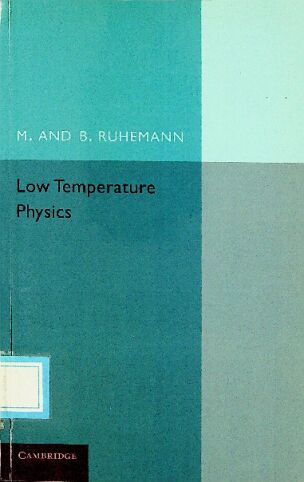
书名:Low temperature physics
责任者: M. and B. Ruhemann. | Ruhemann, B., | Ruhemann, Martin,
出版时间:2014
出版社:Cambridge University Press,
摘要
Originally published in 1937, this book was written to provide a discussion of 'the principal problems that have occupied low temperature physicists since the time when low temperatures began to form a separate branch of experimental science'. Illustrative figures are incorporated throughout and a bibliography is also included. This book will be of value to anyone with an interest in the development of low temperature physics and the history of science.
查看更多
前言
We have attempted in this book to discuss the principal problems that have occupied low temperature physical since the time when low temperatures began to form a separate branch of experimental science. In our general management we have followed the line of gradual penetration from such macroscopic phenomena as condensation and fusion to processes intimately connected with our concepts of elementary particles, such as give rise to magnetic momentary electrical conductivity. This arrangement, naturally enough, follows fairly closely the historical sequence of events, but is free from the monotony of chronological classification.
We have purposely neglected such fields of research as have been copiously treated in textbooks and monographs, as for instance supra-conductivity and the theory of specific heats. In these cases we have dealt merely with the latest developments. On the other hand, we have given particular attention to fields that have not to our knowledge as yet been dealt with in connected form, such M the subject of crystal structures stablemate low temperatures. We believe this principle justifies the very unequal length of the various parts and chapters. Moreover, we have omitted a number of investigations which, though valuable in themselves, are imperfectly connected with the general trend of low-temperature physics, such as Vegard’s very interesting work on the emission spectra of solidified gases.
The rapid development of low-temperature engineering and the numerous unsolved problems that it offers have led us to lay considerable stress on the principles of gas liquefaction and rectification, more especially as most of the work in this domain is not to be found within the scope of general physical lierature.
We have taken pains to avoid the rigidity and professionalism of a textbook, which we believe is alien to our subject. For low-temperature physics specialist neither in the object of its research nor in any particular properties of chese objects, but merely in its methods of approach. It has therefore never claimed the self-sufficiency of such branches as electromagnetism and thermodynamics. On the contrary, itis intimately bow1d up with these and all other branches of physics and has no reason to disavow these connections. Our efforts to draw near to absolute zero are not merely the hectic desires of record-bunter dictated by a genuine curiosity as to the properties of matter, irrespective of whether they are to be measured in amperes, angstrom units or calories. Half a century's experience has taught us that as long as we are in a position to attainy lower temperatures,there will always be something of interest to study there, even if it is but those processes with the help of which the temperature has been lowered. No one seriously believes that because five thousandths of a degree is the lowest limit hitherto reached, there is no point in attempting to go farther.
Though this book may be of some use to thee specialist, we have had in mind as prospective readers rather physicists specialising in the fields and more or less passively interested in low-temperature work and students who have not yet concentrated on one particular branch of physics. On the whole we have deemed it preferable to be too elementary for the former than too "advanced” for the latter.
查看更多
目录
PART I
PHASE EQUILIBRIUM
Chapter I Early Methods of Gas Liquefaction 1
§1 December 1877 1
§2 The Cracow School 6
§3 Van der Waals' Equation and the Law of Corresponding States 9
Chapter II Industrial Air Liquefaction 13
§1 General Principles 13
§2 The Joule-Thomson Effect 18
§3 The Efficiency of Liquefiers 22
Chapter III The Production of Low Temperatures 35
§1 Leiden and Large-Scale Cryogenic Technique 35
§2 Cryostats 42
§3 Small-Scale Cryogenic Technique 47
Chapter IV The Measurement of Low Temperatures 52
§1 Gas Thermometry and the Kelvin Scale 52
§2 The Vapour Pressure as a Measure of Termperature 58
§3 Electrical Thermometry 62
Chapter V Rectification in Theory and Practice 65
§1 Binary Gases and their Equilibrium with Liquids 65
§2 The Rectification Column 69
§3 "Rectification Calculus " 72
§4 The Production of Pure Gases 81
Chapter VI Solid Liquid Equilibri um 88
§1 The Equilibrium Curve 88
§2 The Melting Curves of Condensed Gases 92
§3 Melting Diagrams of Binary Solids 98
PART II
THE SOLID STATE
Chapter I The Crystal Lattice page 103
§1 X-ray Methods at Low Tempera.tures 103
§2 Crystal Structures Stable at Low Tern- peratures 114
§3 Molecular Rotation in Crystals 130
Chapter II The Thermal Energy of Crystals 136
§1 Low Temperature Calorimetry 136
§2 The Specific Heats of Crysta.ls 141
Chapter III Nernst's Third Law 179
§1 The Inaccessibility of Absolute Zero 179
§2 The Principal Significance of Nernst's Theorem 186
PART III
ORBIT AND SPIN
Chapter I Internal Degrees of Freedom 191
§l Degenerate Stats 191
§2 Ortho and Para Hydrogen 194
Chapter II Paramagnetism 201
Chapter§I Degeneracy, Magnetic Moment and Zeeman Effect 201
§2 Magnetic Measurements at Low Tern-peratures 205
§3 The Laws of Curie and Weiss 212
§4 Oxygen and Nitric Oxide 223
§5 Saturation, Langevin's Formula and the Faraday Effect 230
Chapter III Magnetic Cooling 237
Chapter§I The Magneto-Ca.loric Effect 237
§2 Problems connected with Magnetic Cooling 239
§3 Experimental Procedure and Results 248
PART IV
THE "FREE" ELECTR ON
Chapter I Conductivity at Low Temperatures 253
Chapter§1 Introductory 253
§2 Thermal Conductivity 254
§3 Electrical Conductivity 258
Chapter II Supra-conductivity 269
Chapter§1 Introductory 269
§2 Permanent Currents 270
§3 The Transition Curve 272
§4 The Supra-conducting State 275
§5 Subpermeability 279
Note added in Proof 289
Bibliography 291
Addenda 309
查看更多
馆藏单位
中科院文献情报中心