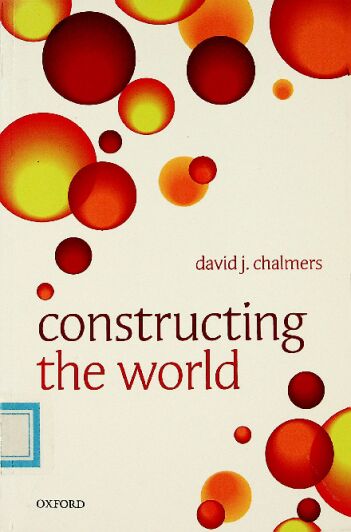
书名:Constructing the world
ISBN\ISSN:9780199608584,9780199608577
出版时间:2012
出版社:Oxford University Press,
摘要
David J. Chalmers constructs a highly ambitious and original picture of the world, from a few basic elements. He develops and extends Rudolf Carnap's attempt to do the same in Der Logische Aufbau Der Welt (1928). Carnap gave a blueprint for describing the entire world using a limited vocabulary, so that all truths about the world could be derived from that description--but his Aufbau is often seen as a noble failure. In Constructing the World, Chalmers argues that something like the Aufbau project can succeed. With the right vocabulary and the right derivation relation, we can indeed construct the world.
The focal point of Chalmers's project is scrutability: roughly, the thesis that ideal reasoning from a limited class of basic truths yields all truths about the world. Chalmers first argues for the scrutability thesis and then considers how small the base can be. All this can be seen as a project in metaphysical epistemology: epistemology in service of a global picture of the world and of our conception thereof.
The scrutability framework has ramifications throughout philosophy. Using it, Chalmers defends a broadly Fregean approach to meaning, argues for an internalist approach to the contents of thought, and rebuts W. V. Quine's arguments against the analytic and the a priori. He also uses scrutability to analyze the unity of science, to defend a conceptual approach to metaphysics, and to mount a structuralist response to skepticism. Based on Chalmers's 2010 John Locke lectures, Constructing the World opens up debate on central areas of philosophy including philosophy of language, consciousness, knowledge, and reality. This major work by a leading philosopher will appeal to philosophers in all areas.
查看更多
目录
Acknowledgments xi
Introduction xiii
How to Read This Book xxv
1 Scrutability and the Aufbau 1
1 Primitive concepts 1
2 Objections to the Aufbau 7
3 From definitional to a priori scrutability 12
4 From descriptions to intensions 16
5 The scrutability base 20
6 Reviving the Aufbau
First Excursus: Scrutability and Knowability 29
Second Excursus: The Inscrutability of Reference and the Scrutability of Truth 34
2 Varieties of Scrutability 39
1 Scrutability theses 39
2 Sentences or propositions? 42
3 Inferential scrutability 47
4 Conditional scrutability 53
5 A priori scrutability 58
6 Generalized scrutability 60
7 Idealization 62
8 Objections from idealization 64
Third Excursus: Sentential and Propositional Scrutability 72
Fourth Excursus: Warrants and Support Structures 92
Fifth Excursus: Insulated Idealization and the Problem of Self-Doubt 101
3 Adventures with a Cosmoscope 108
1 A scrutability base 108
2 The Cosmoscope argument 114
3 The argument from elimination 120
4 The argument from knowability 125
5 Inferential scrutability with a Cosmoscope 134
6 Conditional scrutability 138
7 The objection from recognirional capacities 139
8 The objection from counterfactuals 148
Sixth Excursus: Totality Truths and Indexical Truths 151
4 The Case for A Priori Scrutability 157
1 From Conditional to A Priori Scrutability 157
2 The argument from suspension of belief 159
3 The argument from frontloading 160
4 Causal roles, mediating roles, and justifying roles 167
5 Generalized A Priori Scrutability 169
6 Objections from self-knowledge 171
7 Objections from theories of concepts and reference 173
8 Objections from acquaintance and from nonpropositional evidence 176
9 The objection from empirical inference 181
Seventh Excursus: Varieties of Apriority 185
Eighth Excursus: Recent Challenges to the A Priori 193
5 Revisability and Conceptual Change 199
1 Introduction 199
2 The arguments of 'Two Dogmas' 200
3 Catnap on intensions 204
4 A Carnapian response 205
5 Refining Catnap's account 207
6 A Bayesian analysis of holding-true 211
7 A Bayesian analysis of revisability 214
8 Quinean objections 217
9 Condusion 224
Ninth Excursus: Scrutability and Conceptual Dynamics 226
Tenth Excursus: Constructing Epistemic Space 233
Eleventh Excursus: Constructing Fregean Senses 244
6 Hard Cases 259
1 Introduction 259
2 Mathematical truths 261
3 Normative and evaluative truths 264
4 Ontological truths 267
5 Other philosophical truths 271
6 Modal truths 273
7 Intentional truths 274
8 Social truths 279
9 Deferential terms 280
10 Names 282
11 It Metalinguistic truths 283
12 Indexicals and demonstratives 285
13 Vagueness 288
14 Secondary qualities 289
15 Macrophysical truths 290
16 Counterfactual truths 298
17 Condusion 299
Twelfth Excursus: Scrutability and the Unity of Science 301
7 Minimizing the Base 312
1 Introduction 312
2 Heuristics 313
3 Microphysical expressions 319
4 Color, other secondary qualities, and mass 325
5 Spatiotemporal expressions 325
6 Causal and nomic expressions 336
7 Phenomenal expressions 340
8 Compression using laws 344
9 Quiddities 347
10 Other expressions 353
11 Packages 357
Thirteenth Excursus: From the Aufbau to the Canberra Plan 362
Fourteenth Excursus: Epistemic Rigidity and Super-Rigidity 366
8 The Structure of the World 379
1 Principled scrutability bases 379
2 Definitional Scrutability (and conceptual analysis) 381
3 Analytic and Primitive Scrutability (and primitive concepts) 385
4 Narrow Scrutability (and narrow content) 393
5 Acquaintance Scrutability (and Russellian acquaintance) 399
6 Fundamental Scrutability (and the mind—body problem) 404
7 Structural Scrutability (and structural realism) 409
8 Generalized Scrutability (and Fregean content) 423
Summation: Whither the Aufbau? 426
Fifteenth Excursus: The Structuralist Response to Skepticism 435
Sixteenth Excursus: Scrutability, Supervenience, and Grounding 445
Seventeenth Excursus: Explaining Scrutability 461
Glossary 468
Bibliography 475
Index 485
查看PDF
查看更多
作者简介
David J. Chalmers is Distinguished Professor of Philosophy and Director of the Centre for Consciousness at the Australian National University, and Professor of Philosophy at New York University. After studying mathematics at Adelaide and Oxford, he completed a PhD in philosophy and cognitive science at Indiana University in 1993. His 1996 book The Conscious Mind: In Search of a Fundamental Theory was highly successful with both popular and academic audiences. As director of the Center for Consciousness Studies at the University of Arizona from 1999 to 2004, and as a founder of the Association for the Scientific Study of Consciousness, he has played a major role in developing the interdisciplinary science of consciousness. He is well known for his formulation of the 'hard problem' of consciousness and his arguments against materialism. He has also written on topics as diverse as the nature of meaning, the foundations of artificial intelligence, and philosophical issues in The Matrix.
查看更多
馆藏单位
中科院文献情报中心