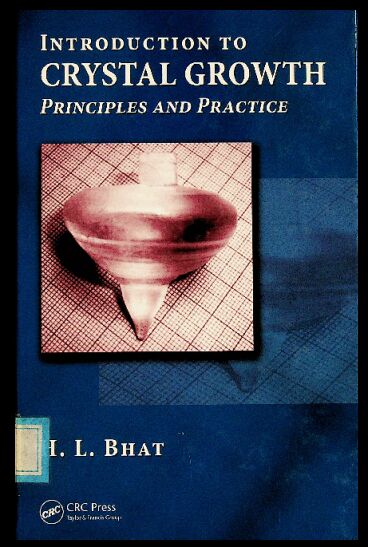
书名:Introduction to crystal growth
责任者:H.L. Bhat. | Bhat, H. L.
出版时间:2015
出版社:CRC Press, Taylor & Francis Group,
前言
Introduction to Crystal Growth: Principles and Practice teaches readers about crystals and their origins. It offers a historical perspective of the subject and includes background information whenever possible.
The first section of this introductory book takes readers through the historical development and motivation of the field of crystal growth. With more than 40 years of experience in the field, the author covers nucleation, two-dimensional layer growth mechanism, defects in crystals, and screw dislocation theory of crystal growth. He also explains some aspects of the important subject of phase diagrams.
The second section focuses on the experimental techniques of crystal growth. For practicing crystal growers, the book provides nuts-and-bolts techniques and tips. It discusses the major techniques categorized by solid–solid, liquid–solid, and vapor–solid equilibria and describes characterization techniques essential to measuring the quality of grown crystals.
查看更多
目录
Preface xv
Author xvii
Section I Principles
1. Introduction 3
What Are Crystals? 3
Why Single Crystals? 4
Why Should One Grow Crystals? 6
Historical Perspective 6
Organization of the Book 10
References 11
2. Nucleation Phenomena 13
Critical Supersaturation 13
Homogeneous (Spontaneous) Nucleation 15
Heterogeneous Nucleation 19
Nucleation on a Substrate 20
Nucleation of a Crystalline Material 21
Equilibrium Shape of Anisotropic Nuclei 22
References 23
3. Crystal Growth Mechanisms 25
Early Theories 25
Two-Dimensional Layer Growth Mechanism 28
Surface Nucleation 32
Verifcation 35
References 36
4. Defects in Crystals 37
Point Defects 37
Vacancy 38
Schottky Defect 39
Frenkel Defect 39
Interstitial Defect 40
Substitutional Defect 40
Color Centers 40
Line Defects or Dislocations 41
Theoretical Estimation of Critical Shear Stress 43
Refnement in Calculation of Critical Shear Stress 45
Edge Dislocation 46
Screw Dislocation 48
Mixed Dislocation 49
Burgers Vector 49
Motion of Dislocations 50
Energy of a Straight Screw Dislocation 51
The Force on a Dislocation When a Shear Stress Is Applied 54
Dislocation Multiplication 56
Low-Angle Grain Boundaries 57
Planar Defects 58
Stacking Faults 58
Twin Boundaries 60
Grain Boundaries in Polycrystals 61
Bulk Defects 61
References 62
5. Dislocations and Crystal Growth 65
Screw Dislocation Theory of Crystal Growth 65
The Theory 66
Experimental Verifcation 68
Growth from Solution 69
Shape of Growth Spirals 71
Interaction of Growth Spirals 72
Vapor–Liquid–Solid Mechanism of Crystal Growth 72
Dendritic Growth 75
References 76
6. Phase Diagrams and Crystal Growth 79
Latent Heat 79
Gibbs’s Free Energy 80
Chemical Potential 81
Gibbs’s Phase Rule 82
Phase Diagrams 83
Single-Component Systems 83
Water 84
Diamond 85
Two-Component Systems 86
Two-Component Solid Solutions 86
Lever Rule 87
Crystallization Path 88
Two-Component Eutectic Systems 89
Two-Component Peritectic Systems 91
Three-Component Systems 91
Concentration–Temperature Phase Diagrams (Solubility Curves) 94
Typical Phase Diagrams 96
Sodium p-Nitrophenolate 96
Gallium Antimonide 98
Lithium Niobate 101
Cesium Lithium Borate 101
Potassium Titanyl Phosphate (K 2 O–P 2 O 5 –TiO 2 System) 104
References 105
Section II Practice
7. Growth from the Solid Phase 111
Introduction 111
Solid–Solid Growth Methods 112
Grain Growth 112
Strain-Annealing Technique 116
Solid-State Phase Transformation 120
General Conclusions 121
References 122
8. Growth from the Melts 123
Introduction 123
Bridgman–Stockbarger and Related Techniques 124
General Considerations 124
Vertical Bridgman Method 124
Vertical Gradient Freeze Technique 125
Horizontal Bridgman Method 126
Equipment 127
Furnaces 127
Electrodynamic Gradient Freeze Furnace 128
Crucibles 129
Mechanical Movement 130
Melt–Solid Interface Shape 131
Examples 133
Growth of Indium Antimonide 134
Materials Synthesis 135
Crystal Growth 135
Limitations 139
Czochralski and Related Techniques 140
Equipment 142
Crucibles 143
Heaters 144
Diameter Control 144
Example 145
Growth of Congruent Lithium Niobate Crystals 146
Refned Processes 148
Growth of Stoichiometric Lithium Niobate 149
Liquid Encapsulation Technique 149
Shaped Crystal Growth 151
Stepanov Method 152
Edge-Defned, Film-Fed Growth 153
Micro-Pulling-Down Method 153
Zone-Melting Techniques 155
Normal and Equilibrium Freezing 155
Principle of Zone Refning 159
Segregation due to Single-Zone Pass 159
Segregation due to Multiple-Zone Passes 160
Zone Leveling 161
Zone Freezing 161
Zone Refning as a Technique for Crystal Growth 162
Horizontal Confguration 162
Material Transport 163
Vertical Confguration: Floating Zone Technique 164
Zone Stability 165
Example 166
Material Synthesis and Preparation of Ingots 166
Typical Growth Run 167
Flame Fusion Technique 170
Technical Considerations 172
Seed Preparation 172
Burner Design 172
Powder Preparation and Feeding 173
Growth Chamber 174
Typical Crystals Grown 174
Crystal Growth by the Arc Fusion Technique 175
Growth by the Skull-Melting Technique 176
References 178
9. Growth from Liquid Solutions 183
Introduction 183
Growth from Aqueous Solution 183
Solution and Solubility 184
Choice of Solvent 185
Additives 187
Nucleation 187
Achievement of Supersaturation 188
Apparatus 188
Mason-Jar Method 188
Holden’s Rotary Crystallizer 190
Temperature Differential Method 193
Growth by Fast Crystallization 195
Growth from Silica Gel 198
Gel Preparation 199
Gelling Mechanism and Structure 201
Apparatus and the Techniques 202
Kinetics and Mechanism of Growth 204
Nucleation Control 205
Hydrothermal Growth 207
Autoclaves 208
Full Bridgman 210
Modifed Bridgman 211
Heating and Temperature Control 211
Pressure Measurements 212
Hydrothermal Growth of Quartz 213
Growth of Other Materials 214
Merits and Demerits 214
Flux Growth 215
Principle 216
Solvents and Solubility 217
Apparatus 219
Crucibles 219
Furnaces 219
Temperature Control .220
Stirring 220
Techniques of Growth 220
Growth by Slow Cooling 221
Growth by Evaporation 222
Nucleation Control 224
Growth by Thermal Gradient 225
Top-Seeded Solution Growth 225
Traveling Heater/Solvent Method 228
General Characteristics of Flux-Grown Crystals 229
Advantages and Disadvantages 231
High-Pressure, High-Temperature Growth 232
Diamond 232
Cubic Boron Nitride 235
References 235
10. Crystal Growth from the Vapor Phase 241
Introduction 241
Classifcation 242
Vapor Transport Mechanisms 242
Convective Flow 242
Laminar Flow 243
Diffusion 243
Thermodiffusion (Soret Effect) 244
Total Flux 244
Nucleation Control 245
Furnaces 246
Experimental Techniques 246
Direct Vapor Transport 246
Closed-Tube System 247
Growth of Silicon Carbide .248
Open-Tube System 250
Chemical Vapor Transport 252
Growth by Reversible Reaction 252
Growth by Irreversible Reaction 254
Concluding Remarks 255
References 255
11. Growth of Thin Films 257
Introduction 257
Epitaxial Growth 257
Growth of Thin Films from the Vapor Phase 259
Vacuum Deposition 259
Sputtering 260
Pulsed Laser Deposition 262
Chemical Vapor Deposition 263
Metal-Organic Chemical Vapor Deposition 265
Growth of Diamond Films by the CVD Process 267
Molecular Beam Epitaxy 268
Liquid Phase Epitaxy 269
Tipping Technique 271
Dipping Technique 272
Sliding Boat Technique 273
Surface Morphology 274
Solid Phase Epitaxy 275
References 276
12. Crystal Characterization 279
Introduction 279
Nomenclature 279
Chemical Composition 280
CHN Analysis 281
Energy-Dispersive x-Ray Analysis 282
Inductively Coupled Plasma Atomic Emission Spectroscopy 283
Dopants and Impurities 284
Compositional Inhomogeneities 284
Morphology and Orientation 285
Goniometry 286
x-Ray Diffraction 288
Dislocation Content 290
Chemical Etching 290
Decoration Technique 291
x-Ray Topography 292
Berg–Barrett Technique 293
Lang Technique 293
Electron Microscopy 296
Low-Angle Grain Boundaries 297
Twins 298
Inclusions 298
References 300
Appendix I 303
Appendix II 305
Appendix III 309
Appendix IV 311
Index 313
查看更多
作者简介
H. L. BHAT obtained his BSc degree from Mysore University and both MSc and PhD degrees from Sardar Patel University, Gujarat, India. He obtained his post Doctoral research training from Strathclyde University, Glasgow, UK. Dr. Bhat joined the Physics department of Indian Institute of Science, Bangalore as a Research Associate in 1973, and progressed steadily to become a professor in 1993. He was the chairman of this department during 2002-06. During 2006-08 he was a CSIR emeritus Scientist. Currently hs is a visiting professor at Centre for Nano and Soft Matter Sciences, Bangalore. His research interests include crystal growth and crystal physics with special reference to ferroelectric, nonlinear optical, semiconductor and magnetic materials. He has over 200 research publications and produced 28 PhDs. He is a member of many professional bodies and currently the Joint Secretary of Materials Research Society of India.
查看更多
馆藏单位
中科院文献情报中心