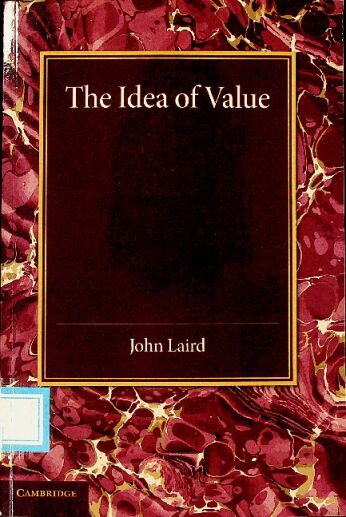
书名:The idea of value
ISBN\ISSN:9781107686878,1107686873
出版时间:1929
出版社:Cambridge University Press
前言
IN the hope that this book may tell its own story, I do not propose to embarrass this preface with any additional ex-planations. I have, however, to make certain necessary and grateful acknowledgments. My colleague, Mr A. S. Ferguson, has read the first proofs in their entirety, to the great advantage of the narrative. Two other colleagues, Mr A. Gray and Mr H. M. Macdonald, have read the parts of the proofs which concerned their special departments of economics and of mathematics. They have done their best to enable me to make my statements tolerably shipshape, if not precisely Bristol-fashion. While writing the book, I also wrote a tiny volume, Modern Problems in Philosophy (Cassell and Co. 1928), and included in it a few pages upon " Values ". There is naturally a certain resemblance in the ideas expressed. In chapter viii of this book, certain matters are treated (not wholly without reminiscence) which I have also treated in a lecture given to the British Institute of Philosophical Studies and shortly to be published in the Journal of the Institute.
查看更多
目录
Preface page v
INTRODUCTION
§1. The technical and the dictionary meanings of value xiii
§2. Comparison with other languages xv
§3. Value and disvalue xvi
§4. "Value" and "good" xvi
§5. A point in history xvii
§6. Plan of this book xx
CHAPTER I. BONUM UTILE
Section I. The conception of value in economics 1
§1. General 1
§2. Value and utility 2
§3. Utility 4
§4. Catallactics 9
§5. Division of economic values 12
§6. Preliminary conclusions 13
§7. "Labour" and "cost of production" theories 18
§8. "Natural value" 16
§9. "Natural value" and the theory of margins 23
Section II. Of means and ends 32
§1. Economics and the study of means 32
§2. Mistakes concerning ends and means 34
§3. Points to be considered 35
§4. The category of "end" 37
§5. "Instrumental" or "conditioning" versus "intrinsic" values 42
§6. Self-justifying and self-sufficient values 44
§7. Summary of the foregoing 47
§8. Complementary, supplementary, alternative and competing ends 49
§9. Heterogony of means and Polytelism page 52
§10. Transvaluations of these values 53
§11. Certain tentative conclusions 59
Section III. Of Signor Croce's opinions 63
CHAPTER II. SPINOZA'S ACCOUNT OF VALUE
§1. Introductory 69
§2. Spinoza's account: the first phase 70
§3. Comments on the first phase 72
§4. Spinoza's account: the second phase 75
§5. Remarks on the second phase 77
§6. Spinoza's account: the third phase 79
§7. The rational good: synopsis 81
§8. Remarks on the above. A. The nature of action 82
§9. B. The nature of passion 84
§10. Action and passion in relation to reason 86
§11. Anticipatory 87
§12. Spinoza's account: the meaning of good and evil in the third phase 89
§13. Man's beatitude 91
CHAPTER III. THE PRINCIPLE OF NATURAL ELECTION
§1. Describing the principle 92
§2. The place of the principle in nature 95
§3. Natural election and utility 98
§4. Natural election and consciousness 99
§5. Natural election and interest 102
§6. Natural election and the principle of perfection 108
CHAPTER IV. THE VALUES OF DESIRE
Section I. General 114
§1. The meaning of "desire" 114
§2. Remarks upon the above 117
§8. Desire and satisfaction 118
§4. Desired and desirable page 122
§5. On an argument of Mr Ross's 125
§6. The quality of desires 128
§7. Further on the same 130
§8. Desire and perfection 182
Section II. Of certain historical opinions 135
§1. Hobbes 135
§2. Schopenhauer 136
§3. C. von Ehrenfels 136
§4. T. H. Green 141
CHAPTER V. BONUM JUCUNDUM
Section I. General 146
§1. Nature of the subject 146
§2. Pleasure and satisfaction 147
§3. Further on the same 148
§4. Fine art and beauty 149
§5. Discussion of objections 151
§6. The nature of aesthetic experience 154
§7. The quality of pleasures 157
§8. Pleasure and perfection 160
§9. The distinction in aesthetic theory 161
§10. Leibniz and Locke 163
§11. The metaphysics of felicity 165
§12. Pleasure and excellence 169
Section II. Meinong's theory of value 172
§1. Preliminary 172
§2. "Personal" value 172
§3. The emotional basis of value 173
§4. The analysis of value-experience 176
§5. The "objective" of prizing and of other valuations 177
§6. Value and excellence 178
CHAPTER VI. THE ANALYSIS OF APPROVAL IN THE BRITISH MORALISTS
§1. Preliminary page 183
§2. Shaftesbury 184
§8 Francis Hutcheson 188
§4. David Hume 193
§5. Adam Smith 207
§6. Price and Reid 217
CHAPTER VII. THE OBJECTIVITY OF VALUES
§1. Preliminary 226
§2. Values and physical objects 226
§8. The values of sensible appearance 228
§4. The objectivity of mental facts 230
§5. "Subjective" variations 231
§6. Recessive and non-recessive approval 284
§7. The insufficiency of ultra-recessive theories 236
§8. Further concerning subjectivity 240
§9. Further concerning objectivity 241
§10. The consequence for value-theory 245
§11. The "right" kind of emotion 246
§12. "Coherence" and value 247
§13. Summing up 252
§14. Judgment and principle in these affairs 258
CHAPTER VIII. BONUM HONESTUM
Section I. General 255
§1. A retrospect concerning perfection and excellence 255
§2. Further concerning excellence 257
§3. Perfection and reason 258
§4. Reason, perfection and moral good 259
Section II. Of value according to metaphysical rationalism page 260
§1. Descartes 260
§2. Geulincx 268
§3. Malebranche 272
Section III. Kant's theory of value 276
§1. Introductory 276
§2. Kant's aesthetic theory 276
§3. Beauty and goodness 279
§4. The sublime and the ideal of beauty 280
§5. The nature of value or dignity 281
§6. Reason as an end 282
§7. The good will 284
§8. Value and freedom 285
§9. The ego or subject of dignity 288
§10. The restriction of dignity to reason 289
§11. The rights of man 291
§12. Perfection and happiness 292
§13. The nature of human dignity 294
§14. Value and existence 297
CHAPTER IX. TOWARDS A CONCLUSION
§1. Explanatory 301
§2. The legitimacy of the elective theory 302
§3. Implications of the elective theory 304
§4. The appreciative versus the elective view 305
§5. The foundations of the appreciative view 306
§6. The genetic argument 308
§7. The appreciative versus the timological view 311
§8. Prizing and evaluation 312
§9. Insufficiency of the appreciative view 314
§10. Prizing and timology 315
§11. Evaluation and reason 318
§12. Natural election versus timology 320
§13. The ambiguity of " value " 321
CHAPTER X. STANDARDS AND MEASURES OF VALUE
Section I. The idea of moral arithmetic page 823
§1. The earlier forms of the explicit idea 323
§2. Bentham's opinions 326
§3. Buffon to Fechner 331
§4. Turgot to Gossen 333
§5. Jevons 335
§6. The legitimacy of "marginalism" 337
§7. Problems in the measurement of pleasures 340
§8. Further on the same 345
§9. The meaning of pleasure 347
Section II. The general theory of value-measurement 349
§1. Axioms of value and of value-measurement 349
§2. The commensurability of all values 353
§3. Further on the same 356
§4. Lines of preference 359
§5. The commingling of values 362
§6. The inverse estimation of commingled values 366
§7. Perceptual evaluation 368
§8. Patterns and schemata of valuation 372
Index 376
查看PDF
查看更多
作者简介
John Laird (1887–1946) was a Scottish philosopher who specialised in metaphysics and moral philosophy. In this book, which was first published in 1929, Laird provides a detailed analysis of the philosophical nature of value. The text begins with a discussion of the main definitions of value, before going through a more detailed examination of the various applications of value in turn. This book will appeal to anyone with an interest in value and the history of philosophy.
查看更多
馆藏单位
中科院文献情报中心