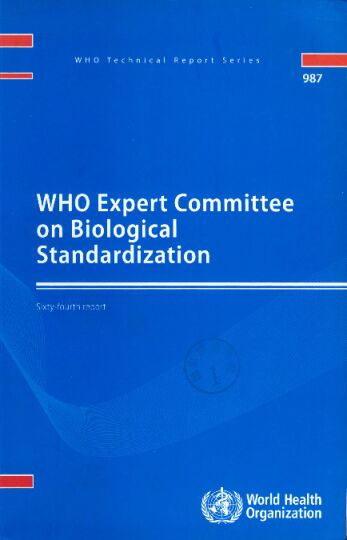
书名:WHO expert committee on biological standardization
责任者:World Health Organization
ISBN\ISSN:9789241209878 0512-3054
摘要
The WHO Expert Committee on Biological Standardization met in Geneva from 21 to 25 October 2013. The meeting was opened by Mr Kees de Joncheere, Director of the Department of Essential Medicines and Health Products (EMP).
Mr de Joncheere welcomed the Committee, meeting participants and observers, and highlighted the growing interest in biological medicines as evidenced by the record number of participants at this year's meeting. Such a level of participation reflected the strong need expressed by countries and regulators to WHO for support in appropriately regulating biological products. He also reminded the group that the standards established by the Committee were designed to be used as common global standards that could promote a process of regulatory convergence. The adoption and adaption of these WHO standards by national regulatory agencies, and their use by the WHO prequalification programme, represented practical approaches for achieving such convergence.
Mr de Joncheere also pointed out that the Committee has for several years recommended that WHO undertake activities specifically aimed at promoting the implementation of the standards it establishes. WHO has responded by coordinating a series of implementation workshops on selected standards that had proved to be both popular and useful. WHO has also been working on ways to strengthen its activities in the context of developing its Programme of Work for the coming years, and Mr de Joncheere presented a brief overview of a recent strategic reorganization process with particular relevance to EMP activities.
Mr de Joncheere then brought attention to the typically full agenda of the Committee which included consideration of three new written standards, and the need to reach decisions on 12 proposals to establish new international reference materials. The Committee would also be asked to consider 16 proposals to initiate new projects on new or replacement international reference materials. Mr de Joncheere expressed his thanks on behalf of WHO to the Committee, to WHO's collaborating centres, and to all the experts, institutions and professional societies working in this area whose efforts provide vital support to WHO programmes. Mr de Joncheere concluded by reminding the group that Committee members acted in their personal capacities as experts and not on behalf of their organizations or countries.
The Secretary to the Committee, Dr David Wood, then presented an overview of WHO Expert Committees and of the important and greatly valued role they played in providing assistance to Member States. Established by the World Health Assembly or Executive Board, WHO Expert Committees acted as official advisory bodies to the Director-General of WHO and were governed by formal rules and procedures. Dr Wood then outlined the organization of the meeting and the major issues to be discussed. Declarations of Interests made by two members of the Committee and by four Temporary Advisors were presented to the group. Following an earlier evaluation, WHO had concluded that none of the declarations made constituted a significant conflict of interest, and the individuals concerned would be allowed to participate fully in the meeting.
Dr Elwyn Griffiths was elected as Chairman and Dr John Petricciani was elected as Rapporteur for the plenary sessions, and for the track considering vaccines and biotherapeutics. Dr Harvey Klein was elected as Chairman and Dr Anthony Hubbard and Dr Micha Nübling as Rapporteurs for the track considering blood products and in vitro diagnostic device reagents. Dr Klein was also elected as Vice-Chairman for the plenary sessions of the Committee. Following participant introductions, the Committee adopted the proposed agenda (WHO/BS/2013.2231).
Before proceeding with the agenda, the Committee took note of the many important contributions that Dr Jean-Marc Spieser, European Pharmacopoeia, Council of Europe, had made over many years to the field of biological standardization, and expressed its regret on learning of his recent death.
查看更多
目录
Abbreviations xiii
1. Introduction 1
2. General 3
2.1 Current directions 3
2.1.1 Strategic directions in biological standardization: WHO priorities 3
2.1.2 Vaccines and biotherapeutics: recent and planned activities in biological standardization 4
2.1.3 Blood products and related in vitro diagnostics: recent and planned activities in biological standardization 6
2.2 Reports 8
2.2.1 Report from the WHO BRN 8
2.2.2 Report from the WHO collaborating centres for biological standards 9
2.3 Feedback from custodian laboratories 10
2.3.1 Developments and scientific issues highlighted by custodians of WHO biological reference preparations 10
2.4 Cross-cutting activities of other WHO committees and groups 13
2.4.1 Updating of the WHO Essential Medicines List 13
2.4.2 Proposal for the naming of similar biotherapeutic products 14
2.4.3 Development of technical supplements to WHO guidance on the storage and transport of time- and temperature-sensitive pharmaceutical products 15
2.4.4 Proposed WHO Guideline on Good Regulatory Review Practice 16
2.4.5 Scientific and regulatory considerations for the stability evaluation of vaccines under a controlled temperature chain 16
2.4.6 Request for guidance on the harmonized labelling of vaccines 17
3. International Recommendations, Guidelines and other matters related to the manufacture and quality control of biological substances 18
3.1 Vaccines and related substances 18
3.1.1 Guidelines on the nonclinical evaluation of vaccine adjuvants and adjuvanted vaccines 18
3.1.2 Guidelines on the quality, safety and efficacy of typhoid conjugate vaccines 18
3.1.3 Guidelines on the quality, safety and efficacy of biotherapeutic protein products prepared by recombinant DNA technology 19
3.1.4 Regulatory written standards pipeline 20
3.1.5 Utility of deep sequencing in the manufacture of oral poliomyelitis vaccine 23
3.2 Blood products and related substances 23
3.2.1 Strategic plan for assuring the quality and safety of blood products and related substances 23
3.2.2 Diagnostic needs for global malaria control and elimination 24
3.2.3 DNA-based cancer diagnostics 25
3.2.4 WHO Consultation on Commutability of WHO Biological Reference Preparations for in vitro Detection of Infectious Markers 26
3.2.5 Fourth Meeting of WHO Collaborating Centres to support the development of WHO biological reference preparations for blood products and in vitro diagnostic devices 27
4. International reference materials - vaccines and related substances 28
4.1 WHO International Standards and Reference Reagents - vaccines and related substances 28
4.1.1 Third WHO International Standard for inactivated poliomyelitis vaccine 28
4.1.2 First WHO International Standard for anti-malaria (Plasmodium falciparum) human serum 29
4.2 Proposed new projects and updates - vaccines and related substances 29
4.2.1 Proposed Third WHO International Standard for diphtheria toxoid for use in flocculation test 29
4.2.2 Proposed First WHO International Standard for typhoid Vi capsular polysaccharide 30
4.2.3 Update on the endorsed proposal for a First WHO International Standard for anti-typhoid Vi p capsular polysaccharide serum (human) 31
4.2.4 Proposed First WHO International Standard for meningococcal serogroup A polysaccharide 31
4.2.5 Proposed Second WHO International Standard for high and low mutant reference virus for MAPREC assay of poliovirus type 2 31
4.2.6 Proposed First WHO International Standard for antiserum to respiratory syncytial virus 32
5. International reference materials - blood products and related substances 33
5.1 Proposed new projects and updates - blood products and related substances 33
5.1.1 Update on the endorsed proposal for a First WHO International Standard for anti-rubella immunoglobulin 33
5.1.2 Proposed Second WHO International Standard for Ancrod 33
5.1.3 Proposed Fourth WHO International Standard for streptokinase 34
5.1.4 Proposal to assign factor IX antigen values to the current Fourth WHO International Standard for blood coagulation factors II, VII, IX, X (plasma) and to the proposed Fifth WHO International Standard for blood coagulation factor IX (concentrate) 34
5.1.5 Proposed Second WHO International Standard for anti-tetanus immunoglobulin (human) 35
5.1.6 Proposed First WHO International Standard for activated coagulation factor Xla 36
6. International reference materials - in vitro diagnostic device reagents 37
6.1 WHO International Standards and Reference Reagents - in vitro diagnostic device reagents 37
6.1.1 First WHO International Reference Panel for HIV-1 circulating recombinant forms RNA for NAT-based assays 37
6.1.2 Second WHO International Standard for hepatitis A virus RNA for NAT-based assays 38
6.1.3 First WHO International Standard for hepatitis B virus e antigen 38
6.1.4 First WHO International Standard for anti-hepatitis B virus e antibodies 39
6.1.5 First WHO International Standard for hepatitis D virus RNA for NAT-based assays 40
6.1.6 Third WHO International Standard for parvovirus B19 DNA for NAT-based assays 41
6.1.7 First WHO International Standard for mycoplasma DNA for NAT-based assays 42
6.1.8 Third WHO International Standard for human serum immunoglobulin E 42
6.2 Proposed new projects and updates - in vitro diagnostic device reagents 44
6.2.1 Proposal to develop a panel of recombinant antigens for the evaluation and quality control of malaria rapid diagnostic tests 44
6.2.2 Proposal to develop a malaria antibody reference panel 44
6.2.3 Proposed Fifth WHO International Standard for hepatitis C virus RNA for NAT-based assays 45
6.2.4 Proposed First WHO International Standard for anti-cytomegalovirus immunoglobulin G (plasma) 45
6.2.5 Proposal to develop reference panels for the standardization of bioassays for cancer diagnostics 46
6.2.6 Proposed First WHO Reference Reagent for high-titre anti-A and anti-B 47
6.2.7 Update on the endorsed proposal for a First WHO International Reference Plasma Panel for lupus anticoagulant 48
6.2.8 Proposals for discontinuation or replacement of WHO biological reference preparations for blood products and related substances 48
7. International reference materials - biotherapeutics other than blood products 50
7.1 WHO International Standards and Reference Reagents - biotherapeutics other than blood products 50
7.1.1 Third WHO International Standard for tumour necrosis factor alpha (human, recombinant) 50
7.1.2 First WHO International Standard for PEGylated granulocyte colony-stimulating factor 50
Annex 1
WHO Recommendations, Guidelines and other documents related to the manufacture and quality control of biological substances used in medicine 53
Annex 2
Guidelines on the nonclinical evaluation of vaccine adjuvants and adjuvanted vaccines 59
Annex 3
Guidelines on the quality, safety and efficacy of typhoid conjugate vaccines 101
Annex 4
Guidelines on the quality, safety and efficacy of biotherapeutic protein products prepared by recombinant DNA technology 175
Replacement of Annex 3 of WHO Technical Report Series, No. 814 175
Annex 5
Biological substances: WHO International Standards and Reference Panels 265
查看PDF
查看更多
馆藏单位
中国标准化研究院国家标准馆