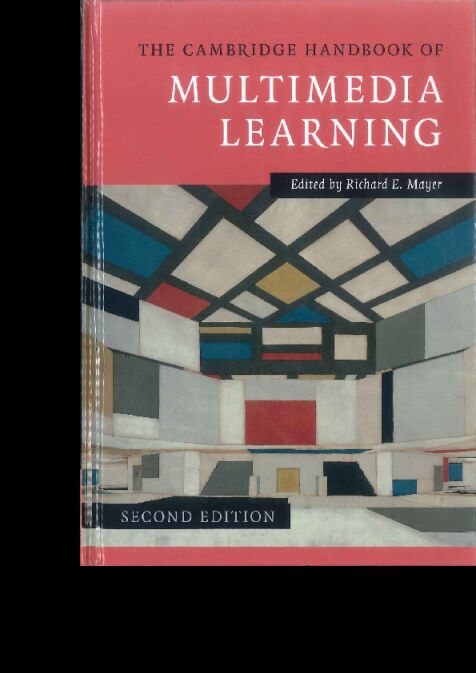
书名:The Cambridge handbook of multimedia learning
出版时间:2014
出版社:Cambridge University Press,
分类号:文化、科学、教育、体育
版次:2nd ed.
前言
As the first and only comprehensive research-based handbook on multimedia learning, The Cambridge Handbook of Multimedia Learning has helped define and shape the field and has become recognized as its major reference work. Since the publication of the first edition in 2005, the field of multimedia learning has grown as a coherent discipline with an accumulated research base worthy of being synthesized and organized in an updated handbook. Therefore, I am pleased to serve as editor of this second edition of The Cambridge Handbook of Multimedia Learning, which remains the most comprehensive and up-to-date volume summarizing research and theory in the field of multimedia learning.
This second edition of the Handbook constitutes the latest progress report from the world's leading multimedia researchers. As in the first edition, the focus of this volume is on how people learn from words and pictures, particularly in computer-based environments. For purposes of the Handbook, multimedia learning is defined as learning from words (e.g., spoken or printed text) and pictures (e.g., illustrations, photos, maps, graphs, animation, or video). Multimedia environments include online instructional presentations, interactive lessons, e-courses, simulation games, slideshows, and even textbooks. Overall, the major goal of this second edition of the Handbook is the same as that of the first edition - to establish what works (by systematically examining research-based principles of effective multimedia instruction) and to explain how it works (by grounding the research findings in cognitive theory).
There are many books providing advice on how to design multimedia learning environments, but they are based largely on the practical experience and wisdom of the authors. Similarly, there are books reporting on the development of online instructional programs and Web sites, but the development efforts are generally based on best practices and informal case studies. Until recently, the lack of scientific research evidence in many multimedia learning books could be justified on the grounds that a solid research base did not yet exist. However, the quantity and quality of scientific research - conducted by researchers around the world - have reached a level warranting a revision of the field's first comprehensive research-based handbook of multimedia learning.
What distinguishes this book from some other books on distance learning or Web-based instruction is our commitment to taking a scientific, evidence-based approach. My goal as editor is to make sure the Handbook provides a comprehensive and focused overview of the state of scientific research on multimedia learning. Each chapter is based on empirical research and grounded in cognitive theory, rather than offering unsubstantiated recommendations, describing best practices, or summarizing software development accomplishments. The chapter authors are research leaders from around the world, who have records of research publication in multimedia learning. As the most comprehensive research-based handbook on multimedia learning, the second edition of The Cambridge Handbook of Multimedia Learning is intended to continue to define and shape the field for years to come.
As the editor, I asked leading multimedia researchers to author chapters in areas in which they have contributed to the empirical research base. Because the field is largely international, the chapter authors span the globe, with more than half the chapters written by authors outside the United States - including chapter authors from Australia, Canada, Germany, France, the Netherlands, and the United Kingdom.
The Handbook consists of 34 chapters organized into five parts. Each chapter focuses on a particular theory of multimedia learning (in Part I), a basic principle of multimedia learning (Part II), an advanced principle of multimedia learning (Part III), multimedia learning of cognitive processing (Part IV), or multimedia learning within an advanced computer-based context (Part V).
In order to provide a common structure among the chapters, I asked authors to organize their chapters around a common set of issues. In particular, I asked the authors of the theory chapters in Part I to provide a concise description of the theory or model with concrete examples, to summarize the theory's contributions to cognitive theory (i.e., to specify predictions that have been tested), to summarize the theory's contributions to instructional design (i.e., to specify recommendations for instruction), to describe any limitations of the theory, and to suggest future directions for research. I asked the authors of each of the other chapters to provide a clear definition and example of the principle or topic of the chapter, to review the relevant published research literature in sufficient detail, to assess the limitations of the research base, to summarize the implications for cognitive theory and for instructional design, and to suggest directions for future research.
I solicited chapters that were concise (i.e., containing no more than 40 double-spaced pages), focused (i.e., reviewing the research on the specified topic), well-referenced (i.e., containing a rich set of relevant references), evidence-based (i.e., providing an up-to-date review of the best empirical evidence), theory-based (i.e., relating the findings to testable predictions of theories when appropriate), and educationally relevant (i.e., drawing implications for educational practice when appropriate). In order to minimize confusion, I asked the authors to clearly define jargon terms in the text as well as in a glossary at the end of the chapter. Each chapter was reviewed and revised.
This book is for anyone interested in how people learn from words and pictures in computer-based environments. Although the Handbook summarizes the research base in multimedia learning, it is intended to be accessible to a general audience. On one hand, the Handbook is designed to support readers with practical interests in how to design or select multimedia learning environments that promote learning. On the other hand, it is designed to support readers who have academic interests in conducting or evaluating research in multimedia learning. The Handbook would be appropriate for courses related to cognitive science, educational psychology, instructional design, human factors, multimedia arts and technology, professional training, and interface design. It would also be useful for instructors interested in designing or improving multimedia lessons in school settings, job training contexts, and informal environments. In short, The Cambridge Handbook of Multimedia Learning belongs on the bookshelf of anyone who is interested in taking an evidence-based approach to Web-based learning, e-learning, hypermedia, multimedia, computer games, Web site design, distance learning, instructional technology, human-computer interaction, virtual environments, or applied cognitive psychology.
As the editor, I have tried to ensure that the Handbook reflects the values that I think are important for our field. In particular, I sought to produce a handbook with the following characteristics: Research-based: The Handbook is intended to summarize the empirical research on multimedia learning rather than describe untested best prac-tices or software development projects. Although I have much respect for the craft knowledge of practitioners and designers, it is important to know if recommendations are supported by scientific evidence and under what conditions they are supported. Thus, I value a focus on scientific evidence as the key to progress in our field. Theory-grounded: The Handbook is intended to relate empirical research to cognitive theories of how people learn. My overriding premise is that multimedia learning environments should be designed in ways that are consistent with what is known about how people learn. Educationally relevant: The Handbook focuses on issues that are relevant to educa ion, that is, to helping people learn. Thus, I sought chapters that offer research-based implications for instructional design. Comprehensive: The Handbook offers a broad view of the field, including contributions from multimedia researchers around the world. I value the perspectives of researchers who have devoted so much of their energy to understanding multimedia learning.Timely: The Handbook offers an up-to-date overview of the field. I value timelines because the scientific study of multimedia learning is maturing at a rapid pace, and so are the practical demands for building multimedia learning environments - ranging from e-courses to in-class simulations. Readable - In my role as editor I have tried to make sure that the chapters are clear and concise, with key terms defined and concrete examples provided. In a multidisciplmary field like this one, it is important that the chapters communicate what is known in a way that general readers can appreciate.
In short, my values motivated me to seek chapters based on empirical research and grounded in cognitive theory rather than chapters that mainly describe development efforts or best practices.
In order to prepare for the second edition, I solicited suggestions from 12 leading multimedia researchers concerning new chapters to add, old chapters to delete or reshape, and new authors to include. I also examined notes and comments I had received and made concerning the first edition, and I examined the current state of the field in terms of research activity. In light of this analysis, I sought to retain the Handbook's basic goal and structure but to ask authors to update and revise their chapters.
This second edition of the Handbook begins (in Part I) with a look at four foundational theories of multimedia learning, each of which has been updated since the previous edition - Sweller's cognitive load theory, Mayer's cognitive theory of multimedia learning, Schnotz's integrated model of text and picture comprehension, and van Merrienboer's four-component instructional design theory.
As in the first edition, each core chapter (in Parts II and III) focuses on a well-established effect or principle that has been researched extensively. On the basis of developments in the field, I added a chapter on the signaling principle (i.e., highlighting parts of a graphic during instruction) to Part II. In Part III, I added chapters on the drawing principle (i.e., asking learners to draw during learning), feedback principle (i.e., giving explanations after learner responses), multiple representation principle (i.e., using different modes to present the information), animation principle (i.e., presenting graphics in dynamic form), learner control principle (i.e., allowing the learner to make choices about the pace and order of instruction), and working memory principle (i.e., the role of individual differences in working memory). I deleted chapters on aging, site maps, and navigation and incorporated much of the material into other chapters to better reflect the development of the research base during the past decade.
In ensuing chapters (in Parts IV and V), I asked the authors to examine the research base in specific contexts of multimedia learning such as teaching of metacognitive skills in a hypertext environment or teaching of cognitive skills using educational games. I reshaped Part IV to focus on multimedia learning of specialized content - cognitive skills, metacognitive strategies, and reasoning about complex systems - which has grown rapidly in the past 10 years, and to downplay multimedia learning in subject areas - deleting chapters on reading, mathematics, history, chemistry, meteorology, and second-language learning, which are better covered in other chapters. In Part V, I broke the chapter on simulations and games into two separate chapters to better reflect the growth of both of those areas, I substituted a chapter on multimedia learning with intelligent tutoring systems for chapters on multimedia learning with pedagogical agents and in virtual reality to also better reflect current research directions, I substituted a chapter on multimedia learning from multiple sources for one on hypermedia, and I added a chapter on learning with video to reflect the development of a solid research base.
Editing this book has been a treat for me, because I could commission chapters from the best researchers in the field and be the first to learn what they had to say. I am pleased to share the fruits of this enterprise with you in a timely fashion. My hope is that you will enjoy reading this Handbook as much as I have enjoyed editing it. I will consider it a success if it helps you to understand what is known about how people learn from words and pictures, gives you useful help in building or selecting effective multimedia learning environments, or encourages you to produce or investigate research that contributes to cognitive theory and educational practice. I hope that you will feel free to contact me at mayer@psych.ucsb.edu to share your comments about the Handbook.
查看更多
目录
List of Contributors ix
Preface xi
Acknowledgments xvii
1.Introduction to Multimedia Learning 1
Part I.Theoretical Foundations
2.Implications of Cognitive Load Theory for Multimedia Learning 27
3.Cognitive Theory of Multimedia Learning 43
4.Integrated Model of Text and Picture Comprehension 72
5.The Four-Component Instructional Design Model: Multimedia Principles in Environments for Complex Learning 104
Part II.Basic Principles of Multimedia Learning
6.Ten Common but Questionable Principles of Multimedia Learning 151
7.The Multimedia Principle 174
8.The Split-Attention Principle in Multimedia Learning 206
9.The Modality Principle in Multimedia Learning 227
10.The Redundancy Principle in Multimedia Learning 247
11.The Signaling (or Cueing) Principle in Multimedia Learning 263
12.Principles for Reducing Extraneous Processing in Multimedia Learning: Coherence, Signaling, Redundancy, Spatial Contiguity, and Temporal Contiguity Principles 279
13.Principles for Managing Essential Processing in Multimedia Learning: Segmenting, Pre-training, and Modality Principles 316
14.Principles Based on Social Cues in Multimedia Learning: Personalization, Voice, Image, and Embodiment Principles 345
Part III.Advanced Principles of Multimedia Learning
15.The Guided Discovery Learning Principle in Multimedia Learning 371
16.The Worked Examples Principle in Multimedia Learning 391
17.The Self-Explanation Principle in Multimedia Learning 413
18.The Generative Drawing Principle in Multimedia Learning 433
19.The Feedback Principle in Multimedia Learning 449
20.The Multiple Representation Principle in Multimedia Learning 464
21.The Learner Control Principle in Multimedia Learning 487
22.Animation Principles in Multimedia Learning 513
23.The Collaboration Principle in Multimedia Learning 547
24.The Expertise Reversal Principle in Multimedia Learning 576
25.The Individual Differences in Working Memory Capacity Principle in Multimedia Learning 598
Part IV.Multimedia Learning of Cognitive Processes
26.Multimedia Learning of Cognitive Processes 623
27.Multimedia Learning of Metacognitive Strategies 647
28.Multimedia Learning and the Development of Mental Models 673
Part V.Multimedia Learning in Advanced Computer-Based Contexts
29.Multimedia Learning with Intelligent Tutoring Systems 705
30.Multimedia Learning with Simulations and Microworlds 729
31.Multimedia Learning with Computer Games 762
32.Multimedia Learning with Video 785
33.Multimedia Learning from Multiple Documents 813
34.Multimedia Learning in e-Courses 842
Author Index 883
Subject Index 905
查看PDF
查看更多
馆藏单位
中国医科院医学信息研究所