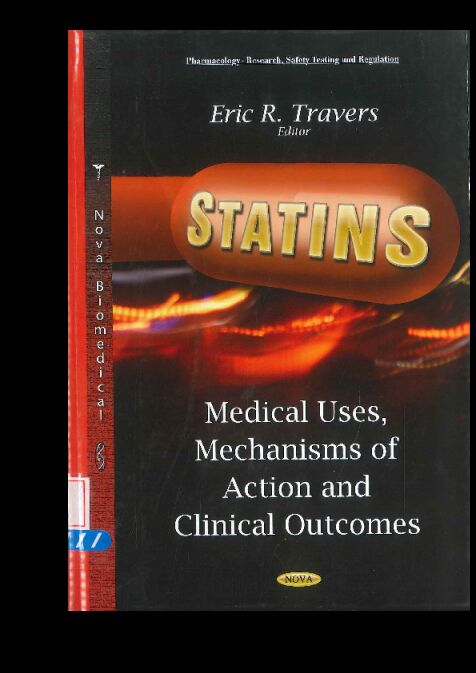
书名:Statins
出版时间:2015
出版社:Nova Science Publishers,
前言
Statins are well-known drags to lower cholesterol levels and play an important role in the prevention of cardiovascular diseases. They inhibit hydroxymethylglutaryl-coenzyme A (HMGCoA) reductase, an enzyme that plays a central role in the production of cholesterol in the liver. Despite the growing experience in the use of statins, it is still difficult to predict the individual patient response in term of efficacy and possible adverse effects. This book discusses several medical uses for statins. It also discusses the mechanisms of action and clinical outcomes of using statins.
Chapter 1 - Statins, HMG-CoA reductase inhibitors, are well-known drugs to lower cholesterol levels and play an important role in the prevention of cardiovascular diseases [associated with increased levels of primarily low-density-lipoprotein (LDL)-cholesterol], especially in the early stages of disease. The effect of statins has been studied in different animal models, including small rodents (rats and mice), but rodents have somewhat different pathways for lipid metabolism and different serum lipoprotein profiles compared to humans (high levels of HDL, no CETP, somewhat refractory to atherogenesis, etc.). It would appear important to focus on the similarities and differences of the effects of hypolipidemic drugs (e.g., statins) in humans and small laboratory animals, since the latter are extensively utilized in pre-clinical studies to screen the potency and efficacy of new hypolipidemic drugs In this regard, it might be useful to better understand the mechanism of action of statins in mice (the most widely-used animal model in pre-clinical hypolipidemic drug testing), because it has been reported that about 50% of all published studies which evaluated the effects of statins in rodents do not demonstrate any hypolipidemic effect, since rodents carry approximately 80% of their cholesterol as HDL. In fact, almost all mouse models of atherogenesis do not mimic the most important event in human atherosclerosis, that is, plaque rupture leading to vessel occlusion. However, the poloxamer 407-induced mouse model of hyperlipidemia is a dose-dependent mouse model that produces an atherogenic plasma lipid profile somewhat similar to humans (including formation of ox-LDL), although it must be emphasized that serum triglyceride concentrations are more sensitive to the effects of poloxamer 407 due to its general lipase inhibitory effects. This model previously evaluated the hypolipidemic efficacy of commercially-available, FDA-approved statins in mice, which mirrored the trend (rank-order) in efficacy observed in humans. Additionally, this model was utilized previously to induce fibrofatty aortic lesions in mice after 4 months, and subsequently mediate regression of established plaque following an additional 4 months of treatment with atorvastatin. In this study, atorvastatin was tested in mice with atherosclerotic lesions produced by either long-terra (4 mo) treatment with poloxamer 407, or mice which consumed a classic high-fat, cholate-containing diet for 4 months. In general, one needs to use higher doses of statin drugs in mice to produce a therapeutic effect. Acute lipemia induced by poloxamer 407 can be effectively treated only by high doses of statins (e.g., atorvastatin). The difficulties associated with recapitulating the phenotypic signatures associated with human atherogenic serum lipid profiles and development of atherosclerotic lesions are discussed. Lastly, some side effects of statins in humans and experimental animal models (e.g., resistance to statin therapy) are discussed, as well as the advantages and disadvantages of various alternative mouse models of atherogenesis resulting from genetic modification.
Chapter 2 - The aim of this chapter is to assess the experimental and clinical evidence regarding potential neuroprotective effects of statins and their possible perioperative benefit. Statins are drugs used to control cholesterol disorders and prevent cardiovascular diseases by four mechanisms: improvement of endothelial function, modulation of inflammatory responses, maintenance of plaque stability, and prevention of thrombus formation. It is possible that these various effects may also be neuroprotective. The anti-inflammatory effects of statins on endothelial cell mechanisms are better understood than their role in neuroprotection or tumoral apoptosis and evidence is only just emerging that statins may be beneficial. Data regarding perioperative use of statins in neurosurgery is scarce, controversial and inconclusive since there is a lack of convincing randomized, prospective clinical trials. More trials in humans are needed to determine whether statins could contribute to the current management of neurosurgical diseases. Not much is known about utilizing statins as a prophylactic treatment and some would probably advocate that we should be treating 'at risk' patients with statins perioperatively or at least it is important to try to put this into a clinical perspective.
Chapter 3 - The use of statins has recently attracted the attention of clinicians. Indeed, statins are probably the most common chronic treatment used for cardiovascular disease (18 million prescription purchase in France and 173.7 million in United States, per year). Moreover, their so-called pleiotropic effects open the gates to much larger medical applications. However, it is still difficult to predict the individual's response to statin therapy. Recent research has shown that variants of candidate genes affect statin efficacy and safety. Clinicians often assume that symptoms occurring with statins are caused by statins, encouraging discontinuation. But so far, only asymptomatic liver enzymes, muscle aches and development of new-onset diabetes mellitus has been proven to be related to statin therapy. To lower cholesterol levels, clinicians could prescribe statin monotherapy or a statin in combination with another agent. There are potential benefits to treating with multiple agents, such as the different mechanisms of action of other lipid-modifying agents, may be a solution against the adverse effects of statins and their intolerance. Given their pleiotropic effects, statins could be used in non-dyslipidemic diseases.
In this chapter, the authors will first examine the properties of statins including their structure, metabolism, and potency. The authors will also look at the pharmacogenomics of statins as. well their mechanisms of action from their lipid-lowering effects to the more complex anti-inflammatory, immunomodulatory, anti-thrombotic, and anti-oxidant properties found independently of the lipid-lowering properties. Following this, the authors will review the potential adverse effects of statins including the mechanisms leading to myopathy and new-onset diabetes mellitus. In this regard, they will assess the benefits and harmful intensification of statin monotherapy compared to the combination of statins and other lipid-modifying medications. Then, the authors will discuss the guidelines regarding the use of statins in the well-established scope of cardiovascular diseases. Finally, the authors will review the potential benefits of statins in non-dyslipdemic disorders in chronic diseases such as rheumatoid arthritis, venous thromboembolism, and polycystic ovary syndrome, as well as in critical illnesses such as sepsis, acute lung injury/acute respiratory distress syndrome or after subarachnoidal hemorrhage. The authors will particularly focus on the latter.
Chapter 4 - Statins are widely used drugs that reduce mortality associated with cardiovascular disease. Despite an extensive evidence base for both their efficacy and adverse effects, the effect of statins on the brain and behaviour remains controversial, with some types of data suggesting harmful effects from statins but with other types of data suggesting beneficial effects. This article reviews these diverse sources of evidence, combining information from randomised clinical trials, case studies and adverse reaction monitoring programs, preclinical research, and epidemiological studies. Statins are discussed for potential psychiatric effects, effects on learning and memory, neuroprotective effects, effects on Alzheimer's disease, and on cerebral blood flow. The authors conclude that although there is some evidence that high doses of statins may have adverse psychiatric effects in some people, these are rare and can be managed through dose alteration or change in statin, and should not impact on current practice for the use of statins management of cardiovascular disease.
Chapter 5 - Cardiac surgery is associated with excellent results for patients treated for acquired cardiac disease such as coronary artery or valve disease. However, the constantly ageing patient population presents with a rising prevalence of relevant co-morbidities leading to a significant risk for postoperative major adverse cardiovascular events. This trend implies the importance of an optimal perioperative medical treatment. In this context, statins have shown to be linked with beneficial effects after on-pump coronary artery bypass graft procedures while less evidence is available for patients referred to valve surgery. This chapter aims to summarize the current evidence for perioperative statin therapy for various kinds of surgery.
Chapter 6 - Atherosclerosis is a disease that begins in childhood. Evidence of fatty streaks, the earliest precursor of atherosclerotic lesions, has been found in the coronary arteries of children as young as two years of age. Hypercholesterolemia is a risk factor for coronary artery disease. Hypercholesterolemia can be either primary, when it is characteristic of the main disease, or secondary when it occurs as a result of either a disease process or drug treatment.
Given the risk of vascular disease, including myocardial infarction (MI), cerebrovascular accidents (CVA, also known as strokes), peripheral vascular disease (PVD), and ruptured aortic aneurysm, any or all of which may follow atherosclerosis, it is important to prevent or slow the early development of atherosclerotic lesions. This prevention necessitates the control of key risk factors such hypercholesterolemia, dyslipidemia, hypertension etc. However, at what point this prevention ought to occur, and in what form, is uncertain.
This uncertainty stems from the fact that using pharmacological primary prevention in the paediatric population is controversial. In an adult patient the course of action is clear. Hypercholesterolemia warrants the initiation of a statin. Statins, also known as hydroxymethylglutaryl Co-enzyme A inhibitors (or HMG-CoA inhibitors) act by altering cholesterol metabolism. In considering the paediatric population, the clinical course of vascular disease and the effect of altering this clinical course,are less certain. Questions of safety, efficacy and ethics abound.The use of statins in the paediatric population will be examined in this chapter.
Chapter 7 - Portal hypertension is a common clinical consequence of chronic liver disease that is associated with significant morbidity and mortality. Newly described pathophysiological mechanisms has opened new perspectives for therapeutic approaches, where statins may represent an attractive option to reduce portal pressure by targeting multiple molecular pathways such as endothelial dysfunction, oxidative stress, prostanoids production, angiogenesis and HSC activation. In this work the authors described how statins may correct hemodynamic abnormalities in portal circulation of cirrhotic patients and also summarize some promising results humans and animals in studies.
Chapter 8 - Worldwide, epithelial ovarian cancer constitutes the most lethal gynecological malignancy. Annually, about 240.000 women are newly diagnosed and 150.000 die of mis disease. Its lethality is mainly explained by a late diagnosis, at advanced stages, and by a transient response to available therapies. Thus, despite optimal surgical cytoreduction and a complete response to platinum-based chemotherapy, the majority of cases eventually relapses and dies of their disease determining a 5-year survival not exceeding 40%.
Current hypothesis for ovarian carcinogenesis establishes as a major determinant for malignant transformation of ovarian surface epithelium the chronic exposure to an inflammatory environment. Several conditions predispose to chronic inflammation, one of them the obesity. More importantly, recent studies confer a prognosis even worse to those ovarian cancer patients that are obese. A possible explanation for a more deleterious outcome in this subpopulation can be found in the presence of metabolic abnormalities and higher levels circulating of pro-inflammatory mediators. In fact, studies by the author's group and others show that alterations in lipid metabolism and the presence of higher levels of leptin, both conditions commonly found in the obese population, favor a pro-inflammatory environment that promotes cell growth, invasion, metastasis, and resistance to chemotherapeutic agents by the cancer cells.
Interestingly, some retrospective evidence suggests that patients receiving statins during their ovarian cancer treatment experience a better outcome than those not receiving them. Statins, HMGCoA reductase inhibitors, are usually prescribed to reduce cholesterol levels but they also possess pleiotropic effects that negatively influence ovarian carcinogenesis. By inhibiting the mevalonate pathway, statins would have a systemic effect, similar to that observed in atherosclerosis, reducing the inflammatory stimuli present in the tumor microenvironment and inhibiting the activation of multiple intracellular signaling cascades critical for metabolism, proliferation, cell death, migration, invasion, metastasis, and drug sensitivity of the ovarian cancer cell.
In the present chapter the authors summarize the current evidence on molecular mechanisms supporting the beneficial effect of statins in ovarian cancer. In particular, reasons to maintain statin use among those newly diagnosed ovarian cancer patients already taking this medication. Furthermore, reasons to consider this drug in the design of future clinical trials in the treatment of epithelial ovarian cancer.
Chapter 9 - Inhibitors of 3-hydroxy- 3-methylglutary-coenzyme A reductase (HMG-CoA) or statins are important drugs used in the treatment of dyslipidemia by reducing the biosynthesis of cholesterol. In addition to the main effect of lowering blood cholesterol levels, they have pleiotropic effects of which can be highlighted: i) improvement of endothelial function through modulation of endothelial nitric oxide synthase (eNOS) activity and inhibition of endothelin; ii) anti-inflammatory effects resulting from the reduction of proinflammatory cell signaling, oxidative stress, interaction of leukocytes to endothelial cells, and platelet and tissue factor activation; iii) stabilization of atherosclerotic plaque; iv) reduction of osteoclast formation and stimulation of osteoblasts (antiosteoporotic effect); and v) immunomodulation. It is known that these effects are variable and are not common to all statins. Even so, given the potential of these drugs, statins are currently the most prescribed medicines worldwide, and generally are extremely well tolerated by patients. However, adverse effects with different magnitudes can be observed in muscles, with occurrences ranging from a mild myalgia to rhabdomyolysis, progressing to acute renal failure and even death. The statin-induced rhabdomyolysis is a rare event, and is estimated to occur in 0.3 per 100,000 patient years of exposure, with a mortality rate of 9%. Regarding muscular symptoms, myalgia is characterized by pain with or without muscle weakness, not accompanied by an increased in creatine phosphokinase (CPK) enzyme, contrasting to myositis, that leads to an increase of this enzyme associated with muscle symptoms. Conversely, rhabdomyolysis, in generally, is characterized by muscle symptoms and significant increases in CPK levels (generally greater than 10 times the normal upper limit), and elevated levels of creatinine, renal dysfunction, dark urine, and myoglobinuria. Therefore, monitoring CPK levels is recommended during treatment with statins, since it is known the occurrence of an increase in their levels with potential severe effects on muscles even in the absence of muscular symptomatology. On the other hand, the opposite also occurs with muscle manifestations even in the absence of elevated CPK. The mechanisms by which statins develops miotoxicity remains not fully understood. Among the hypotheses proposed, the blocked in cholesterol biosynthesis induced by statins can be a myotoxicity determinant since the reduction in cholesterol content of cell membranes of skeletal muscle could make them unstable. Another hypothesis considers the farnesyl pyrophosphate and geranylgeranyl pirosfofate decrease, which normally activate regulatory proteins binding to guanosine triphosphate (GTP), which promotes cell maintenance and growth while decreasing apoptosis. Lastly, the hypothesis of myopathy occurrence across the depletion of coenzyme Q10 (CoQ10) in mitochondria is also considered. In association with drug therapy in clinical practice, it is often recommended to dyslipidemic patients the practice of regular physical exercises, which are known to be the most effective and cheapest intervention in reducing morbidity and mortality from cardiovascular diseases. However, miotoxicity can negatively interfere with the exercise or, in the opposite direction, the exercises may, itself, potentiate the statin myotoxic effect.
Chapter 10 - Hyperlipidemia is one of the major risk factors of cardiovascular disease (CVD). Hydroxymethylglutaryl coenzyme-A (HMG-CoA) reductase inhibitors, or statins, have now become the most commonly prescribed drugs to intended lower serum low-density lipoprotein cholesterol levels, which eventually prevent primary or secondary CVD events. However, it has also been argued that statin therapy may associate with new onset diabetes mellitus (DM) in clinical trials and metaanalyses. This association is universally observed across different statins -the homologous class effect— in some studies, while there could be varying levels of risk or gradient risk increases depending on the individual statins or their doses in some studies. Although the strength of association is weak and heterogeneous, the consistency cannot be denied. Therefore, it is critical that clinicians be aware of this presumed risk of developing DM because DM per se is a risk factor for CVD. This minireview presents current knowledge on the association between statins and developing DM and discusses the benefit-risk balance, i.e., the balance between numbers needed to treat and the numbers needed to harm, as well as potential confounding factors that could play a role in the statin-DM association. This comprehensive evaluation draws the conclusion that the benefits of statin therapy outweigh the new onset DM and reinforces the importance of continued statin therapy, -though the statin-DM association continues to be considered a risk among a certain segment of patients with specific characteristics. This motivates more further, more in-depth research to realize treatment optimization through identifying the most beneficial patient population while minimizing the risk of new onset DM.
查看更多
目录
Preface vii
Chapter 1 Statin Treatment in Experimental Lipemia and Atherosclerosis: The Similarities and Differences with Humans 1
Chapter 2 Statins: Potentially Neuroprotective Agents 27
Chapter 3 Statins: Pharmacology, Medical Uses and Clinical Outcomes 39
Chapter 4 Statins and the Brain: Good, Bad or Both? 81
Chapter 5 Statins in Cardiac Surgery: The Current Evidence 105
Chapter 6 The Role of Statin Therapy in Children 125
Chapter 7 Statins and Portal Hypertension 145
Chapter 8 Molecular Mechanisms Behind the Beneficial Effects of Statins in Ovarian Cancer 165
Chapter 9 Statin-Induced Myopathy 183
Chapter 10 Statins: Diabetogenicity is Weak, but an Antiathelogenic Effect is More Real 197
Index 209
查看PDF
查看更多
馆藏单位
中国医科院医学信息研究所