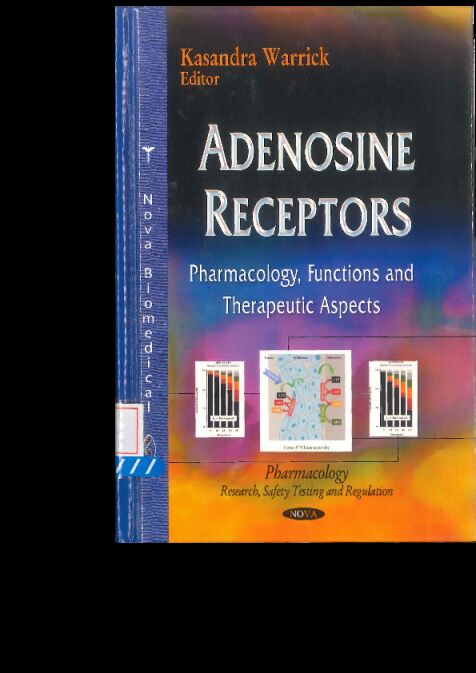
书名:Adenosine receptors
出版时间:2015
出版社:Nova Science Publishers,
前言
Adenosine is a ubiquitous adenine base purine that mediates diverse biological and physiological processes in the cardiovascular system, both in cardiac and vascular tissues. Adenosine was reported to be involved in smooth muscle contraction, neurotransmission/neuromodulation, immune response and inflammation, platelet aggregation and modulation of cardiac function. Adenosine availability, in the extracellular space, depends on its release from a variety of cell types, as a result of adenosine triphosphate (ATP) enzymatic breakdown of both intra- and extracellular adenine nucleotides and intracellular S-adenosylhomocysteine. This book discusses the pharmacology, functions and therapeutic aspects of adenosine receptors.
Chapter I - Organ transplantation unavoidably entails ischemia-reperfusion injury (IRI) resulting in graft dysfunction and increased morbidity and mortality. Ischemia, the loss of blood supply to an organ or tissue, results in oxygen deprivation and cellular injury. Reperfusion, the restoration of blood flow and thus oxygen to ischemic tissue, further exacerbates injury and has both short- and long-term effects on organ function. IRI is a rapid inflammatory response involving oxidative stress, cytokine production, innate immune cell activation, activation of adhesion molecules and leukocyte infiltration. Adenosine is a nucleoside that is locally released in response to cellular stress such as IRI and largely serves as an endogenous mechanism to combat excessive inflammation. Adenosine signals through four G protein-coupled receptor subtypes: A1R, A2AR, A2BR, and A3R. Because adenosine has a very short half-life and is rapidly metabolized, its therapeutic use is limited. Thus, potent and selective adenosine receptor agonists have been synthesized and utilized in many experimental studies to dissect the roles of each receptor in organ injury. A2AR activation is well documented to potently attenuate IRI and other inflammatory conditions in lung, heart, liver and kidney, and the anti-inflammatory effects of A2AR agonists on various leukocytes have been demonstrated. A2AR signaling is classically linked to stimulatory G proteins resulting in up-regulation of cAMP production and transcriptional activation of cAMP-regulated genes. This chapter examines the role of A2AR activation in IRI and the anti-inflammatory and immunosuppressive potential of pharmacologic A2AR agonists. Currently no therapeutic strategies are clinically available that directly targets IRI, and A2AR agonists represent a promising avenue for the prevention of IRI after transplantation. This novel therapeutic strategy is reviewed as a foundational discussion for future research initiatives in the prevention of IRI.
Chapter II - Adenosine is a ubiquitous adenine base purine that mediates diverse biological and physiological processes in the cardiovascular system, both in cardiac and vascular tissues. Adenosine was reported to be involved in smooth muscle contraction, neurotransmission/neuromodulation, immune response and inflammation, platelet aggregation and modulation of cardiac function. Adenosine availability, in the extracellular space, depends on its release from a variety of cell types, as a result of adenosine triphosphate (ATP) enzymatic breakdown of both intra- and extracellular adenine nucleotides and intracellular S-adenosylhomocysteine. Other important source of extracellular adenosine lies on the activity of nucleoside transporters, both equilibrative (ENT) and concentrative (CNT), particularly ENT1, ENT4 and CNT2. As such adenosine can reach concentrations able to activate adenosine receptors. Four adenosine receptor subtypes have been identified, A_1, A_2A, A_2b and A_3 receptors, and were found to trigger different signalling pathways and to present differential affinity requirements. Correlation between the ENT activity and adenosine receptor activation is also discussed focusing on the impact that changes or disruption of the interplay between these effectors may cause in the vascular physiology, namely by contributing to disease. All adenosine receptor subtypes have been identified in the vascular wall of many different arteries and veins. A brief overview of the current knowledge and of the authors' research work will be integrated considering important aspects of the adenosine-vascular interaction with particular emphasis on adenosine receptor subtypes pharmacology in the three vascular layers, intima, media and adventitia, namely by explaining their individual contribution for vasoconstriction/vasodilation. Integration of these knowledge with the morphological features of arteries/veins, namely by evidencing how innervation may vary from dense to sparse (depending on vessel localization) or how smooth muscle cell layers of the media varies (depending on vessel type and/or localization) will also be discussed, clarifying the contribution of adenosine receptors to peripheral vascular resistance. In the last decade several new adenosine receptor ligands have been identified as having promising therapeutic activities but during clinical trials some of them have been discontinued due to side effects. Despite of this fact, a renewed interest in this research area is emerging and several new adenosine receptor ligands have been developed and are undergoing clinical trials for a broad range of indications such as neurodegenerative disorders, inflammation, wound healing, cardiac imaging, etc. In summary, in this chapter an overview of adenosine/adenosine receptors physiology and pharmacology in the vasculature is presented guiding the reader to new and putative therapeutic applications.
Chapter III - The role of adenosine and adenosine receptors in tumourigenesis has been largely investigated. Studies suggest a contradictory role of adenosine in viability of normal and cancer cells, ascribed to the stimulation of adenosine receptors subtypes, named A_1, A_2a, A_2b, and A_3, which couple to different signal transduction pathways and can be co-expressed in the same cell. Several studies have suggested a crucial role for A_3 adenosine receptors on cancer cells' cytotoxicity, improving, by opposition, normal cells proliferation. This dual effect, coupled with the fact that these receptors are overexpressed in several tumours and expressed at low levels in normal tissues, suggested A_3 agonists as promising cancer therapeutic strategies. However, time has proved this to be an oversimplified view. In fact, activation of adenosine A_3 receptors can lead both to malignant cell proliferation and death, depending on agonist's concentration. Moreover, A_3 agonists can mediate cytotoxicity independently of adenosine A_3 receptor activation. Melanoma is considered one of the most aggressive malignant tumours, due to its high metastatic potential and resistance to current treatment modalities. Patients with metastatic melanoma present poor prognosis, with an overall survival of 8-18 months. Melanoma incidence is increasing faster than any other solid tumour accounting for a global annual incidence of about 160 thousands new cases. This chapter intends to integrate the authors' research work and the current knowledge concerning the role of adenosine/adenosine receptors in the complex interplay of proliferation, cell death mechanisms and metastatic progression of melanoma. The authors' group has shown adenosine receptor subtypes expression, on different metastatic melanoma cell lines. Their activation did not affect cell proliferation of human A375 and mouse K1735-M2 cells. However, proliferation of human C32 cells was increased, after activation of A_3 adenosine receptor, by micromolar concentrations of adenosine or nanomolar concentrations of the selective A_3 agonist, Cl-IB-MECA. By opposition, Cl-IB-MECA, at micromolar concentrations, caused marked cytotoxicity, through A_3-independent mechanisms. A major role for adenosine A_3 receptors in C32 cell proliferation induced by an adenosine metabolite, inosine, through PLC-PKC-MEK1/2-ERK1/2 pathway activation was demonstrated. Inosine also enhanced proliferation of A375 cells and stimulated metastatic processes evaluated in both cell lines (migration, adhesion, invasion and colony-formation), through adenosine A_3 receptor activation. The combination Cl-IB-MECA and paclitaxel was investigated and found to induce multiple mechanisms of cell death and inhibit metastatic processes. This combination emerges, therefore, as a promising new therapeutic strategy for human metastatic melanoma, potentially overcoming chemotherapy multiresistance and improving patient prognosis.
Chapter IV - There is a considerable bulk of evidence for the relevance of ATP in the regulation of bladder function in health and in disease conditions. However the actions of its metabolite, adenosine, on bladder tissue only recently are being unveiled. All four subtypes of adenosine receptors (A_1, A_2aA_2A, A_2B and A_3) have been identified in the bladder of experimental animals by RT-PCR and Western blot analysis; these receptors are differently distributed among the urothelium and detrusor layers. Adenosine receptors are also present in the human bladder where they can modulate filling sensations and voiding. While adenosine inhibits nerve-evoked acetylcholine release from cholinergic nerve efferents, via high affinity A_1 receptors, high concentrations of the nucleoside are required to reduce detrusor contractions induced by carbachol, ATP and potassium depolarizations. Characterization of the adenosine receptor involved in detrusor smooth muscle relaxation is still a matter of debate. Besides the major effects of the nucleoside on bladder voiding, adenosine also influences the filling phase of the micturition reflex by controlling the release of ATP from urothelial cells and the firing of sensory nerve afferents, via A_1 receptors activation. Differences in the kinetics of ATP metabolism by ectonucleotidases and adenosine biosynthesis between luminal and serosal sides of the urothelium may explain the dominant role of adenosine in the suburothelium and detrusor smooth muscle layers. Thus, the adenosine signaling pathway is now being explored as a potential therapeutic target for human bladder disorders, including inflammatory diseases, overactivity and outflow obstruction.
Chapter V - Methotrexate (MTX) is an anti-tumor medicine classified into the anti-folate drugs. MTX suppresses DNA synthesis through inhibiting dihydrofolate reductase (DHF) of de novo nucleic acid pathway, which suppresses proliferation of malignant tumors. MTX is also utilized as for antirheumatic medicine as the lower doses of MTX are able to suppress effectively the inflammation of the synovial tissues in RA patients, In the authors' previous study, plasma adenosine level was markedly increased during induction of inflammation in rats with adjuvant-induced arthritis (arthritic rats). MTX-induced suppression of osteoclastogenesis was canceled by the addition of adenosine in vitro as well as in vivo. Deoxyadenosine (dAdo) is known to regulate proliferation of immune cells and partly share metabolic pathways with adenosine. Adenosine deaminase (ADA) is a key enzyme which metabolize both of adenosine and dAdo to produce inosine and deoxyinosine perpetually. Here the authors examined the regulatory role of dAdo in MTX-induced suppression of inflammatory bone destruction and investigated a possible involvement of ADA as a target molecule of MTX. In rats with adjuvant-induced arthritis, in whole bone marrow cultures for evaluating osteoclastogenesis, MTX markedly suppressed osteoclastogenesis and dAdo completely canceled its suppression. This cancellation was partially blocked by caffeine, antagonist for the adenosine receptors, A_1 AR, A_2nAR and A_3AR. Semi-quantitative RT-PCR showed that MTX suppressed expression of RANKL without affecting osteoprotegerin (OPG) expression. Addition of dAdo clearly recovered the expression of RANKL and slightly suppressed OPG expression, which result in augment in osteoclastogenesis. In arthritic rats, MTX-induced suppression of inflammatory bone destruction was completely cancelled by the injection of dAdo. A marked induction of ADA was apparent in bone marrow cells observed in the bone destruction sites around ankle joints in arthritic rats. MTX strikingly suppressed expression of ADA in the corresponding area, Immunoblot analysis also showed a clear induction of ADA protein in arthritic rats and a marked suppression of ADA protein when arthritic rats were treated with MTX. In bone marrow cultures for evaluating osteoclastogenesis, expression of ADA mRNA was markedly suppressed by MTX and dAdo partially cancelled its inhibition. These observations suggest that ADA is involved in the MTX-mediated inhibition of inflammatory bone destruction regulated by adenosine and dAdo. Suppression of ADA by MTX may contribute to the stability of dAdo. A list of abbreviation: AA, adjuvant-induced arthritis; ADA, adenosine deaminase; AR, adenosine receptor; CFA, complete Freund adjuvant; dAdo, deoxyadenosine; MNC, multinucleated cells; MTX, methotrexate; RA, rheumatoid arthritis; RANK, receptor activator NF-κB ligand, TRAP, tartrate acid-resistant phosphatase
查看更多
目录
Preface vii
Chapter I Anti-Inflammatory and Immunosuppressive Actions of Adenosine A2A Receptor in Ischemia-Reperfusion Injury after Organ Transplantation 1
Chapter II Adenosine Receptors in the Vasculature: Physiology, Pharmacology and Therapeutic Perspectives 37
Chapter III Insights on the Role of Adenosine and Adenosine Receptors on Melanoma: New Therapeutic Strategies 77
Chapter IV Urinary Bladder Disorders: Is Adenosine Friend or Foe? 115
Chapter V Involvement of Deoxyadenosine and Adenosine Deaminase in the Methotrexate-Induced Suppression of Inflammatory Bone Destruction 143
Index 165
查看PDF
查看更多
馆藏单位
中国医科院医学信息研究所