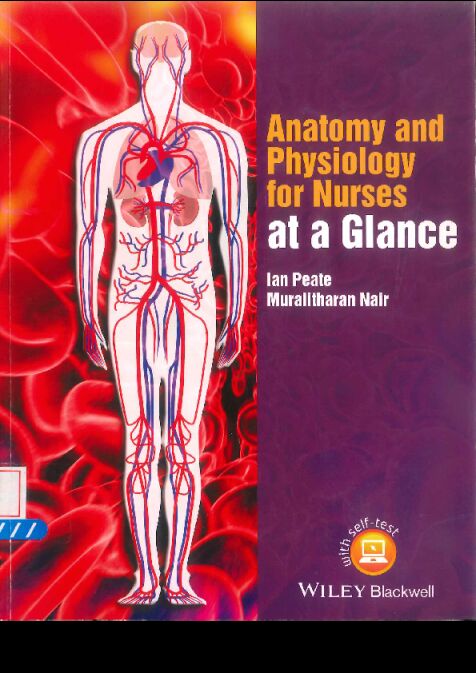
书名:Anatomy and physiology for nurses at a glance
责任者:Ian Peate | Muralitharan Nair.
出版时间:2015
出版社:John Wiley & Sons Inc.,
前言
In order to care effectively for people (sick or well) the nurse has to have an understanding and insight into anatomy and physiology.A\The human body is composed of organic and inorganic molecules that are organised at a variety of structural levels; despite this an individual should be seen and treated in a holistic manner, if the nurse is to provide appropriate and timely care, it is essential that they can recognise illness, deliver effective treatment and refer appropriately with the person at the centre of all they do.A\Nurses are required to demonstrate a sound knowledge of anatomy and physiology with the intention of providing safe and effective nursing care. This is often assessed as a part of a programme of study. The overall aim of this concise text is to provide an overview of anatomy and physiology and the related biological sciences that can help to develop your practical caring skills and improve your knowledge with the aim of you becoming a caring, kind and compassionate nurse. It is anticipated that you will be able to deliver increasingly complex care for the people you care for when you understand how the body functions.A\This text provides you with the opportunity to apply the content to the care of people. As you begin to appreciate how people respond or adapt to pathophysiological changes and stressors you will be able to understand that people (regardless of age) have specific biological needs.A\The integration and application of evidence-based theory to practice is a key component of effective and safe health care. This goal cannot be achieved without an understanding of anatomy and physiology.A\Living systems can be expressed from the very smallest level; the chemical level, atoms, molecules and the chemical bonds connecting atoms provide the structure upon which living activity is based. The smallest unit of life is the cell. Tissue is a group of cells that are alike, performing a common function. Organs are groups of different types of tissues working together to carry out a specific activity. Two or more organs working together to carry out a particular activity is described as a system. Another system that possesses the characteristics of living things is an organism, with the capacity to obtain and process energy, the ability to react to changes in the environment and to reproduce.A\Anatomy is associated with the function of a living organism and as such it is almost always inseparable from physiology. Physiology is the science dealing with the study of the function of cells, tissues, organs and organisms; it is the study of life.A\This At A Glance provides you with structure and a comprehensive approach to anatomy and physiology. Ian Peate, Muralitharan Nair
查看更多
目录
Preface vii
Abbreviations viii
Acknowledgements ix
How to use your revision guide x
About the companion website xi
Part 1 Foundations 1
1 The genome 2
2 Homeostatic mechanisms 4
3 Fluid compartments 6
4 Cells and organelles 8
5 Transport systems 10
6 Blood 12
7 Inflammation and immunity 14
8 Tissues 16
Part 2 The nervous system 19
9 The brain and nerves 20
10 Structures o! the brain 22
11 The spinal cord 24
12 The blood supply 26
13 The autonomic nervous system 28
14 Peripheral nervous system 30
Part 3 The heart and vascular system 33
15 The heart 34
16 Blood flow through the heart 36
17 The conducting system 38
18 Nerve supply to the heart 40
19 Structure of the blood vessels 42
20 Blood pressure 44
21 Lymphatic circulation 46
Part 4 The respiratory system 49
22 The respiratory tract 50
23 Pulmonary ventilation 52
24 Control of breathing 54
25 Gas exchange 56
Part 5 The gastrointestinal tract 59
26 The upper gastrointestinal tract 60
27 The lower gastrointestinal tract 62
28 The liver, gallbladder and biliary tree 64
29 Pancreas and spleen 66
30 Digestion 68
Part 6 The urinary system 71
31 The kidney: microscopic 72
32 The kidney: microscopic 74
33 The ureter, bladder and urethra 76
34 Formation of urine 78
Part 7 The male reprodictive system 81
35 External male genitalia 82
36 The prostate gland 84
37 Spermatogenesis 86
Part 8 The female reproductive system 89
38 Female internal reproductive organs 90
39 External female genitalia 92
40 The breast 94
41 The menstrual cycle 96
Part 9 The endocrine system 99
42 The endocrine system 100
43 The thyroid and adrenal glands 102
44 The pancreas and gonads 104
Part 10 The musculoskeletal system 107
45 Bone structure 108
46 Bone types 110
47 Joints 112
48 Muscles 114
Part 11 The skin 117
49 The skin layers 118
50 The skin appendages 120
51 Epithelialisation 122
52 Granulation 124
Part 12 The senses 127
53 Sight 128
54 Hearing 130
55 Olfaction 132
56 Gustation 134
Appendices
Appendix 1 Cross-references to chapters in Pathophysiology for Nurses at a Glance 136
Appendix 2 Normal physiological values 138
Appendix 3 Prefixes and suffixes 140
Appendix 4 Glossary 147
Further reading 150
Index 151
查看PDF
查看更多
馆藏单位
中国医科院医学信息研究所