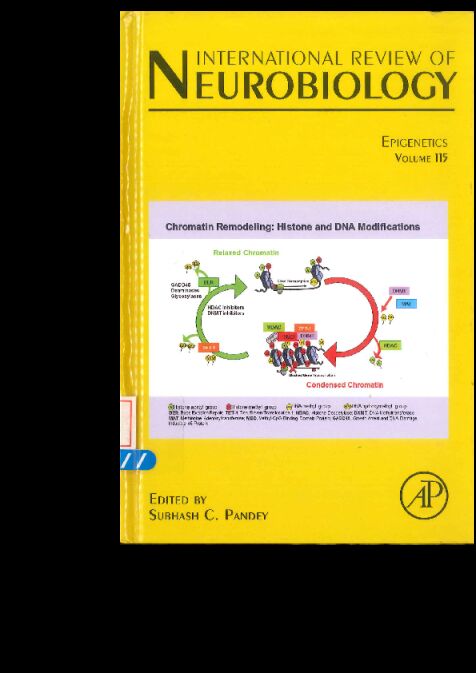
书名:Epigenetics
ISBN\ISSN:9780128013113,0128013117
出版时间:2014
出版社:Academic Press,
前言
Epigenetics is an emerging area in neuroscience research that appears to be crucial in regulating the pathophysiology of brain disorders. Chromatin architecture is regulated by chemical modifications to DNA and histories. DNA and histone methylation, as well as other histone modifications such as acetylation and phosphorylation, have been shown to regulate gene transcription. These epigenetic modifications cause short- and long-term changes in gene function without producing changes in DNA sequence. The epigenome can be effected before and after birth by several environmental factors, and this modified epigenome can play an important role in the etiology of many brain diseases and associated behavioral phenotypes.
Recently, it has been recognized that changes in epigenetic processes prior to birth can produce profound effects on brain development and thereby regulate several neurodevelopmental disorders. The first chapter on "Environmental alterations of epigenetics prior to the birth" by Lo and Zhou has provided attractive evidence of how aversive environmental exposure, including alcohol drinking of parents, might produce changes in epigenetic processes (DNA methylation, histone modification, and noncod-ing RNA) and predispose offspring to neurodevelopmental disease. This chapter will provide readers a better understanding of the prenatal epigenetic modifications due to environmental factors and related neurodevelopmental deficits and development of neuropsychiatric disorders later in life.
Transgenerational epigenetic inheritance has emerged as a fascinating mechanism for the inheritance of brain disorders. It appears that epigenetic changes produced by environmental factors such as alcohol exposure in the germline during embryonic development can be transmitted across several generations and contribute significantly to the inheritance of brain disease. The second chapter on "Transgenerational epigenetics and brain disorders" by Rachdaoui and Sarkar has discussed recent findings on transgenerational epigenetic inheritance. Readers of this chapter will learn the epigenetic mechanisms involved in the heritability of alcohol-induced neurobehavioral disorders such as fetal alcohol spectrum disorders.
Alcoholism in general is a complex psychiatric disorder and is dictated by positive and negative affective states. The third chapter on "The epigenetic landscape of alcoholism" by Krishnan et al. discusses evidence that chroma-tin remodeling causes changes in gene expression in specific brain regions contributing to the pathophysiology not only to alcoholism but also to comorbid anxiety disorders representing the "dark side of addiction." Here, evidence is presented to show that pharmacologically manipulating epige-netic targets may have great therapeutic potential in treating alcoholism with or without comorbid anxiety disorders.
Another environmental factor which has been shown to modulate chromatin architecture is stress. In the fourth chapter entitled "Epigenetic regulatory mechanisms in stress-induced behavior," Chakravarty et al. discuss various epigenetic regulatory mechanisms in the brain under stressful situations. The review will give readers an overview of epigenetic dys-regulation of neuropsychiatric diseases such as depression.
Epigenetic modifications appear to play a role in the etiology of schizophrenia. In the fifth chapter on "Epigenetics of schizophrenia: an open and shut case," Gavin and Floreani discuss several epigenetic studies, some of which suggest that schizophrenia is characterized by overly restrictive chromatin. However, recent studies indicate that the epigenetic mechanisms regulating the pathophysiology of schizophrenia may be more complex. They provide evidence based on recent studies in the field that it is plausible that drugs which further restrict chromatin may be efficacious in treating schizophrenia.
Autism spectrum disorder (ASD) is a neurodevelopmental disorder and recent evidence suggests the involvement of epigenetic mechanisms in pathophysiology of ASD. The sixth chapter on "Epigenetic mechanisms in autism spectrum disorder" by Zhubi et al. covers recent progress in the field regarding the impact of epigenetic mechanisms on transcriptional programs in the brain and their role in the pathophysiology of ASD.
MicroRNAs (miRNAs) are a class of small nonprotein-coding RNAs that have been shown to regulate gene expression and represent another layer of complexity in which epigenetics regulates the genome. The seventh chapter entitled "MicroRNAs and ethanol toxicity" by Miranda provides a discussion on recent findings that clearly suggest that miRNAs are an important component of the epigenetic machinery that modulate gene networks during pre- and postnatal ethanol exposure.
All chapters in this volume of the International Review of Neurobiology have attempted to summarize the recent progress and trends underlying epigenetic mechanisms of brain disorders. One of the environmental factors, alcohol, can interact with the epigenome at several levels and has the ability to modulate brain structure and function, thereby exerting profound effects on endophenotypes. Epigenetic mechanisms, as discussed above, play an important role in the pathophysiology of depression, stress, anxiety, schizophrenia, and autism. Taken together, the evidence presented here indicates that pharmacological agents which modulate the epigenome such as histone deacetylase and DNA methyltransferase inhibitors have potential therapeutic value in treating various brain disorders. In the future, studies that extend these preclinical epigenetic findings into humans across all brain diseases discussed here, offer the hope that one day we may be able to target the epigenome to treat these brain disorders, including alcoholism. SUBHASH C. PANDEY Departments of Psychiatry, and Anatomy and Cell Biology, University of Illinois at Chicago, and Jesse Brown Veterans Affairs Medical Center, Chicago, Illinois, USA
查看更多
目录
Contributors ix
Preface xi
1. Environmental Alterations of Epigenetics Prior to the Birth 1
Chiao-Ling Lo and Feng C. Zhou
1. Introduction 2
2. Manifestation of Environmental Factors 4
3. Mechanisms of Environmentally Induced Epigenetic Changes 19
4. Effect of Epigenetic Alterations on Neurodevelopment 25
Acknowledgments 34
References 34
2. Transgenerational Epigenetics and Brain Disorders 51
Nadia Rachdaoui and Dipak K. Sarkar
1. Introduction to Transgenerational Epigenetic Inheritance 51
2. Epigenetics and Epigenetic Processes 53
3. Evidence for Transgenerational Epigenetic Inheritance 55
4. Germline-lndependent Epigenetic Inheritance 57
5. Germline-Dependent Epigenetic Transmission 57
6. Transgenerational Epigenetic Effects on Brain Disorders 60
7. Concluding Remarks 66
Acknowledgment 66
References 67
3. The Epigenetic Landscape of Alcoholism 75
Harish R. Krishnan, Amul J. Sakharkar, Tara L Teppen, Tiffani D. M. Berkel, and Subhash C. Pandey
1. Introduction 76
2. Epigenetic Regulation due to Histone Covalent Modifications 78
3. Epigenetic Regulation due to DNA Methylation 89
4. Genome-Wide Approaches to Understand the Basis of Alcoholism 98
5. Using Invertebrate Models to Study the Basis of Ethanol Phenotypes 99
6. Inheritance of a Drug Phenotype 100
7. Conclusions 101
Acknowledgments 103
References 104
4. Epigenetic Regulatory Mechanisms in Stress-Induced Behavior 117
Sumana Chakravarty, Salil Saurav Pathak, Swati Maitra, Nitin Khandelwal, Karisetty Bhanu Chandra, and Arvind Kumar
1. Introduction 118
2. Stress-Induced Neural and Behavioral changes in Adulthood and the Epigenetic Mechanisms Involved 119
3. DNA Methylation and Demethylation in Stress-Induced Neural and Behavioral Responses 138
4. Role of Noncoding RNAs in Epigenetic Regulation of Stress-Mediated Effects 139
5. Early-Life Stress-Induced Adult Onset Behavioral Disorders and the Epigenetic Mechanisms Involved 144
6. Conclusion 146
Acknowledgments 147
References 147
5. Epigenetics of Schizophrenia: An Open and Shut Case 155
David P. Gavin and Christina Floreani
1. Introduction 156
2. An Epigenetics Primer 157
3. Heterochramatization 157
4. Euchromatization 161
5. Schizophrenia and Epigenetics 167
6. Fulfilling the Promise of Epigenetics in Schizophrenia 178
7. Conclusion 184
Acknowledgments 184
References 184
Further Reading 201
6. Epigenetic Mechanisms in Autism Spectrum Disorder 203
Adrian Zhubi, Edwin H. Cook, Alessandro Guidotti, and Dennis R. Grayson
1. Introduction 204
2. Molecular Aspects of Epigenetic Mechanisms 206
3. Genetic Defects with Epigenetic Implications 213
4. Epigenetic Dysregulation of ASD Candidate Genes 218
5. Environmental Model of Autism 227
6. Conclusions 229
Acknowledgments 231
References 231
Further Reading 244
7. MicroRNAs and Ethanol Toxicity 245
Rajesh C. Miranda
1. Introduction 246
2. miRNAs and Their Biogenesis 247
3. Mechanisms of miRNA Function 252
4. miRNAs as Mediators of Ethanol Effects in Developing and Adult Tissues 258
5. miRNA-Medlated Transgenerational Inheritance of Information; A Novel Mechanism for Transgenerational Transfer of Epimutations? 271
6. Conclusions 273
Acknowledgments 275
References 275
Index 285
Contents of Previous Volumes 291
查看PDF
查看更多
馆藏单位
中国医科院医学信息研究所