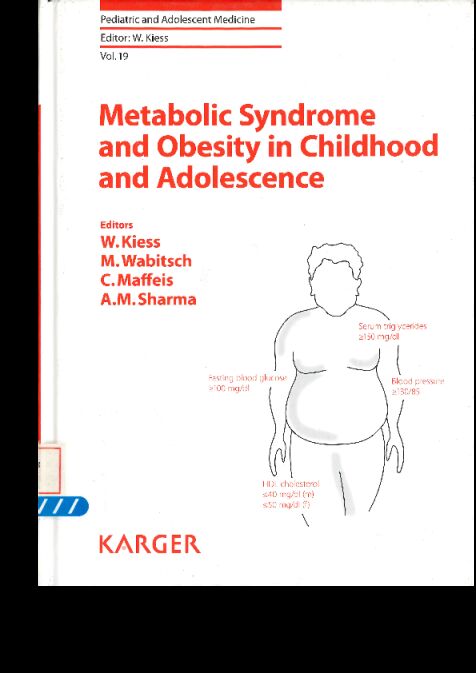
书名:Metabolic syndrome and obesity in childhood and adolescence
责任者:Wieland Kiess | Martin Wabitsch | Claudio Maffeis | Arya M. Sharma.
前言
In this volume in our series 'Pediatric and Adolescent Medicine,' probably the most common and most urgent clinical problem in pediatrics and adolescent medicine is being covered by experts from around the world. The volume discusses pertinent and prevalent topics such as the definition and clinical aspects of obesity. Additionally, novel viewpoints and ideas for the future are presented; these will facilitate both interaction with obese children and adolescents in a fair and appropriate way and collaboration with the individuals affected to seek appropriate and effective prevention and treatment measures.
In section number one, definitions and clinical aspects are covered. Martin Wabitsch from the University of Ulm, Germany, and Antje Korner from the University of Leipzig, Germany, discuss different definitions and the basic clinical aspects of obesity in childhood and adolescence. They describe obesity as part of metabolic syndrome and indeed as one of the causes leading to the full-blown clinical picture of metabolic syndrome. Abdullah Bereket from Istanbul, Turkey, and his co-workers report on the following in their chapter on the clinical entity of hypothalamic obesity: obesity caused by injury or trauma to or surgery on the hypothalamus as well as the fact that inborn genetic diseases affecting nuclei and regions of the hypothalamus can cause obesity in a very severe and extreme way. Abdullah Bereket and his colleagues emphasize that hypothalamic obesity is still resistant to traditional therapeutic measures, that prevention should be mandatory but is also difficult, and that new clinical trials with new treatment protocols are urgently required.
In section two, Yvonne Bottcher and Peter Kovacs from the University of Leipzig, Germany, first present a very nicely written chapter on the genetics of obesity in childhood and adolescence. They focus on DNA and methylation and the biology of the disease. Second, Hermann Kalhoff and Mathilde Kersting from Dortmund and Bonn, Germany, outline all aspects of nutrition in relation to metabolic syndrome and obesity in childhood and adolescence. Third, sedentary behavior has been identified as a public health issue for the last 10 years. This is being pointed out in the excellent chapter from France, in which Maithe Tauber and her colleagues from Toulouse rightly argue that preventive interventions should focus on changing the sedentary lifestyle, even and especially at a young age. In this fine contribution they also report on why people adopt a sedentary lifestyle. Fourth, Sandra Plachta-Danielzik and Manfred James Miiller from the University of Kiel, Germany, review their own data and perform a meta-analysis of all available information on socio-economic aspects as causes of metabolic syndrome and obesity. It is actually their contribution via the 'KOPS' study in Kiel that has drawn our attention to the socio-economic aspects of metabolic syndrome during the last decade.
In section three, the consequences of obesity in childhood and adolescence are discussed. Martin Wabitsch and Christian Denzer from the University of Ulm, Germany, review the impact of obesity on carbohydrate metabolism. They especially refer to insulin resistance, glucose intolerance, and the long-term development of type 2 diabetes early in life. Falk Thielemann, Klaus-Peter Guenther, and Maik Stiehler from the University of Dresden, Germany, discuss the orthopedic aspects of obesity in children and adults. In fact, back pain, hip and knee pain, and a vast array of orthopedic complications that are typical of severe obesity are already present in childhood. A very often neglected aspect of obesity at all ages, namely, urogenital complications, is summarized in the chapter by Anita Morandi and Claudio Maffeis from the University of Verona in Italy. In fact, renal disease, even including terminal renal failure as well as urolithiasis in the long term, and lower urinary tract symptoms such as itching, painful urination, and cystitis are already related to obesity in childhood and adolescence. The last chapter in this section deals with the putative consequences of obesity in childhood on pubertal development; it is still unclear whether obesity has led to an earlier onset of puberty in affected populations or whether the phenomena of the prevalence of obesity and an earlier age at menarche and puberty are merely coincidental. Our groups from the University of Leipzig in Germany and the University of Melbourne in Australia (authors Isabel V. Wagner, Matthew Sabin, and Wieland Kiess) summarize the available data.
In section four, the societal aspects and prevention of obesity are discussed. Indeed, during the last couple of years, it has become clear that societal aspects and indeed the social sciences have to be addressed much more when one wants to speak about obesity in childhood and adolescence. In fact, Ulrike Igel and Gesine Grande (University of Applied Sciences (HTWK), Leipzig, Germany) discuss the relationship between neighborhood characteristics and obesity in children and adolescents. This topic is very new, very pressing, and indeed innovative. Robert H. Lustig from the University of California, San Francisco, USA, writes about the role of food industries and the role of a 'Western' diet as causative factors in the development of obesity. He sets science and politics, as sometimes conflicting and sometimes counterproductive entities, as the focus of this chapter. Currently, the most talked about societal aspect in our lives seems to be economics; it is therefore understandable that an economic perspective on childhood obesity is also presented in this section. Rolf Holle and his colleagues from the University of Munich, Germany, do this in a very comprehensive, innovative, and diligent way. Finally, two chapters on new ways to think about prevention are presented by two young investigators from the University of Leipzig, Germany. Jana Markert identifies barriers that are obstacles to families' participation in childhood obesity prevention programs. She draws from a large body of data that she and her co-workers have assembled and already partially published on this matter. Since electronic data usage and electronic communication means are now so prevalent in our lives, it is important to investigate e-health approaches and their effects on obesity prevention. Can electronic communication means and social networks be used for obesity prevention and even treatment (chapter by Sabine Herget, University of Leipzig)?
In section five, new obesity treatments are presented. Thomas Reinehr from Dat-teln, Germany, who has developed his own Obeldicks obesity treatment program and has successfully evaluated and institutionalized it, reviews available obesity programs, their efficacy, and their routine clinical use. Next, in one chapter, bariatric surgery in adolescents is reviewed: Paola Luca, Elizabeth Dettmer, Jakob C. Langer, and Jill K. Hamilton from Calgary and Toronto, Canada, report on the current status of adolescent bariatric surgery as an evolving field. Lastly, Geoff D.C. Ball and co-workers from several Canadian Universities describe their vast experience and insights related to working effectively with families and operating within the healthcare system to manage pediatric obesity. It is important that in this last contribution in our volume, Geoff D.C. Ball and co-authors in fact go far beyond mere 'weight loss' and describe the many aspects of metabolic syndrome and obesity in childhood and adolescence once more in a comprehensive and interdisciplinary manner. Wieland Kiess, Leipzig Martin Wabitsch, Ulm Claudio Maffeis, Verona Arya M. Sharma, Edmonton, Alta.
查看更多
目录
Preface vii
Definitions and Clinical Aspects
Definitions 1
Hypothalamic Obesity in Children 13
Causes
Genetics of Obesity in Childhood and Adolescence 31
Nutrition 40
Sedentary Lifestyle 53
Socio-Economic Aspects 68
Consequences
Carbohydrate Metabolism 75
Orthopaedic Aspects of Obesity in Children and Adults 84
Urogenital Complications: Renal Disease, Urolithiasis and Lower Urinary Tract Symptoms 99
Influences of Childhood Obesity on Pubertal Development 110
Societal Aspects and Prevention
Urban Living Conditions:The Relation between Neighborhood Characteristics and Obesity in Children and Adolescents 126
Metabolic Syndrome and the 'Western Diet': Science and Politics 137
An Economic Perspective on Childhood Obesity 148
Prevention of Childhood and Adolescent Obesity and its Barriers 160
E-Health in Overweight and Obesity Prevention 166
Obesity Management
Obesity Treatment Programmes 171
Adolescent Bariatric Surgery: Current Status in an Evolving Field 179
Beyond Weight Loss: Experiences and Insights Related to Working Effectively with Families and Operating within the Health Care System to Manage Pediatric Obesity 187
Author Index 194
Subject Index 195
查看PDF
查看更多
馆藏单位
中国医科院医学信息研究所