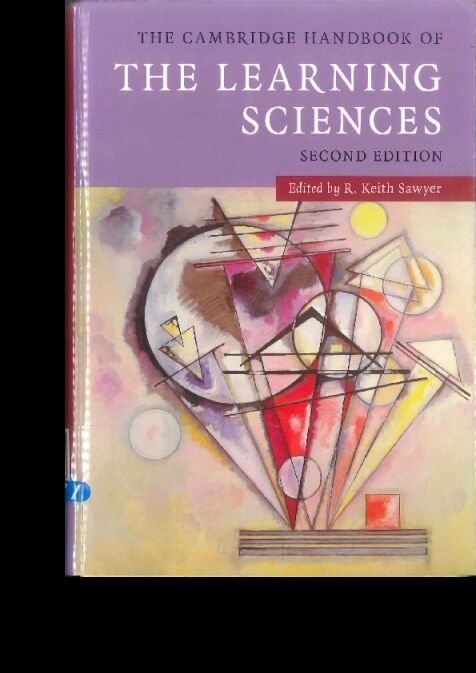
书名:The Cambridge handbook of the learning sciences
ISBN\ISSN:9781107033252,9781107626577
出版时间:2014
出版社:Cambridge University Press,
分类号:文化、科学、教育、体育
版次:2nd ed.
前言
This book is for everyone who wants to know what scientists have discovered about how people learn education researchers, teachers, administrators, policy makers, consultants, and software designers. This handbook is your introduction to a powerful approach to reforming education and schools, an approach that builds on the learning sciences to design new learning environments that help people learn more deeply and more effectively.A\In 2006, the first edition of The Cambridge Handbook of the Learning Sciences (CHLS) was published. As the first comprehensive overview of learning sciences research, CHLS found a broad audience and was widely adopted as a text in university learning sciences programs. The impact was international, with particularly large numbers of readers in the United States and in Europe, and with translated editions in Chinese and Japanese also selling well. Because of this significant impact, and exciting new advances in the field, the need has increased for a second edition.A\This second edition represents developments in the field since the text of the first edition was finished in 2005. This new second edition, CHLS 2E, shows how educators can use the learning sciences to design effective and innovative learning environments - including school classrooms and informal settings such as science centers or after school clubs, online learning, and educational software. Each chapter in CHLS 2E describes exciting new classroom environments, based on the latest science about how people learn. These classroom environments combine new curricular materials, new collaborative activities, support for teachers, and innovative educational software, often using the unique advantages of the Internet to extend learning beyond the walls of the school. CHLS 2E is a true "handbook" in that readers can use it to design the schools of the future - schools that are based on learning sciences research and that draw on the full potential of computer and Internet technology to improve students' experiences. The learning sciences are supporting deep links between formal schooling and the many other learning institutions available to students libraries, science centers and history museums, after school clubs, online activities that can be accessed from home, and even collaborations between students and working professionals.A\In particular, this handbook describes how to use the new sciences of learning to design effective learning environments, in classrooms and outside, often taking advantage of new computer technology. As Chapter 2, "Foundations of the Learning Sciences," points out, learning sciences is a "design science" that incorporates both research and practice. Redesigning schools so that they are based on scientific research is a mammoth undertaking, and it will require the participation of all of the groups that read this book: teachers, parents, school leaders, policy makers, and education researchers.A\This second edition has some overlap with the first edition, but most of it is completely new: of the 36 chapters here, 23 of them are written by authors whose work did not appear in the first edition, and 20 of them discuss topics that did not have dedicated chapters in the first edition. The 13 chapters that are repeated from the first edition have been substantially rewritten.A\In this second edition, the chapter topics and their authors were selected by a distributed, collective process that involved the entire learning sciences community, as well as input from readers and users of the first edition. To determine the chapter topics to be included in this second edition, I gathered three sources of information:A\•I conducted an online survey, using SurveyMonkey, that was distributed to the membership of the International Society of the Learning Sciences (ISLS), asking which topics from the first edition should remain in the second edition, and which new topics should be added. I received 90 responses to this survey.•The publisher, Cambridge University Press, distributed the same survey to seven instructors who were using the first edition in their university courses. •I used Google Scholar to determine the number of citations each of the chapters had received.A\These three information sources were largely consistent with each other, and I used this information to identify the 36 chapter topics. Then I distributed a second survey to the ISLS membership, asking them to suggest authors for each of these chapter topics. Because of the increasing international scope of the learning sciences, one of my personal goals was to increase the number of non-U.S. contributors in the second edition. After all, the annual learning sciences conferences have now been held in many different countries, all with active learning sciences research programs. The ISLS hosts two conferences, the International Conference of the Learning Sciences (ICLS) conference (in even years) and the Computer Supported Collaboration Learning (CSCL) conference (in odd years). The ICLS has been held in The Netherlands (2008) and in Australia (2012). The CSCL has been held in Canada (1999), The Netherlands (2001), Norway (2003), Taiwan (2005), Greece (2009), and Hong Kong (2011).A\Because the field has such broad international participation - the ISLS includes members from six continents - in my second survey I asked ISLS members to suggest names of both U.S. and non-U.S. experts on each topic. The contributors to the second edition come from almost every country with active learning sciences research. Of the 72 contributors, 47 are from the United States; 11 are from Europe; 4 are from Canada; 6 are from Asia; 3 are from Israel; and 1 is from Australia. (Contrast this with the first edition: only 5 authors were from outside the United States.)A\The 36 chapters of the CHLS are organized into six parts. •Part I: Foundations. Each of these chapters focuses on a foundational concept that has been influential in learning sciences research from the origin of the field in the 1980s and 1990s. These foundational concepts are introduced in Chapter 2. •Part II: Methodologies. Learning scientists use a broad range of methodologies, including experimental psychological methods. I chose not to provide a chapter on experimental designs - although they have contributed substantially to learning sciences research because such introductions are easy to find elsewhere, and also because experimental designs are not typically used in designing real-world learning environments. The chapters here focus on innovative methodologies that have, at least in part, been developed by the learning sciences community - often to bring together research and practice, and to bridge the elemental and systemic levels of analysis (see Chapter 2). •Part III: Practices that Foster Effective Learning. Each of these chap-ters describes an innovative classroom practice, based in learning sciences research, that has been documented to lead to enhanced learning outcomes. •Part IV: Learning Together. A wide range of educational research has found that collaboration contributes to learning. Unlike an older generation of educational software, where each student worked in isolation at his or her own computer, the advent of the Internet and of wireless handheld devices supports students in learning collaborations, so that computers bring students together instead of pulling them apart. These chapters show how learning environments can be designed to foster more effective learning conversations. •Part V: Learning Disciplinary Knowledge. This section is new in the second edition. These chapters are written primarily for a broad audience of learning scientists, and secondarily for education researchers working in that discipline. The focus of each chapter is: What unique epistemologies, practices, and findings - inspired by this discipline's content - change the way we think about learning more generally? How does studying learning in this discipline add to what we know from studies of learning more generally? •Part VI: Moving Learning Sciences Research into the Classroom. Globally, many education systems are looking to learning sciences research to help them redesign their schools for a 21st-century knowledge and innovation age. Learning sciences researchers are prepared to offer practical solutions, because the discipline works to bridge research and practice. These chapters summarize the key messages from learning sciences for education policy makers, and explore what might happen when we take learning sciences findings and use them to reform schools, classrooms, and teacher practices.A\In my own introduction and conclusion to this handbook, I explain why the learning sciences are important not only to education, but to our entire society. The major advanced nations and the entire global economy are rapidly changing. In these two chapters, I draw on a large body of recent scholarship that describes the mismatch between the schools we have today and the demands of the knowledge age. Because the learning sciences are discoveringhow to teach the deep knowledge, skills, and attitudes required in the knowledge society, they are positioned to provide the blueprint for the schools of the future.A\This six-part structure does not reflect established divisions within the field - far From it. The chapter topics that emerged from the process I described earlier seemed to me to fall naturally into these six groupings, but another editor might have come up with a different organizational structure. Many of the chapters touch on themes common to more than one part, and could have been placed in more than one location in the handbook. There is a lot of cross-referencing between chapters both within and among these six parts, and this coherence and interconnection is one of the strengths of the learning sciences.A\A book like CHLS is a massive undertaking; 72 authors have contributed to this book, and many other members of the learning sciences community have contributed indirectly, by reading and commenting on chapter drafts. As with any professional community, the knowledge that emerges is collectively created by all of the participants. Many important scholars whose names do not appear as authors nonetheless have contributed to the collective endeavor of the learning sciences. While editing this handbook, I have discovered that the members of this professional community are deeply aware that they are each only one participant in a broad community of practice, and that the knowledge generated cannot be considered to be owned or possessed by any one researcher. By sharing openly and working collaboratively, learning sciences researchers have made great strides in less than two decades. I hope that CHLS functions as a resource that will allow a significant expansion of this community of practice, allowing everyone involved with education to tap into these new findings and begin the task of designing the schools of the future.A\I would like to thank my editors at Cambridge University Press, whose commitment to this project was an inspiration. Over the years, I discussed the structure and timing of a second edition with many different editors who successively served as the psychology editor at Cambridge. Phil Laughlin was the original editor on the 2006 first edition. He was replaced by Eric Schwartz, who was replaced by Simina Calin, who was replaced by Emily Spangler, who was replaced by Adina Berk. Ms. Berk reviewed the second edition proposal and issued a contract in March 2012. Ms. Berk left Cambridge in August 2012. In March 2013, David Repetto took over as my editor, and he expertly took the project into production.A\I would like to thank the leadership of the International Society of the Learning Sciences (ISLS). In preparing this second edition, I relied heavily on two surveys, described above, that the ISLS passed on to their membership list. The Board of Directors of the ISLS also provided me with several statistics that demonstrate the increasing impact of the learning sciences, and I drew on these while preparing this Preface.A\I am grateful to each of the authors for the hard work they invested. It was a true pleasure to work with such a deeply professional group of scholars, with everyone delivering their chapters "on time and under budget," as they say. I am particularly grateful that the authors were willing to respond to my suggestions - in many cases I offered very detailed comments that required them to invest a significant amount of time to write a second draft. My goal was to read with the mindset of our target reader, a newcomer to the field of learning sciences. I worked to identify passages or terms that might be difficult for a newcomer to understand. A second goal was to ensure that each chapter was as concise and focused as possible; because there are 36 chapters, each one had rather strict length limitations. Having worked so closely with these scholars through their multiple drafts, I have a deeper understanding of why the learning sciences is having such a significant impact on education.
查看更多
目录
List of Figures ix
List of Tables xiii
List of Contributors xv
Preface xix
1.Introduction: The New Science of Learning 1
Part I.Foundations
2.Foundations of the Learning Sciences 21
3.Scaffolding 44
4.Metacognition 63
5.A History of Conceptual Change Research: Threads and Fault Lines 88
6.Cognitive Apprenticeship 109
7.Learning in Activity 128
Part II.Methodologies
8.Design-Based Research: A Methodological Toolkit for Engineering Change 151
9.Microgenetic Methods 171
10.Analyzing Collaboration 191
11.Frontiers of Digital Video Research in the Learning Sciences: Mapping the Terrain 213
12.A Learning Sciences Perspective on the Design and Use of Assessment in Education 233
13.Educational Data Mining and Learning Analytics 253
Part III.Practices that Foster Effective Learning
14.Project-Based Learning 275
15.Problem-Based Learning 298
16.Complex Systems and the Learning Sciences 319
17.Tangible and Full-Body Interfaces in Learning 339
18.Embodiment and Embodied Design 358
19.Videogames and Learning 377
Part IV.Learning Together
20.Knowledge Building and Knowledge Creation: Theory,Pedagogy, and Technology 397
21.The Social and Interactive Dimensions of Collaborative Learning 418
22.Arguing to Learn 439
23.Informal Learning in Museums 461
24.Computer-Supported Collaborative Learning 479
25.Mobile Learning 501
26.Learning in Virtual Worlds 522
Part V.Learning Disciplinary Knowledge
27.Research in Mathematics Education: What Can it Teach Us about Human Learning? 545
28.Science Education and the Learning Sciences as Coevolving Species 565
29.Learning Historical Concepts 587
30.Learning to Be Literate 605
31.Arts Education and the Learning Sciences 626
Part VI.Moving Learning Sciences Research into the Classroom
32.Learning Sciences and Policy Design and Implementation: Key Concepts and Tools for Collaborative Engagement 649
33.Designing for Learning: Interest, Motivation, and Engagement 668
34.Learning as a Cultural Process: Achieving Equity through Diversity 686
35.A Learning Sciences Perspective on Teacher Learning Research 707
36.Conclusion: The Future of Learning: Grounding Educational Innovation in the Learning Sciences 726
Index 747
查看PDF
查看更多
馆藏单位
中国医科院医学信息研究所