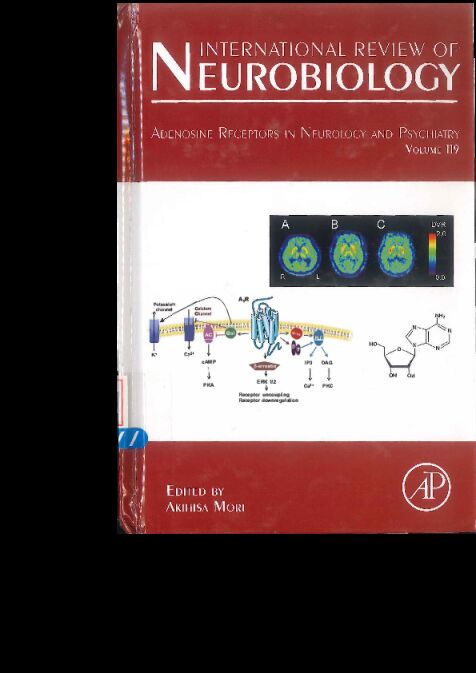
书名:Adenosine receptors in neurology and psychiatry
前言
Most diseases resulting from brain dysfunction are very tragic not only for the patients themselves but also for their families because these diseases deprive them of both the quality of human life and often compassion. The brain is one of the last frontiers in modern biology, with many unknown mechanisms. Thereby, the areas of neurology and psychiatry are the most challenging for scientists those whose goal is to open the gates to new cures for diseases involving the brain.
Adenosine is a purine ribonucleoside and is ubiquitously distributed throughout the mammalian body. Since the 1920s, adenosine and purine receptors have been studied extensively in biomedical research. Approximately an 80-year journey of research already traveled by great ancestors stands before us.
Since the beginning of research, there have been significant outcomes ensuring that the adenosine and purine families contribute to the mammalian cardiovascular system, including vasodilation and heart function. It should be noted that the progression of receptor science has always been supported by molecular biology for receptor classification and promoted via the appearance of pharmacological tools like selective agonists and antagonists to identify receptor function. These tools also sometimes become known in the development of medicines as new therapeutics themselves. Adenosine receptor science is, of course, not an exception. Tn the early 1970s, it -was proposed that adenosine was an important neuromodulator in both the peripheral and central nervous systems. This was evidenced by studies using methylxanthines, such as caffeine and theophylline, as antagonists at adenosine receptors. Furthermore, in the beginning of the 1990s, we saw an explosion of adenosine receptor science because molecular biology and pharmacology identified the four adenosine receptor subtypes: the A_1, A_2a, A_2B, and A_3 receptors. At the same time, caffeine, a non-selective adenosine antagonist, was still widely employed in many studies, including human epidemiology, as a kind of unique contribution for the field, until selective receptor agents -were invented (for example, a cup of coffee containing caffeine made science close to many people's mind). Recently, receptor selective agents were created to assist and accelerate the entire research effort, which often brought to light particular physiological functions of adenosine as a neuromodulator/neurotransmitter. Some of the adenosine agents also became new candidates as medicines for the treatment of brain dysfunction.
Due to the nature of adenosine, which is a ubiquitous modulator of cellular activity, it is not surprising that there is a growing body of interest for adenosine and its receptors and their role as new and broad targets for research of brain function and dysfunction.
I invited distinguished scientists, who are working to further adenosine receptor science by seeking new therapies for a number of CNS diseases as well as adenosine function in the brain, to contribute to this volume. These scientists participated enthusiastically by sharing their new insights, knowledge, therapeutic strategies, views, and future applications for adenosine receptor science from multiple disease and brain functional perspectives, such as Parkinson's disease, Huntington's disease, epilepsy, cognitive function, cerebral ischemia, sleep, depression, anxiety, and schizophrenia.
In the early 1990s, when I started to work in the research area of adenosine receptor function in the brain, I did not have any idea like I do today that there could be so many aspects and practical ideas for new therapies involving adenosine receptors, as described in this volume. Now, I am very confident knowing that tomorrow will be more fantastic and will produce practical cures for neurological and psychiatric diseases from the continued research and progression of adenosine receptor science.
Finally, I would like to acknowledge the tremendous efforts and huge insights made into adenosine receptor science by my colleagues and contributors for this volume. Akihisa Mori Cherry blossom season in Tokyo, 2014
查看更多
目录
Contributors xi
Preface xv
1. Adenosine Receptor Neurobiology: Overview 1
Jiang-Fan Chen, Chien-fei Lee, and Yijuang Chern
1. General Introduction 2
2. Source and Regulation of Extracellular Adenosine Level 4
3. ARs Subtypes: Classification and Gene Structures 5
4. Expression of ARs in the Brain 7
5. Structure Biology of Adenosine A_2A Receptors 8
6. Canonical and Noncanonical Signaling Pathways of ARs 9
7. Interactions Between ARs and Other GPCRs and Neurotrophic Factor Receptors 18
8. AR Functions: Insights from Pharmacological and Genetic-KO Approaches 19
9. ARs and Glial Functions 26
10. Pathophysiological Functions of ARs 27
11. ARs as Drug Targets 29
Acknowledgments 30
References 30
Further Reading 49
2. Adenosine Receptor PET Imaging in Human Brain 51
Masahiro Mishina and Kiich Ishiwata
1. Introduction 51
2. PET Imaging of Adenosine A_1 Receptors 55
3. PET Imaging of Adenosine A_2a Receptors 59
4. Conclusions 63
References 63
3. An Overview of Adenosine A_2A Receptor Antagonists in Parkinson's Disease 71
Peter Jenner
1. Problems in the Treatment of Parkinson's Disease 72
2. Non-dopaminergic Approaches to the Treatment of PD 73
3. Adenosine A_2A Receptor Antagonists and Motor Function 74
4. Adenosine A_2A Receptor Antagonists and Nonmotor Symptoms of PD 77
5. A_2A Adenosine Receptor Antagonists and Neuroprotection in PD 78
6. A_2a Receptor Antagonists and Clinical Outcomes in PD 79
7. Conclusions 82
References 83
4. Mode of Action of Adenosine A_2A Receptor Antagonists as Symptomatic Treatment for Parkinson's Disease 87
Akihisa Mori
1. Introduction 88
2. The Basal Ganglia Thalamocortical Circuit and Pathophysiology of PD 88
3. Striatal MSNs 90
4. Localization of Adenosine A_2a Receptors On/Around Striatal MSNs 91
5. Proposed Mechanism of Adenosine A_2a Receptor Function and Mode of Action of A_2A Receptor Antagonists on Motor Control via the Basal Ganglia 93
6. New Aspect for the Pathophysiological Change to Striatopallidal MSNs in PD 106
7. Concluding Remarks 108
References 109
5. Adenosine Receptors and Dyskinesia in Pathophysiology 117
Masahiko Tomiyama
1. Pathogenesis of Levodopa-lnduced Dyskinesia 117
2. Adenosine A_2a Receptors and Levodopa-lnduced Dyskinesia 119
References 122
6. Clinical/Pharmacological Aspect of Adenosine A_2A Receptor Antagonist for Dyskinesia 127
Tomoyuki Kanda and Shin-ichi Uchida
1. Introduction 128
2. Noncltnical Studies of the Effects of Adenosine A_2A Receptor Antagonists on Dyskinesia 130
3. Clinical Outcomes of Adenosine A_2A Receptor Antagonist on Dyskinesia 138
4. Comparison Between Nonclinical and Clinical Findings on Adenosine A_2a Receptor Blockade and Dyskinesia 144
5. Conclusions 147
References 147
7. Interaction of Adenosine Receptors with Other Receptors from Therapeutic Perspective in Parkinson's Disease 151
Nicolas Morin and Therese Di Paolo
1. Introduction 152
2. Adenosine Receptors in the Basal Ganglia and Signal Transduction 154
3. A_1 and A_2a Adenosine Receptor Interactions and Heterodimerization 157
4. Adenosine and Dopamine Receptor Interactions and Heterodimerization 158
5. Adenosine and Glutamate Receptor Interactions and Heterodimerization 159
6. Discussion 160
7. Conclusion 161
Acknowledgments 162
References 162
8. Effects of the Adenosine A_2A Receptor Antagonist on Cognitive Dysfunction in Parkinson's Disease 169
Shin ichi Uchida, Takako Kadowaki-Horita, and Tomoyuki Kanda
1. Introduction 170
2. Cognitive Dysfunction in PD 171
3. The Role of Adenosine A_2a Receptors on Cognitive Function 179
4. Effects of Adenosine A_2A Receptor Antagonists on Cognitive Dysfunction in PD 179
5. Conclusion 184
References 135
9. Clinical Nonmotor Aspect of A_2A Antagonist in PD Treatment 191
Masahiro Nomoto, Masahiro Nagai, and Noriko Nishikawa
1. Introduction 191
2. Case Report 192
3. Discussion 193
4. Conclusion 193
References 193
10. Adenosine Receptors and Huntington's Disease 195
Chien-fei Lee and Yijuang Chern
1. Pathogenetic Mechanisms of Huntington's Disease 196
2. Alteration in Adenosine Homeostasis in HD 199
3. Regulation of Adenosine Receptors in HD 202
4. Therapeutic Actions of Adenosine Receptor Agonists and Antagonists in HD 209
5. Positron Emission Tomography Imaging for Adenosine Receptor Occupancy in HD 219
6. Concluding Remarks 220
Acknowledgments 220
References 221
11. Adenosine Receptors and Epilepsy: Current Evidence and Future Potential 233
Susan A. Masino, Masahito Kawamura, Jr., and David N. Ruskin
1. Introduction 233
2. Adenosine Regulates Ongoing Neurotransmission 235
3. Adenosine Receptor Subtypes and Epilepsy 236
4. Chronic Changes in Adenosine Receptor Activation 239
5. Gliosis, Adenosine Kinase, and Epileptogenesis 240
6. Human Adenosine Receptor Polymorphisms 240
7. Adenosine and Neuroinflammation 241
8. Adenosine-Based Mechanisms Underlying Anticonvulsant Diet Therapy 242
9. Conclusions 244
References 245
12. Adenosine Receptor Control of Cognition in Normal and Disease 257
Jiang-Fan Chen
1. Adenosine as an Upstream Regulator of Dopamine, Glutamate, and Brain-Derived Neurotrophic Factor Signaling: A Molecular Basis for AR Control of Cognition 258
2. Adenosine Receptor Modulation of Synaptic Plasticity: A Cellular Basis for AR Control of Cognition 262
3. Adenosine Receptor Modulates Learning and Memory in Normal Animals 267
4. Adenosine Receptor Control of Cognition in Neuropsychiatric Disorders 274
5. Concluding Remarks 287
Acknowledgments 288
References 288
Further Reading 307
13. Adenosine Receptors in Cerebral Ischemia 309
Alessia Melani, Anna Maria Pugliese, and Felicita Pedata
1. Introduction 310
2. A_1 Receptors in Brain Ischemia 312
3. A_2A Receptors in Brain Ischemia 317
4. A_2B Receptors in Brain Ischemia 326
5. A_3 Receptors in Brain Ischemia 328
6. Conclusions 332
References 332
14. Roles of Adenosine and its Receptors in Sleep-Wake Regulation 349
Zhi-Li Huang, Ze Zhang, and Wei-Min Qu
1. Introduction 351
2. Formation, Metabolism, and Transport of Adenosine in the Central Nervous System 351
3. Adenosine Is a Key Signaling Molecule for PGD_2-lnduced Sleep 353
4. An Increase in the Extracellular Adenosine Level Promotes Sleep 355
5. Predominant Roles of A_2A Receptor in Sleep Regulation 357
6. The Involvement of A_2A Receptor in the NAc in Sleep-Wake Regulation 361
7. A, Receptors Contribute to Sleep Induction in a Region-Dependent Manner 363
8. Conclusions 365
Acknowledgments 366
References 366
15. Involvement of Adenosine A_2a Receptors in Depression and Anxiety 373
Koji Yamada, Minoru Kobayashi, and Tomoyuki Kanda
1. Introduction 374
2. Adenosine Receptors and Anxiety 374
3. Adenosine Receptors and Depression 380
4. Mechanisms of Actions After the Blockade of Adenosine A_2A Receptors 384
5. Conclusion 387
References 388
16. The Adenosine Neuromodulation System in Schizophrenia 395
Daniel Rial, Diogo R. Lara, and Rodrigo A. Cunha
1. Clinical Features of Schizophrenia 396
2. Morphological and Neurochemical Features of Schizophrenia 399
3. The Adenosine Neuromodulation System 407
4. Impact of Manipulating the Adenosine System in Animal Models of Schizophrenia 416
5. Impact of Caffeine and Other Drugs Acting on the Adenosine Modulation System in Schizophrenic Patients 420
6. Proposed Adenosine Hypothesis of Schizophrenia 424
Acknowledgments 425
References 425
Index 451
Contents of Recent Volumes 463
查看PDF
查看更多
馆藏单位
中国医科院医学信息研究所