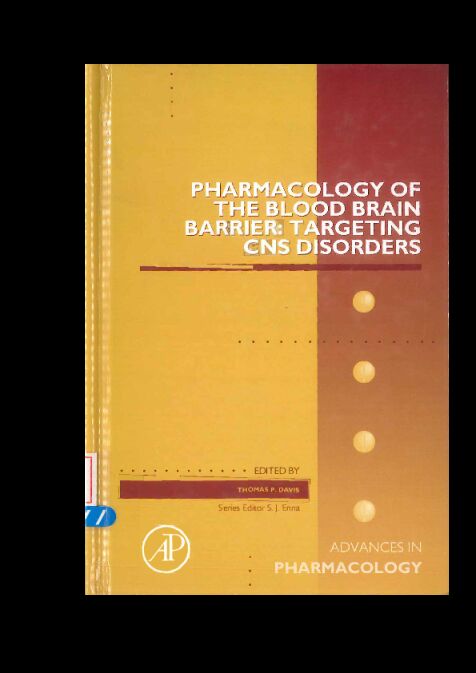
书名:Pharmacology of the blood brain barrier
ISBN\ISSN:9780128002827,0128003383
出版时间:2014
出版社:Academic Press,
前言
The field of blood-brain barrier (BBB) pharmacology is a relatively new area. We owe our start to the seminal work of Reese and Karnovsky in 1967, whom answered an ongoing controversy, first observed by Paul Ehrlich in 1885, that the BBB lies principally at the endothelium of cerebral capillary endothelial cells. Soon after in 1969, Brightman and Reese showed key ultrastructural evidence of protein tight junctions that function to block paracellular delivery of almost all solutes to the brain primarily due to high transendothelial cell resistance. In 2002, leaders at the National Institute of Neurological Disorders and Stroke formed a Stroke Progress Review Group (SPRG), which recognized the urgency to determine the role of the BBB in stroke. This SPRG identified the priority to "better define the molecular influences and cell-signaling mechanisms that characterize the interaction between circulating blood elements and the blood vessel wall, the extracellular matrix, glia and neurons (together, the neurovascular unit)...." (NVU). The BBB and NVU remain the most significant challenge to central nervous system (CNS) drug development from the past century. This fact drives the passion of our students and colleagues. We understand that progress in preventing, diagnosing, or treating diseases of the CNS depends upon understanding the BBB and NVU. It is often stated, "if we cannot get the drug into the brain we cannot treat a disease of the brain."
Presented in this timely volume are three sections of seminal contributions from outstanding, internationally acclaimed experts describing (1) BBB/NVU protein, ion, and receptor-mediated transporters that can be pharmacologically targeted to improve/modulate CNS drug delivery; (2) world-class experts' focus on specific targeting of CNS disorders associated with stroke, inflammation, ischemia, cancer, human African trypanosomi-asis sleeping sickness, and two exciting chapters by established experts describing recent advances in engineering proteins, peptides, and antibodies to treat CNS disorders; and (3) a special innovative section on the challenges of treating complex comorbidities such as hyperglycemia/diabetes/hemor-rhagic transformation/stroke; aging/metabolic syndrome/ischemic stroke; and drag abuse-induced CNS disorders.
I wish to thank each one of my valued colleagues for making this volume possible. What links each of these authors together is a strong allegiance to their chosen field that is interactive, collegial and focused on excellence. In short, we are a "tight group" of friends as well. As BBB/NVU investigators we have a unique perspective, and responsibility, to address a critical priority; that after a century of developing and testing CNS therapeutics, pharmaceutical and biotech companies remain frustrated at the enormity of problems associated with delivering drugs to the CNS. It is my hope that this volume is a source of inspiration, drug development strategy, and ideas that result in improved CNS drug development and delivery. If the chapters in this volume attain these goals and aid patient outcome, it is a success. Thomas P. Davis Department of Pharmacology, College of Medicine, University of Arizona, Tucson, Arizona, USA
查看更多
目录
Preface xi
Contributors xiii
1. ABC Transporter Regulation by Signaling at the Blood-Brain Barrier: Relevance to Pharmacology 1
1. Introduction 2
2. ABC Transporters at the Blood-Brain Barrier 4
3. ABC Transporter Regulation 7
4. Conclusion 20
Conflict of Interest 20
Acknowledgments 20
References 21
2. P-glycoprotein Trafficking as a Therapeutic Target to Optimize CNS Drug Delivery 25
1. Introduction 26
2. The BBB/Neurovascular Unit 27
3. Endothelial Cells and the BBB 27
4. Transport Across the Brain Barriers 29
5. P-glycoprotein 29
6. Drug Delivery to the CNS: Strategies Developed to Circumvent Brain Barrier Sites 34
7. Inhibition of Brain Barrier Efflux Transporters 35
8. Conclusion 39
Conflict of Interest 41
Acknowledgments 41
References 41
3. Functional Expression of Drug Transporters in Glial Cells: Potential Role on Drug Delivery to the CNS 45
1. Introduction 47
2. Physiological Role of the BBB and Brain Parenchymal Cellular Compartments 47
3. Functional Expression of Drug Transporters in Glial Cells 48
4. Regulation of Drug Transporters in Glial Cells in the Context of Neuropathologies 84
5. Conclusion 93
Conflicts of Interest 94
Acknowledgments 94
References 94
4. Blood-Brain Barrier Na Transporters in Ischemic Stroke 113
1. Introduction 114
2. Ion Transporters and Channels of the BBB 116
3. BBB Na-K-CI Cotransport and Na/H Exchange in Ischemic Stroke and Cerebral Edema 119
4. Signaling Mechanisms: Roles of AMP Kinase and p38, JNK and ERK MAP Kinases 126
5. Hormonal and Metabolic Factor Effects on BBB Na Transporter Expression and Activities 132
6. Future Directions 135
7. Conclusion 136
Conflicts of Interest 136
Acknowledgments 136
References 136
5. Transcytosis of Macromolecules at the Blood-Brain Barrier 147
1. Introduction 148
2. Mechanisms of Macromolecule Transcytosis 150
3. Endocytosis in Brain Endothelia 150
4. Vesicle Trafficking and Subcellular Localization in Brain Endothelia 154
5. Recycling of Vesicles to Apical or Basolateral Membranes 155
6. Exocytosis in Endothelia 157
7. Targeting Receptor-Mediated Transport for Drug Delivery to Brain 157
8. Conclusion 159
Conflict of Interest 160
References 160
6. Drug Delivery to the Ischemic Brain 165
1. Introduction 166
2. Pathophysiology of Ischemia 167
3. Drug Delivery to the Hypoxic/lschemic Brain 179
4. Conclusion 191
Conflict of Interest 192
References 192
7. Delivery of Chemotherapeutics Across the Blood-Brain Barrier: Challenges and Advances 203
1. Introduction 205
2. Blood-Brain Barrier Disruption 205
3. Primary CNS Lymphoma 212
4. Chemoprotection Studies 226
5. Advances in Neuroimaging 230
6. Conclusion 235
Conflict of Interest 236
Acknowledgments 237
References 237
8. Delivery of Antihuman African Trypanosomiasis Drugs Across the Blood-Brain and Blood-CSF Barriers 245
1. Introduction 246
2. A Brief History of HAT 247
3. Clinical Presentation of the Disease 248
4. Unique Diagnostic Markers 251
5. Vector 252
6. Diagnosis of HAT 253
7. Treatment of HAT 253
8. Parasite Resistance: Is Combination Therapy the Way Forward? 259
9. BBB Transport of Anti-HAT Drugs 260
10. Latest Research Developments 266
11. Conclusion 268
Conflict of Interest 268
Acknowledgments 268
References 268
9. Delivery of Therapeutic Peptides and Proteins to the CNS 277
1. Introduction 278
2. Obstacles to Delivering Protein and Peptides to the CNS 278
3. Saturable Mechanisms of Peptide and Protein Passage Across the BBB 284
4. Strategies to Enhance the Delivery of Proteins and Peptides to the CNS 286
5. Conclusion 292
Conflict of Interest 292
Acknowledgments 292
References 293
10. Engineering and Pharmacology of Blood-Brain Barrier-Permeable Bispecific Antibodies 301
1. Introduction 302
2. Making the Case for Antibodies as Central Nervous System Therapeutics 304
3. BBB Shuttles for Macromolecules 307
4. Engineering BBB-Permeable Bispecific Antibodies 312
5. Analytical Challenges and Pharmacokinetics/Pharmacodynamics Models 324
6. Conclusion 328
Conflict of Interest 328
References 329
11. Pharmacological Significance of Prostaglandin E_2 and D_2 Transport at the Brain Barriers 337
1. Introduction 338
2. Roles and Kinetics of PGE_2 and PGD_2 in the CNS 341
3. Transporters for PGs and Interspecies Differences 342
4. PGE_2 Efflux Transport System at the BBB 345
5. PGE_2 and PGD_2 Efflux Transport Systems at the BCSFB 351
6. Conclusion 355
Conflict of Interest 356
Acknowledgments 356
References 356
12. Steroids and the Blood-Brain Barrier: Therapeutic Implications 361
1. Introduction 362
2. Blood-Вrain Barrier 363
3. Steroids and the Brain 367
4. Steroid:BBB Interaction 370
5. Conclusion 381
Conflict of Interest 382
References 382
13. Combination Approaches to Attenuate Hemorrhagic Transformation After tPA Thrombolytic Therapy in Patients with Poststroke Hyperglycemia/Diabetes 391
1. Introduction 392
2. Increased Hemorrhagic Transformation After tPA Thrombolytic Therapy 393
3. Underlying Mechanisms: Multiple Pathological Pathways 393
4. DM and Hyperglycemia-Mediated Vascular Pathology 394
5. Ischemic Stroke and BBB Disruption 395
6. tPA and Extracellular Proteolysis Dysfunction-Mediated BBB Disruption 396
7. Multiple Pathological Factors and Interactions 397
8. Combination Approaches in Focal Embolic Stroke Model of Hyperglycemia/Diabetic Rats 400
9. Conclusion 403
Conflict of Interest 403
References 404
14. Aging, the Metabolic Syndrome, and Ischemic Stroke: Redefining the Approach for Studying the Blood-Brain Barrier in a Complex Neurological Disease 411
1. Introduction 412
2. Cell Aging 413
3. Age and the Metabolic Syndrome 420
4. Linking Metabolic Syndrome and Aging 425
5. Conclusion 434
Conflict of Interest 435
References 435
15. Drug Abuse and the Neurovascular Unit 451
1. Introduction 452
2. Molecular Targets of Common Substances of Abuse 452
3. The Neurovascular Unit 455
4. Transport of Drugs of Abuse into the Brain 457
5. Regulation of the NVU by Drugs of Abuse 4569
6. Conclusion 470
Conflict of Interest 471
References 471
Index 481
查看PDF
查看更多
馆藏单位
中国医科院医学信息研究所