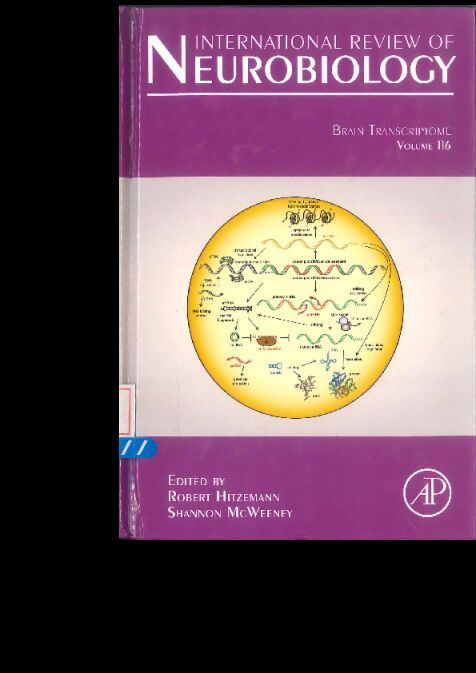
书名:Brain transcriptome
责任者:Edited Robert Hitzemann | Shannon McWeeney.
ISBN\ISSN:9780128011058,012801105X
出版时间:2014
出版社:Elsevier Academic Press,
摘要
Published since 1959, International Review of Neurobiology is a well-known series appealing to neuroscientists, clinicians, psychologists, physiologists, and pharmacologists. Led by an internationally renowned editorial board, this important serial publishes both eclectic volumes made up of timely reviews and thematic volumes that focus on recent progress in a specific area of neurobiology research.
This volume, concentrates on the brain transcriptome. •Brings together cutting-edge research on the brain transcriptome
查看更多
目录
Contributors ix
1. Introduction to Sequencing the Brain Transcriptome 1
Robert Hitzemann, Priscila Darakjian, Nikki Walter, Ovidiu Dan lancu, Robert Searles, and Shannon McWeeney
1. Introduction 2
2. From Microarrays to RNA-Seq 2
3. NGS Platforms 5
4. RNA-Seq Overview 5
5. RNA-Seq and Data Analysis 9
6. Sequencing the Brain Transcriptome 12
7. Conclusions 14
Acknowledgments 14
References 15
2. Analysis Considerations for Utilizing RNA-Seq to Characterize the Brain Transcriptome 21
Christina L Zheng, Sunita Kawane, Daniel Bottomly, and Beth Wilmot
1. Introduction 22
2. Defining and Quantifying Transcript/Gene Expression 23
3. Detecting Differential Expression 30
4. Frameworks for Interpretation 39
5. Summary 43
References 43
3. Data Integration and Reproducibility for High-Throughput Transcriptomics 55
Michael Mooney and Shannon McWeeney
1. Opportunities for Secondary Use of Data and Meta-Anlaysis in Transcriptomics 55
2. Selecting the Unit of Comparison 59
3. Metrics for Agreement 60
4. Studies on Reproducibility and Validation 61
5. Guidelines for Cross-Platform Studies 62
6. Other Data Integration Considerations 64
7. Summary 67
References 68
4. Coexpression and Cosplicing Network Approaches for the Study of Mammalian Brain Transcriptomes 73
Ovidiu Dan lancu, Alexandre Colville, Priscila Darakjian, and Robert Hitzemann
1. Introduction 74
2. Construction of Coexpression and Cosplicing Networks 75
3. Cosplicing Network Construction 78
4. Biological Annotation of Coexpression and Cosplicing Networks 82
5. Effects of Genetic Selection on Gene Networks 85
6. Module Preservation Across Subpopulations and Species 86
7. Module Disruption Related to Behavioral Changes 37
8. Summary and Future Directions 90
References 91
5. Splicing in the Human Brain 95
Ammar Zaghlool, Adam Ameur, Lucia Cavelier, and Lars Feuk
1. Pre-mRNA Splicing in Human Cells 96
2. Alternative Pre-mRNA Splicing 96
3. Tissue-Specific Alternative Splicing 100
4. Alternative Splicing in the Brain 100
5. Brain-Specific Splicing Regulation 103
6. Transcription-Coupled Regulation of Alternative Splicing 105
7. Cotranscriptional and Posttranscriptional Splicing 107
8. Global Analysis of Pre-mRNA Splicing 109
9. The Influence of RNA Extraction Methods on Transcriptome Analysis 110
10. Computational Methods to Study Splicing Dynamics 114
References 117
6. Understanding Complex Transcriptome Dynamics in Schizophrenia and Other Neurological Diseases Using RNA Sequencing 127
Xi Wang and Murray J. Cairns
1. Introduction 128
2. RNA-Seq Studies on Neurological Disorders 130
3. Quantifying Transcriptome Dynamics in Neurological Disorders 136
4. Discussion and Perspectives 144
References 147
7. The Central Role of Noncoding RNA in the Brain 153
Boris Guennewig and Antony A. Cooper
1. Introduction 154
2. The Long and Short of Noncoding RNAs 156
3. Types and Function of IncRNAs 162
4. RNA Structure 165
5. Splicing 166
6. NcRNA Editing 167
7. Epigenetic Modifications 169
8. ncRNAs Are Involved in Neuronal Development, Maintenance, and Plasticity 170
9. Evolutionary Role of ncRNAs and Primate Specificity 173
10. The Role of (Retro)transposons and Pseudogenes in ncRNA Evolution 175
11. ncRNAs and Disease 176
12. Perspectives and Outlook 180
Acknowledgments 181
References 181
8. Genetics of Gene Expression in CNS 195
Ashutosh K. Pandey and Robert W. Williams
1. Introduction 196
2. Genetic Resources for eQTL Analysis in Mice 208
3. Genetic Mapping Methods 212
4. RNA-seq eQTL Studies 214
5. Pros and Cons of Arrays and RNA-seq for eQTL Studies 215
6. RNA-seq Read Alignment and Normalization 218
7. eQTL Mapping of Alternative Splicing and Polyadenylation 220
8. RNA-seq for Allele-Specific Expression 221
9. Conclusions 222
Acknowledgments 223
References 223
9. Transcriptomic Changes in Brain Development 233
Allissa A. Dillman and Mark R. Cookson
1. Introduction 233
2. Gene Expression 234
3. DNA Sequence Variation and Epigenetic Modification in Brain Development 238
4. Alternative Splicing 240
5. RNA Editing 242
6. Noncoding RNA 243
7. Summary 245
References 245
10. Gene Expression in the Addicted Brain 251
Zhifeng Zhou, Mary-Anne Enoch, and David Goldman
1. Introduction 252
2. Molecular Adaptations Accompanying Early Response and Long-Term Adaptations in the Addicted Brain 253
3. Substance-Specific and Shared Gene Expression Changes in Addicted Brain 257
4. Region-Specific Gene Expression Changes in Addicted Brain 259
5. Perturbation of the Glutamatergic System in Addicted Brain 261
6. Epigenetic Regulation of Gene Expression in Addicted Brain 264
7. Conclusion 267
References 267
11. RNA-Seq Reveals Novel Transcriptional Reorganization in Human Alcoholic Brain 275
Sean P. Farris and R. Dayne Mayfield
1. Overview 276
2. RNA-Seq of Postmortem Brain Tissue 276
3. Detection of Technical Biases in RNA-Seq Data 278
4. Normalization of RNA-Seq Data 284
5. Alternative Splicing and Differential Expression 284
6. Long Noncoding RNA 287
7. Novel Three Prime Untranslated Regions 287
8. Genetic Variation and Alcohol Dependence 289
9. Biological Coexpression Networks 291
10. Future Directions 292
References 294
Index 301
Contents of Recent Volumes 311
查看PDF
查看更多
馆藏单位
中国医科院医学信息研究所