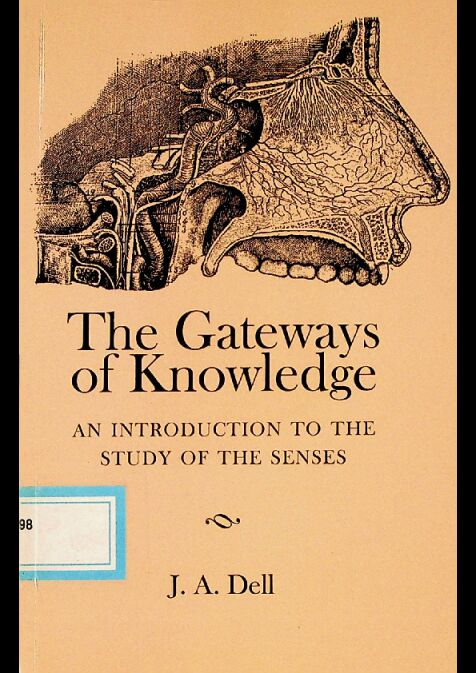
书名:The gateways of knowledge
责任者:J.A. Dell. | Dell, John Alexander.
ISBN\ISSN:9781107655836,1107655838
出版时间:1912
出版社:Cambridge University Press
前言
MR DELL has written on the Study of the Senses, on simple experimental psychology. Nature Study has been praised as a training in observation, and as, in the use of the telescope, the astronomer must study the error of the instrument, so, where that instrument is the naked eye, the naturalist must learn what tricks it may play him. Can we call anyone a trained observer who is unconscious of such errors as might arise from persistence of vision, from the negative afterimage or from the blind spot of the retina?
That part of Nature which is most accessible for exploration in a school classroom is human nature - boy nature- "The proper study of mankind is man." Here, Mr Dell has shown us a proper way - the scientific way - of studying the mind of boy.
Hitherto, the laboratory psychologist has often regarded the schoolmaster as too untrained and too ignorant to be a competent ally as an experimenter in mental fields. Nor has the schoolmaster been altogether willing to regard his classroom as chiefly an exploration ground for the rambling psychological explorer. But now these studies are beginning to interest the rising generation of schoolmasters. If some of us were not so busy organizing laboratories and propagating cookery recipes for oxygen and chlorine, we might have leisure to explore the material lavished around us in the minds of our pupils.
Mr Dell has been fortunate in throwing his experiments into a form in which they can be used for classroom work. This often involves a great simplification and cheapening of apparatus. The methods have to be transformed from the conditions of the physician's consulting room where patients are elaborately treated one at a time to those of the classroom where boys are dealt with by the dozen. It is just this preliminary examination by the schoolmaster which may correctly select those who should be passed on for further examination by the school doctor.
Mr Dell has also shown how boys may be not merely passive under examination but active co-operators with their teacher in explorations of mutual interest. Many teachers have found the difficulty of organizing practical work for large classes. This book, therefore, while nominally showing the pupil how to learn, will really tell the teacher how to teach.
Someone will ask whether a book on the Senses can be called "Nature Study." Let Wordsworth answer in his lines on Tintern Abbey. The poet's definition of Nature would have been all-embracing:- ...... "the light of setting suns, And the round ocean and the living air, And the blue sky, and in the mind of man."
The title of this little book is an echo of an earlier title : "The Five Gateways of Knowledge," by Prof. George Wilson, of Edinburgh, having been published by Messrs Macmillan & Co. in 1857 ; and by their goodwill we feel free to use this phrase again. Prof. Wilson makes his acknowledgments to "The Holy War" by John Bunyan. "This famous town of Mansoul had five gates...Ear-gate, Eye-gate, Mouth-gate, Nose-gate, and Feel-gate."
Prof. Wilson addressed his lectures to a philosophical audience; the present book is intended for use in Higher Primary and Lower Secondary Schools, that is to say, for pupils of about 12 to 15 years of age. For their sakes the wording is clear and simple.
In the last sixty years methods of education have become increasingly practical, hence abundant and varied practical exercises are suggested. Complete instructions are given for these exercises so that the book shall be intelligible in the absence of a teacher. The proposed practical work is not only what might be done by eager boys and girls on half holidays, but what can be done by every pupil in the course of ordinary school work. The pictorial illustrations chosen are aids to observation, not substitutes. Sufficient directions are given for the supply of necessary material.
查看更多
目录
I. THE MEANING OF OBSERVATION 1
II. THE BRAIN, NERVES, AND SENSE-ORGANS 5
III. THE SENSE OF TOUCH 17
IV. HEAT, COLD, AND PAIN 31
V. THE MACHINERY OF MOVEMENT 36
VI. THE EXPERIENCE OF MOVEMENT 47
VII. TASTE AND SMELL 65
VIII. SOUND AND HEARING 73
IX. LIGHT 85
X. THE EYE 92
XI. HOW THE EYE IS USED IN SEEING 102
XII. THE EXPERIENCE OF SIGHT 119
XIII. ACTION 145
XIV. MEMORY 156
APPENDIX 168
INDEX 170
查看更多
馆藏单位
中科院文献情报中心