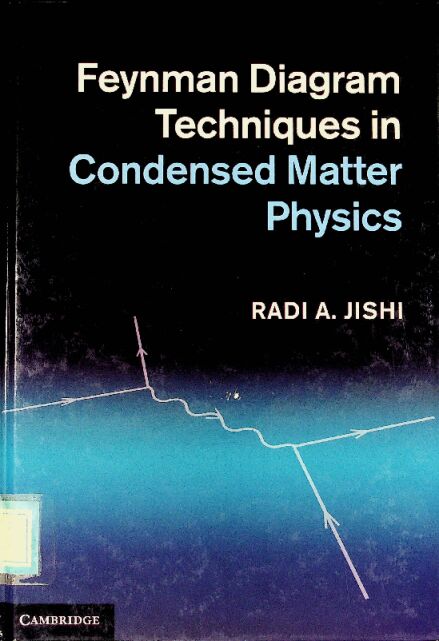
书名:Feynman diagram techniques in condensed matter physics
ISBN\ISSN:9781107025172,1107025176
出版时间:2013
出版社:Cambridge University Press
摘要
A concise introduction to Feynman diagram techniques, this book shows how they can be applied to the analysis of complex many-particle systems, and offers a review of the essential elements of quantum mechanics, solid state physics and statistical mechanics. Alongside a detailed account of the method of second quantization, the book covers topics such as Green's and correlation functions, diagrammatic techniques and superconductivity, and contains several case studies. Some background knowledge in quantum mechanics, solid state physics and mathematical methods of physics is assumed. Detailed derivations of formulas and in-depth examples and chapter exercises from various areas of condensed matter physics make this a valuable resource for both researchers and advanced undergraduate students in condensed matter theory, many-body physics and electrical engineering. Solutions to exercises are available online.
查看更多
前言
In both theory and practice, condensed matter physics is concerned with the phys-ical properties of materials that are comprised of complex many-particle systems. Modeling the systems' behavior is essential to achieving a better understanding of the properties of these systems and their practical use in technology and industry.
Maximal knowledge about a many-particle system is gained by solving the Schrödinger equation. However, an exact solution of the Schrodinger equation is not possible, so resort is made to approximation schemes based on perturbation theory. It is generally true that, in order to properly describe the properties of an interacting many-particle system, perturbation theory must be carried out to infinite order. The best approach we have for doing so involves the use of Green's function and Feynman diagrams. Furthermore, much of our knowledge about a given complex system is obtained by measuring its response to an external probe, such as an electromagnetic field, a beam of electrons, or some other form of perturbation; its response to this perturbation is best described in terms of Green's function.
Two years ago, I set out to put together a guide that would allow advanced undergraduate and beginning graduate students in physics and electrical engineer-ing to understand how Green's functions and Feynman diagrams are used to more accurately model complicated interactions in condensed matter physics. As time went by and the book was taking form, it became clear that it had turned into a reference manual that would be useful to professionals and educators as well as students. It is a self-contained place to learn or review how Feynman diagrams are used to solve problems in condensed matter physics. Great care has been taken to show how to create them, use them, and solve problems with them, one step at a time. It has been a labor of love. My reward is the thought that it will help others to understand the subject.
The book begins with a brief review of quantum mechanics, followed by a short chapter on single-particle states. Taken together with the accompanying exercises, these two chapters provide a decent review of quantum mechanics and solid state physics. The method of second quantization, being of crucial importance, is dis-cussed at length in Chapter 3, and applied to the jellium model in Chapter 4. Since Green's functions at finite temperature are defined in terms of thermal averages, a review of the basic elements of statistical mechanics is presented in Chapter 5, which, I hope, will be accessible to readers without extensive knowledge of the subject.
Real-time Green's functions are discussed in Chapter 6, and some applications of these functions are presented in Chapter 7. Imaginary-time functions and Feynman diagram techniques are dealt with in Chapters 8 and 9. Every effort has been made to provide a step-by-step derivation of all the formulas, in as much detail as is necessary. Rules for the creation of the diagrams and their translation into algebraic expressions are clearly delineated. Feynman diagram techniques are then applied to the interacting electron gas in Chapter 10, to electron-phonon and electron-photon interactions in Chapter 11, and to superconductivity in Chapter 12. These techniques are then extended to systems that are not in equilibrium in Chapter 13.
Many exercises are given at the end of each chapter. For the more difficult problems, some guidance is given to allow the reader to arrive at the solution. Solutions to many of the exercises, as well as additional material, will be provided on my website (www.calstatela.edu/faculty/rjishi).
Over the course of the two years that it took me to finish this book, I received help in various ways from many people. In particular, I would like to thank David Guzman for extensive help in preparing this manuscript, and Hamad Alyahyaei for reading the first five chapters. I am indebted to Linda Alviti, who read the whole book and made valuable comments. I am grateful to Professor I.E. Dzyaloshinski for reading Chapter 9 and for his encouraging words. I also want to thank Dr. John Fowler, Dr. Simon Capelin, Antoaneta Ouzounova, Fiona Saunders, Kirsten Bot, and Claire Poole from Cambridge University Press for their help, guidance, and patience. I would also like to express my gratitude to my wife and children for their encouragement and support. Permission to use the quote from Russell's The Scientific Outlook (2001) was provided by Taylor and Francis (Routledge). Copy-right is owned by Taylor and Francis and The Bertrand Russell Foundation Ltd. Permission to use Gould's quote from Ever Since Darwin (1977) was provided by W.W. Norton & Company.
This book is dedicated to the memory of my parents, who, despite adverse conditions, did all they could to provide me with a decent education.
Los Angeles, California R. A.J.
July,2012
查看更多
目录
Preface
1 A brief review of quantum mechanics 1
1.1 The postulates
1.2 The harmonic oscillator 10
Further reading 13
Problems 13
2 Single-particle states 18
2.1 Introduction 18
2.2 Electron gas 19
2.3 Bloch states 21
2.4 Example: one-dimensional lattice 27
2.5 Wannier states 29
2.6 Two-dimensional electron gas in a magnetic field 31
Further reading 33
Problems 34
3 Second quantization 3
3.1 N-particle wave function 37
3.2 Properly symmetrized products as a basis set 38
3.3 Three examples 40
3.4 Creation and annihilation operators 42
3.5 One-body operators 47
3.6 Examples 48
3.7 Two-body operators 50
3.8 Translationally invariant system 51
3.9 Example: Coulomb interaction 52
3.10 Electrons in a periodic potential 53
3.11 Field operators 57
Further reading 61
Problems 61
4 The electron gas 65
4.1 The Hamiltonian in the jellium model 66
4.2 High density limit 69
4.3 Ground state energy 70
Further reading 76
Problems 76
5 A brief review of statistical mechanics 78
5.1 The fundamental postulate of statistical mechanics 78
5.2 Contact between statistics and thermodynamics 79
5.3 Ensembles 81
5.4 The statistical operator for a general ensemble 85
5.5 Quantum distribution functions 87
Further reading 89
Problems 89
6 Real-time Green's and correlation functions 91
6.1 A plethora of functions 92
6.2 Physical meaning of Green's functions 95
6.3 Spin-independent Hamiltonian, translational invariance 96
6.4 Spectral representation 98
6.5 Example: Green's function of a noninteracting system 106
6.6 Linear response theory 109
6.7 Noninteracting electron gas in an external potential 114
6.8 Dielectric function of a noninteracting electron gas 117
6.9 Paramagnetic susceptibility of a noninteracting electron gas 117
6.10 Equation of motion 121
6.11 Example: noninteracting electron gas 122
6.12 Example: an atom adsorbed on graphene 123
Further reading 125
Problems 126
7 Applications of real-time Green's functions 130
7.1 Single-level quantum dot 130
7.2 Quantum dot in contact with a metal: Anderson's model 133
7.3 Tunneling in solids 135
Further reading 140
Problems 140
8 Imaginary-time Green's and correlation functions 143
8.1 Imaginary-time correlation function 144
8.2 Imaginary-time Green's function 146
8.3 Significance of the imaginary-time Green's function 148
8.4 Spectral representation, relation to real-time functions 151
8.5 Example: Green's function for noninteracting particles 154
8.6 Example: Green's function for 2-DEG in a magnetic field 155
8.7 Green's function and the Û-operator 156
8.8 Wick's theorem 162
8.9 Case study: first-order interaction 169
8.10 Cancellation of disconnected diagrams 174
Further reading 176
Problems 176
9 Diagrammatic techniques 179
9.1 Case study: second-order perturbation in a system of fermions 179
9.2 Feynman rules in momentum-frequency space 186
9.3 An example of how to apply Feynman rules 192
9.4 Feynman rules in coordinate space 193
9.5 Self energy and Dyson's equation 196
9.6 Energy shift and the lifetime of excitations 197
9.7 Time-ordered diagrams: a case study 199
9.8 Time-ordered diagrams: Dzyaloshinski's rules 204
Further reading 210
Problems 210
10 Electron gas: a diagrammatic approach 213
10.1 Model Hamiltonian 213
10.2 The need to go beyond first-order perturbation theory 214
10.3 Second-order perturbation theory: still inadequate 216
10.4 Classification of diagrams according to the degree of divergence 218
10.5 Self energy in the random phase approximation (RPA) 219
10.6 Summation of the ring diagrams 220
10.7 Screened Coulomb interaction 222
10.8 Collective electronic density fluctuations 223
10.9 How do electrons interact? 227
10.10 Dielectric function 229
10.11 Plasmons and Landau damping 234
10.12 Case study: dielectric function of graphene 239
Further reading 244
Problems 245
11 Phonons, photons, and electrons 247
11.1 Lattice vibrations in one dimension 248
11.2 One-dimensional diatomic lattice 252
11.3 Phonons in three-dimensional crystals 254
11.4 Phonon statistics 255
11.5 Electron-phonon interaction: rigid-ion approximation 256
11.6 Electron-LO phonon interaction in polar crystals 261
11.7 Phonon Green's function 262
11.8 Free-phonon Green's function 263
11.9 Feynman rules for the electron-phonon interaction 265
11.10 Electron self energy 266
11.11 The electromagnetic field 269
11.12 Electron-photon interaction 272
11.13 Light scattering by crystals 273
11.14 Raman scattering in insulators 276
Further reading 281
Problems 281
12 Superconductivity 284
12.1 Properties of superconductors 284
12.2 The London equation 289
12.3 Effective electron-electron interaction 291
12.4 Cooper pairs 295
12.5 BCS theory of superconductivity 299
12.6 Mean field approach 304
12.7 Green's function approach to superconductivity 309
12.8 Determination of the transition temperature 316
12.9 The Nambu formalism 317
12.10 Response to a weak magnetic field 319
12.11 Infinite conductivity 325
Further reading 326
Problems 326
13 Nonequilibium Green's function 331
13.1 Introduction 331
13.2 Schrodinger, Heisenberg, and interaction pictures 332
13.3 The malady and the remedy 336
13.4 Contour-ordered Green's function 341
13.5 Kadanoff-Baym and Keldysh contours 343
13.6 Dyson's equation 347
13.7 Langreth rules 349
13.8 Keldysh equations 351
13.9 Steady-state transport 352
13.10 Noninteracting quantum dot 360
13.11 Coulomb blockade in the Anderson model 363
Further reading 366
Problems 366
Appendix A: Second quantized form of operators 369
Appendix B: Completing the proof of Dzyaloshinski's rules 375
Appendix C: Lattice vibrations in three dimensions 378
Appendix D: Electron-phonon interaction in polar crystals 385
References 390
Index 394
查看PDF
查看更多
作者简介
Radi A. Jishi is a Professor of Physics at California State University. His research interests centre on condensed matter theory, carbon networks, superconductivity, and the electronic structure of crystals.
查看更多
馆藏单位
中科院文献情报中心