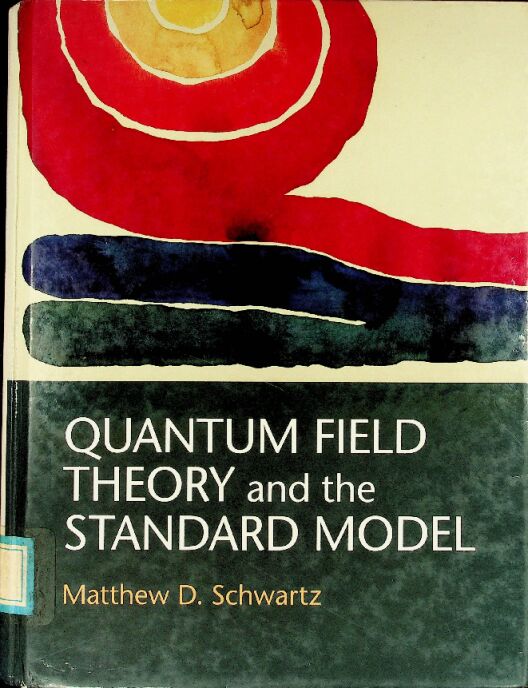
书名:Quantum field theory and the standard model
ISBN\ISSN:9781107034730,1107034736
出版时间:2014
出版社:Cambridge University Press
前言
Providing a comprehensive introduction to quantum field theory, this textbook covers the development of particle physics from its foundations to the discovery of the Higgs boson. Its combination of clear physical explanations, with direct connections to experimental data, and mathematical rigor make the subject accessible to students with a wide variety of backgrounds and interests. Assuming only an undergraduate-level understanding of quantum mechanics, the book steadily develops the Standard Model and state-of-the-art calculation techniques. It includes multiple derivations of many important results, with modern methods such as effective field theory and the renormalization group playing a prominent role. Numerous worked examples and end-of-chapter problems enable students to reproduce classic results and to master quantum field theory as it is used today. Based on a course taught by the author over many years, this book is ideal for an introductory to advanced quantum field theory sequence or for independent study.
查看更多
目录
Preface page xv
Part I Field theory 1
1 Microscopic theory of radiation 3
1.1 Blackbody radiation 3
1.2 Einstein coefficients 5
1.3 Quantum field theory 7
2 Lorentz invariance and second quantization 10
2.1 Lorentz invariance 10
2.2 Classical plane waves as oscillators 17
2.3 Second quantization 20
Problems 27
3 Classical field theory 29
3.1 Hamiltonians and Lagrangians 29
3.2 The Euler–Lagrange equations 31
3.3 Noether's theorem 32
3.4 Coulomb's law 37
3.5 Green's functions 39
Problems 42
4 Old-fashioned perturbation theory 46
4.1 Lippmann–Schwinger equation 47
4.2 Early infinities 52
Problems 55
5 Cross sections and decay rates 56
5.1 Cross sections 57
5.2 Non-relativistic limit 63
5.3 e~+e~− → μ~+μ ~− with spin 65
Problems 67
6 The S-matrix and time-ordered products 69
6.1 The LSZ reduction formula 70
6.2 The Feynman propagator 75
Problems 77
7 Feynman rules 78
7.1 Lagrangian derivation 79
7.2 Hamiltonian derivation 84
7.3 Momentum-space Feynman rules 93
7.4 Examples 97
7.A Normal ordering and Wick's theorem 100
Problems 103
Part II Quantum electrodynamics 107
8 Spin 1 and gauge invariance 109
8.1 Unitary representations of the Poincare group 109
8.2 Embedding particles into fields 113
8.3 Covariant derivatives 120
8.4 Quantization and the Ward identity 123
8.5 The photon propagator 128
8.6 Is gauge invariance real? 130
8.7 Higher-spin fields 132
Problems 138
9 Scalar quantum electrodynamics 140
9.1 Quantizing complex scalar fields 140
9.2 Feynman rules for scalar QED 142
9.3 Scattering in scalar QED 146
9.4 Ward identity and gauge invariance 147
9.5 Lorentz invariance and charge conservation 150
Problems 155
10 Spinors 157
10.1 Representations of the Lorentz group 158
10.2 Spinor representations 163
10.3 Dirac matrices 168
10.4 Coupling to the photon 173
10.5 What does spin 1/2 mean? 174
10.6 Majorana and Weyl fermions 178
Problems 181
11 Spinor solutions and CPT 184
11.1 Chirality, helicity and spin 185
11.2 Solving the Dirac equation 188
11.3 Majorana spinors 192
11.4 Charge conjugation 193
11.5 Parity 195
11.6 Time reversal 198
Problems 201
12 Spin and statistics 205
12.1 Identical particles 206
12.2 Spin-statistics from path dependence 208
12.3 Quantizing spinors 211
12.4 Lorentz invariance of the S -matrix 212
12.5 Stability 215
12.6 Causality 219
Problems 223
13 Quantum electrodynamics 224
13.1 QED Feynman rules 225
13.2 γ-matrix identities 229
13.3 e~+e~− → μ~+μ~− 230
13.4 Rutherford scattering e~−p~+ → e~−p~+ 234
13.5 Compton scattering 238
13.6 Historical note 246
Problems 248
14 Path integrals 251
14.1 Introduction 251
14.2 The path integral 254
14.3 Generating functionals 261
14.4 Where is the iε? 264
14.5 Gauge invariance 267
14.6 Fermionic path integral 269
14.7 Schwinger–Dyson equations 272
14.8 Ward–Takahashi identity 277
Problems 283
Part III Renormalization 285
15 The Casimir effect 287
15.1 Casimir effect 287
15.2 Hard cutoff 289
15.3 Regulator independence 291
15.4 Scalar field theory example 296
Problems 299
16 Vacuum polarization 300
16.1 Scalar ø3 theory 302
16.2 Vacuum polarization in QED 304
16.3 Physics of vacuum polarization 309
Problems 314
17 The anomalous magnetic moment 315
17.1 Extracting the moment 315
17.2 Evaluating the graphs 318
Problems 321
18 Mass renormalization 322
18.1 Vacuum expectation values 323
18.2 Electron self-energy 324
18.3 Pole mass 330
18.4 Minimal subtraction 334
18.5 Summary and discussion 336
Problems 338
19 Renormalized perturbation theory 339
19.1 Counterterms 339
19.2 Two-point functions 342
19.3 Three-point functions 345
19.4 Renormalization conditions in QED 349
19.5 Z_1 = Z_2: implications and proof 350
Problems 354
20 Infrared divergences 355
20.1 e~+e~− → μ~+μ~− (+γ) 356
20.2 Jets 364
20.3 Other loops 366
20.A Dimensional regularization 373
Problems 380
21 Renormalizability 381
21.1 Renormalizability of QED 382
21.2 Non-renormalizable field theories 386
Problems 393
22 Non-renormalizable theories 394
22.1 The Schrodinger equation ¨ 395
22.2 The 4-Fermi theory 396
22.3 Theory of mesons 400
22.4 Quantum gravity 403
22.5 Summary of non-renormalizable theories 407
22.6 Mass terms and naturalness 407
22.7 Super-renormalizable theories 414
Problems 416
23 The renormalization group 417
23.1 Running couplings 419
23.2 Renormalization group from counterterms 423
23.3 Renormalization group equation for the 4-Fermi theory 426
23.4 Renormalization group equation for general interactions 429
23.5 Scalar masses and renormalization group flows 435
23.6 Wilsonian renormalization group equation 442
Problems 450
24 Implications of unitarity 452
24.1 The optical theorem 453
24.2 Spectral decomposition 466
24.3 Polology 471
24.4 Locality 475
Problems 477
Part IV The Standard Model 479
25 Yang–Mills theory 481
25.1 Lie groups 482
25.2 Gauge invariance and Wilson lines 488
25.3 Conserved currents 493
25.4 Gluon propagator 495
25.5 Lattice gauge theories 503
Problems 506
26 Quantum Yang–Mills theory 508
26.1 Feynman rules 509
26.2 Attractive and repulsive potentials 512
26.3 e~+e~− → hadrons and α_s 513
26.4 Vacuum polarization 517
26.5 Renormalization at 1-loop 521
26.6 Running coupling 526
26.7 Defining the charge 529
Problems 533
27 Gluon scattering and the spinor-helicity formalism 534
27.1 Spinor-helicity formalism 535
27.2 Gluon scattering amplitudes 542
27.3 gg → gg 545
27.4 Color ordering 548
27.5 Complex momenta 551
27.6 On-shell recursion 555
27.7 Outlook 558
Problems 559
28 Spontaneous symmetry breaking 561
28.1 Spontaneous breaking of discrete symmetries 562
28.2 Spontaneous breaking of continuous global symmetries 563
28.3 The Higgs mechanism 575
28.4 Quantization of spontaneously broken gauge theories 580
Problems 583
29 Weak interactions 584
29.1 Electroweak symmetry breaking 584
29.2 Unitarity and gauge boson scattering 588
29.3 Fermion sector 592
29.4 The 4-Fermi theory 602
29.5 CP violation 605
Problems 614
30 Anomalies 616
30.1 Pseudoscalars decaying to photons 617
30.2 Triangle diagrams with massless fermions 622
30.3 Chiral anomaly from the integral measure 628
30.4 Gauge anomalies in the Standard Model 631
30.5 Global anomalies in the Standard Model 634
30.6 Anomaly matching 638
Problems 640
31 Precision tests of the Standard Model 641
31.1 Electroweak precision tests 642
31.2 Custodial SU(2), ρ, S, T and U 653
31.3 Large logarithms in flavor physics 657
Problems 666
32 Quantum chromodynamics and the parton model 667
32.1 Electron–proton scattering 668
32.2 DGLAP equations 677
32.3 Parton showers 682
32.4 Factorization and the parton model from QCD 685
32.5 Lightcone coordinates 695
Problems 698
Part V Advanced topics 701
33 Effective actions and Schwinger proper time 703
33.1 Effective actions from matching 704
33.2 Effective actions from Schwinger proper time 705
33.3 Effective actions from Feynman path integrals 711
33.4 Euler–Heisenberg Lagrangian 713
33.5 Coupling to other currents 722
33.6 Semi-classical and non-relativistic limits 725
33.A Schwinger's method 728
Problems 732
34 Background fields 733
34.1 1PI effective action 735
34.2 Background scalar fields 743
34.3 Background gauge fields 752
Problems 758
35 Heavy-quark physics 760
35.1 Heavy-meson decays 762
35.2 Heavy-quark effective theory 765
35.3 Loops in HQET 768
35.4 Power corrections 772
Problems 775
36 Jets and effective field theory 776
36.1 Event shapes 778
36.2 Power counting 780
36.3 Soft interactions 782
36.4 Collinear interactions 790
36.5 Soft-Collinear Effective Theory 795
36.6 Thrust in SCET 802
Problems 810
Appendices 813
Appendix A Conventions 815
A.1 Dimensional analysis 815
A.2 Signs 817
A.3 Feynman rules 819
A.4 Dirac algebra 820
Problems 821
Appendix B Regularization 822
B.1 Integration parameters 822
B.2 Wick rotations 823
B.3 Dimensional regularization 825
B.4 Other regularization schemes 830
Problems 833
References 834
Index 842
查看PDF
查看更多
馆藏单位
中科院文献情报中心