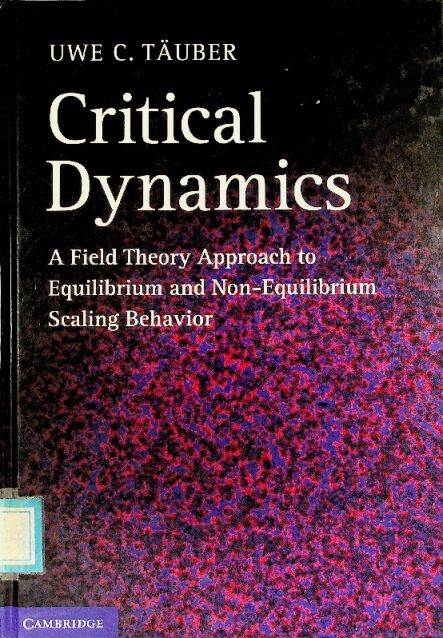
书名:Critical dynamics
责任者:Uwe C. Tauber. | Tauber, Uwe C.,
ISBN\ISSN:9780521842235,0521842239
出版时间:2014
出版社:Cambridge University Press
摘要
Introducing a unified framework for describing and understanding complex interacting systems common in physics, chemistry, biology, ecology, and the social sciences, this comprehensive overview of dynamic critical phenomena covers the description of systems at thermal equilibrium, quantum systems, and non-equilibrium systems. Powerful mathematical techniques for dealing with complex dynamic systems are carefully introduced, including field-theoretic tools and the perturbative dynamical renormalization group approach, rapidly building up a mathematical toolbox of relevant skills. Heuristic and qualitative arguments outlining the essential theory behind each type of system are introduced at the start of each chapter, alongside real-world numerical and experimental data, firmly linking new mathematical techniques to their practical applications. Each chapter is supported by carefully tailored problems for solution, and comprehensive suggestions for further reading, making this an excellent introduction to critical dynamics for graduate students and researchers across many disciplines within physical and life sciences.
查看更多
前言
The goal of this advanced graduate-level textbook is to provide a description of the field-theoretic renormalization group approach for the study of time-dependent phenomena in systems either close to a critical point, or displaying generic scale invariance. Its general aim is a unifying treatment of classical near-equilibrium, as well as quantum and non-equilibrium systems, providing the reader with a thorough grasp of the fundamental principles and physical ideas underlying the subject.
Scaling ideas and the renormalization group philosophy and its various mathematical formulations were developed in the 1960s and early 1970s. In the realm of statistical physics, they led to a profound understanding of critical singularities near continuous phase transitions in thermal equilibrium. Beginning in the late 1960s, these concepts were subsequently generalized and applied to dynamic critical phenomena. By the mid-1980s, when I began my research career, critical dynamics had become a mature but still exciting field with many novel applications. Specifically, extensions to quantum critical points and to systems either driven or initialized far away from thermal equilibrium opened fertile new areas for in-depth analytical and numerical investigations.
By now there exists a fair sample of excellent textbooks that provide profound expositions of the renormalization group method for static critical phenomena, adequately introducing statistical field theory as the basic tool, and properly connecting it with its parent, quantum field theory. However, novice researchers who wish to familiarize themselves with the basic techniques and results in the study of dynamic critical phenomena still must resort largely to the original literature, supplemented with a number of very good review articles. Over the years, various outstanding texts have emerged that address specific subfields such as one-dimensional systems, numerical methods, equilibrium statistical and quantum field theory, quantum phase transitions, non-equilibrium quantum dynamics, growth models, pattern formation, and the glass transition, to list just a few. Yet there has been no published attempt at a comprehensive introductory overview of field-theoretic tools and perturbative renormalization group methods applied to stochastic non-linear systems, near-equilibrium critical dynamics, non-equilibrium phase transitions, and driven systems displaying generic scale invariance.
Given this startling gap in the literature, I immediately and gladly consented when in 1997 John Cardy proposed to me to coauthor precisely such a text. John had recently completed his brilliant, concise book Scaling and Renormalization in Statistical Physics; and I had just delivered a brief lecture course on Dynamic Critical Phenomena at the University of Oxford, where I was a postdoctoral research associate at the time. Our initial, in retrospect rather naive, vision was that based on our lecture notes and research papers, we should be able to compile a comprehensive introduction to the field of critical dynamics within about a year or two. That task, however, turned out to be much more daunting, and progress excruciatingly slower than we had anticipated. As time passed, only very few chapters had materialized, and John's principal research interest increasingly deviated from classical non-equilibrium phenomena, he decided to withdraw from the project. Following a year-long hiatus, I eventually endeavored to revive our book plans in 2003; and it has still taken me another decade to write this present and considerably evolved version of the text John and I had originally envisaged.
It is the aim of this book to give a thorough account, in a conceptually unified manner, of time-dependent behavior of classical systems close to an equilibrium critical point, dynamical critical phenomena in quantum systems, and scaling properties of systems far from equilibrium, which either exhibit a phase transition between different non-equilibrium stationary states as some parameter is varied, or whose dynamics naturally leads to a scale-invariant critical state. I wish to emphasize that this text does not intend to provide a comprehensive review of this immense field, but instead to present an accessible introduction to the main and basic results that have accumulated through the combined efforts of many accomplished researchers, along with the fundamental analytical tools of field-theoretic representations for stochastic dynamics and the renormalization group approach. Although the full power of the field-theoretic method will be developed, an effort has been made to keep the text from becoming too technical, always trying to refer back to the physical interpretation of the formalism as it evolves. In particular, introductory material in each section describes more heuristic physical arguments before plunging into the mathematics, and various illustrations, from both real and numerical experiments, that have been included. I confess that maintaining this delicate balance between intuitive physical insight and more rigorous mathematical treatment has been one of my major challenges in writing this treatise.
The first two chapters are intended to give a rather quick yet still self-contained introduction and overview of the theory of thermodynamic phase transitions, and of various formulations of stochastic dynamics. Along with the first exposition of dynamical scaling and critical dynamics in Chapter 3, and the various less technical introductions in later chapters, these should be readily usable in graduate-level lecture courses; indeed, I have employed them myself in advanced courses on Statistical Mechanics and Solid State Physics. Much of the remainder of this text, however, will probably be covered less frequently in standard course sequences. Instead, the bulk of this book may hopefully serve as an adequate foundation for self or independent group study. I trust, therefore, that the collections of problems and exercises at the end of each chapter will entice diligent readers to delve deeper into the technical and mathematical issues involved, and provide additional opportunities to practice newly acquired concepts and techniques.
Field-theoretic methods generally provide an enormously powerful toolbox, and the renormalization group is definitely indispensible in establishing universal features. However, there are indisputably other prominent theoretical approaches that researchers working in this field are well-advised to consult and employ. Naturally, exact solutions, though typically only feasible for one-dimensional 'simple' model systems, are invaluable cornerstones of any theoretical development, and may quite obviously serve as crucial test cases for approximate analysis. For example, various very clever approximation schemes to deal with stochastic master and Langevin equations have been developed and brought to fruition for many specific applications. And, last but certainly not least, numerical algorithms and computer simulations have become fantastically efficient over the past years, and often provide detailed insights into complex behavior emergent in stochastic interacting systems. Data obtained from careful and properly analyzed Monte Carlo simulations in fact have to a large extent replaced real laboratory experiments in establishing the basic facts that any successful theory needs to reproduce or predict. But this development has not been entirely beneficial to the field, and I fervently hope that the near future will see a revival of truly quantitative and high-quality experimental investigations of non-equilibrium systems; it appears as if perhaps new data will originate predominantly from a biological context.
Since there already exist outstanding expositions of exactly solvable models and their mathematical treatment, as well as extensive introductions to modern computer simulation algorithms and data analysis, these topics are only barely discussed in this book. Inevitably, I found that I had to make tough decisions on which topics to include. Naturally, the final choice of material is strongly biased towards my own expertise and personal research trajectory. I most sincerely apologize, therefore, to any readers and distinguished colleagues who find their own important contributions inadequately represented or improperly acknowledged, and stress again that a complete and comprehensive survey is not what I have strived to achieve. My perhaps most notable omissions include the powerful Keldysh formalism for non-equilibrium quantum dynamics; non-perturbative numerical renormalization group approaches that have enjoyed a tremendously successful comeback in the past decade; turbulence and scale invariance in fluid dynamics; the depinning transition of manifolds driven through random media; and dynamic scaling in structural and spin glasses. Each chapter of this text lists the most important references that I have regularly consulted, along with a bibliography of suggested original or more advanced literature for further in-depth studies. Once again, I do not claim these lists to be complete or exhaustive, but I nevertheless trust them to be useful.
As a student and young researcher, I learned a substantial fraction of the material presented in this text from wonderful lecture courses delivered by Franz Schwabl, Wolfgang Götze, Wilhelm Brenig, and Reinhard Folk at the Technische Universität Munchen; David Nelson and Daniel Fisher at Harvard University; John Cardy and ¨ John Chalker at the University of Oxford; and from the remarkable lecture notes by Hans-Karl Janssen at the Heinrich–Heine-Universität Düsseldorf. My mentors ¨ will inevitably find parts of their excellent lectures reflected in various chapters of this book. Yet while I owe a tremendous amount of knowledge and insight to their outstanding didactic efforts, naturally any errors and misconceptions in this text and other inadequacies are solely mine and should not be blamed on these exceptional scholars.
I am moreover deeply indebted to my research collaborators in various topics in statistical physics over many years that are at least in part represented in this volume. These include my esteemed colleagues as well as current and past students Vamsi Akkineni, Jeremy Allam, Timo Aspelmeier, Hiba Assi, Christian Baumgartel, Paul Bourgine, Michael Bulenda, Thomas Bullard, John Cardy, ¨ Harshwardhan Chaturvedi, George Daquila, Jayajit Das, Oliviér Deloubrière, Hans- ` Werner Diehl, Sebastian Diehl, Ulrich Dobramysl, Barbara Drossel, Reinhard Eckl, Vlad Elgart, Kimberley Forsten-Williams, Erwin Frey, Wilmut Gasser, Ivan Georgiev, Yadin Goldschmidt, Manoj Gopalakrishnan, Bertrand Halperin, Qian He, Malte Henkel, Henk Hilhorst, Haye Hinrichsen, Martin Howard, Terence Hwa, Hans-Karl Janssen, Swapnil Jawkar, Alex Kamenev, Bernhard Kaufmann, Thana-nart Klongcheongsan, Vivien Lecomte, Jero ˆ me Magnin, Mauro Mobilia, Thomas Nattermann, David Nelson, Klaus Oerding, Michel Pleimling, Gunnar Prüssner, Zoltán Rácz, Leo Radzihovsky, Matthew Raum, Beth Reid, Andrew Rutenberg, Jaime Santos, Beate Schmittmann, Alfred Schorgg, Gunter Schütz, Franz Schwabl, Matthew Shimer, Robin Stinchcombe, Steffen Trimper, Benjamin Vollmayr-Lee, Mark Washenberger, Carsten Wengel, Frédéric van Wijland, and Royce Zia. In addi-tion to John Cardy, who originally incited this endeavor, many of the colleagues listed above have in fact crucially contributed to the contents of this text, directly through their invaluable contributions to the field, via the many insightful discussions we enjoyed during our collaborations, by providing me with corrections, constructive criticism, and feedback, or by cheerfully encouraging me to pursue and persist with this daunting enterprise. I would especially like to thank Ulrich Dobramysl for generating the colorful book cover image, George Daquila for his drawing of Fig. 11.1; and Michel Alba and Jeremy Allam for their kind permissions to peruse their experimental data (Figs. 3.7 and 9.8) prior to peer-reviewed publication.
In the long course of writing this book, several academic institutions have provided me with considerable financial and administrative support. During my postdoctoral years, I was fortunate to hold research positions at Harvard University, the University of Oxford, and the Technische Universit ä t München, in part funded through the Deutsche Forschungsgemeinschaft and the European Union's Marie Curie Fellowship program. Since 1999, Virginia Tech has been my scientific home, and my colleagues there and our students have continuously generated an inspiring and stimulating environment for my academic teaching and research program. The National Science Foundation's Division of Materials Research, the US Department of Energy's Office of Basic Energy Sciences, and Bank of America's Jeffress Memorial Trust have crucially supported my group's research during the past decade. I also wish to specifically acknowledge the friendly hospitality of the Université de Paris-Sud Orsay and the University of Oxford during my first sabbatical in 2005, and the Institut des Systèmes Complexes – Paris ˆIle-de-France (ISC-PIF) during my most recent research leave in the fall of 2012, during which several chapters of this text were completed.
I emphatically profess that this book could and would not have been written without the firm and committed support of my beloved family. My wife Karin has been absolutely crucial to the success of this project through her indefatigable encouragement and deeply rooted trust in my ability to finally complete this task even at the various instances when I almost faltered. It is therefore only apt and just that this volume be dedicated to her, the love of my life. My daughters Lilian and Judith have always been curious what this strange book was all about that caused their father so much anxiety, and took his precious time away from them. Lilian even won our ancient bet that I would not have finished the manuscript by the time she left for college; my only consolation is that the text will at least be published prior to her attaining a postgraduate degree, and Judith's graduation from high school. My mother Gertraud Täuber has always been unwavering in her love and understanding, and throughout my entire life laid the foundations of my career and accomplishments. I hope they all will find some joy and satisfaction too in this finally completed product.
Last but not least, I am very grateful to a series of capable and experienced editors and staff at Cambridge University Press, namely Lindsay Barnes, Laura Clark, Graham Hart, Sarah Matthews, Rebecca Mikulin, Rufus Neal, Antonaeta Ouzounova, Fiona Saunders, Eoin O'Sullivan, Megan Waddington, Emily Yossarian; and most prominently Simon Capelin, who served as my responsible editor both at the beginning and happy ending of this enterprise, as well as Vania Cunha, Elizabeth Horne, Frances Nex, and Zoë Pruce, whose kind and ¨ expert assistance in its final stages were invaluable. I sincerely appreciate their professional expertise and helpful advice over more than a decade, and most of all, their seemingly indestructible patience.
查看更多
目录
Preface page xi
Part I Near-equilibrium critical dynamics
Introduction 3
1 Equilibrium critical phenomena 5
1.1 Mean-field theory 6
1.2 Landau–Ginzburg theory 16
1.3 Scaling theory 23
1.4 Momentum shell renormalization group 28
1.5 Appendix: Functional derivatives and integration 39
Problems 41
2 Stochastic dynamics 45
2.1 Dynamic response and correlation functions 46
2.2 Stochastic processes 56
2.3 Three examples 67
2.4 Langevin equations 77
Problems 92
3 Dynamic scaling 96
3.1 Dynamic scaling hypothesis 97
3.2 Continuum theory: relaxational models 101
3.3 Conserved quantities and reversible mode couplings 112
Problems 126
4 Dynamic perturbation theory 130
4.1 Response field formalism 131
4.2 Relaxational dynamics: systematic perturbation theory 135
4.3 Feynman diagrams 142
4.4 Vertex functions 153
4.5 Appendix: discretization, Jacobian, and response loops 167
Problems 168
5 Dynamic renormalization group 171
5.1 Primitive divergences and scaling dimensions 172
5.2 Renormalization via dimensional regularization 177
5.3 Renormalization group and dimensional expansion 185
5.4 Broken rotational symmetry and Goldstone modes 193
5.5 Appendix: integrals in dimensional regularization 202
Problems 204
6 Hydrodynamic modes and reversible mode couplings 207
6.1 Coupling to a conserved scalar field 208
6.2 Reversible mode couplings in isotropic ferromagnets 217
6.3 The O(n)-symmetric Sasvári–Schwabl–Szépfalusy model 226
6.4 Critical dynamics of binary fluids 238
Problems 246
7 Phase transitions in quantum systems 251
7.1 Coherent-state path integrals 252
7.2 Boson superfluids 266
7.3 Quantum critical phenomena 283
7.4 Quantum antiferromagnets 290
7.5 Appendix: Matsubara frequency sums 301
Problems 301
Part II Scale invariance in non-equilibrium systems Introduction 307
8 Non-equilibrium critical dynamics 309
8.1 Non-equilibrium critical relaxation and 'aging' 310
8.2 Coarsening and phase ordering 319
8.3 Effects of violating the detailed balance conditions 329
8.4 Non-equilibrium work and fluctuation theorems 336
8.5 Appendix: general Gaussian fluctuations 339
Problems 341
9 Reaction-diffusion systems 345
9.1 Rate equations and scaling theory 346
9.2 Field theory for stochastic interacting particle systems 355
9.3 Diffusion-limited annihilation: depletion zones 367
9.4 Pair annihilation of distinct particle species 376
9.5 Fluctuation effects in two-species binary reactions 382
Problems 394
10 Active to absorbing state transitions 400
10.1 The directed percolation universality class 401
10.2 DP variants and other percolation processes 412
10.3 Branching and annihilating random walks 426
Problems 437
11 Driven diffusive systems and growing interfaces 443
11.1 Driven diffusive systems 444
11.2 Critical dynamics of driven Ising lattice gases 456
11.3 Driven interfaces and the KPZ equation 469
11.4 Renormalization group analysis of the KPZ equation 479
Problems 492
Index 499
查看PDF
查看更多
作者简介
Uwe C. Täuber is a Professor in the Department of Physics at Virginia Tech, where his research focuses on the characterization of phase transitions and generic scale invariance in non-equilibrium systems.
查看更多
馆藏单位
中科院文献情报中心