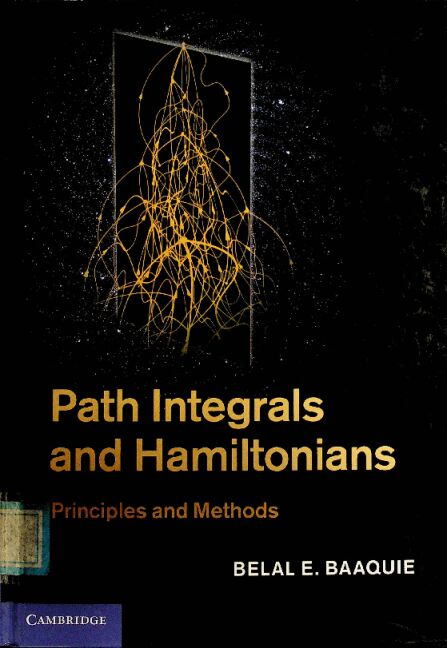
书名:Path integrals and Hamiltonians
责任者:Belal E. Baaquie | National University of Singapore.
出版时间:2014
出版社:Cambridge University Press
摘要
Providing a pedagogical introduction to the essential principles of path integrals and Hamiltonians, this book describes cutting-edge quantum mathematical techniques applicable to a vast range of fields, from quantum mechanics, solid state physics, statistical mechanics, quantum field theory, and superstring theory to financial modeling, polymers, biology, chemistry, and quantum finance. Eschewing use of the Schrödinger equation, the powerful and flexible combination of Hamiltonian operators and path integrals is used to study a range of different quantum and classical random systems, succinctly demonstrating the interplay between a system's path integral, state space, and Hamiltonian. With a practical emphasis on the methodological and mathematical aspects of each derivation, this is a perfect introduction to these versatile mathematical methods, suitable for researchers and graduate students in physics and engineering.
查看更多
前言
Quantum mechanics is undoubtedly one of the most accurate and important scientific theories in the history of science. The theoretical foundations of quantum mechanics have been discussed in depth in Baaquie (2013e), where the main focus is on the interpretation of the mathematical symbols of quantum mechanics and on its enigmatic superstructure. In contrast, the main focus of this book is on the mathematics of path integral quantum mechanics.
The traditional approach to quantum mechanics has been to study the Schrödinger equation, one of the cornerstones of quantum mechanics, and which is a special case of partial differential equations. Needless to say, the study of the Schrödinger equation continues to be a central task of quantum mechanics, yielding a steady stream of new and valuable results.
Interestingly enough, there are two other formulations of quantum mechanics, namely the operator approach of Heisenberg and the path integral approach of Dirac–Feynman, that provide a mathematical framework which is independent of the Schrödinger equation. In this book, the Schrödinger equation is never directly solved; instead the Hamiltonian operator is analyzed and path integrals for different quantum and classical random systems are studied to gain an understanding of quantum mathematics.
I became aware of path integrals when I was a graduate student, and what intrigued me most was the novelty, flexibility and versatility of their theoretical and mathematical framework. I have spent most of my research years in exploring and employing this framework.
Path integration is a natural generalization of integral calculus and is essentially the integral calculus of infinitely many variables, also called functional integration. There is, however, a fundamental feature of path integration that sets it apart from functional integration, namely the role played by the Hamiltonian in the formalism. All the path integrals discussed in this book have an underlying linear structure that is encoded in the Hamiltonian operator and its linear vector state space. It is this combination of the path integral and its underlying Hamiltonian that provides a powerful and flexible mathematical machinery that can address a vast variety and range of diverse problems. Path integration can also address systems that do not have a Hamiltonian and these systems are not studied. Instead, topics have been chosen that can demonstrate the interplay of the system's path integral, state space, and Hamiltonian.
The Hamiltonian operator and the mathematical formalism of path integration make them eminently suitable for describing quantum indeterminacy as well as classical randomness. In two chapters of the book, namely Chapter 7 on stochastic processes and Chapter 17 on compact degrees of freedom, path integrals are applied to classical stochastic and random systems. The rest of the chapters analyze systems that have quantum indeterminacy.
The range and depth of subjects that come under the sway of path integrals are unified by a common thread, which is the mathematics of path integrals. Problems seemingly unrelated to indeterminacy such as the classification of knots and links or the mathematical properties of manifolds have been solved using path integration. The applications of path integrals are almost as vast as calculus, ranging from finance, polymers, biology, and chemistry to quantum mechanics, solid state physics, statistical mechanics, quantum field theory, superstring theory, and all the way to pure mathematics. The concepts and theoretical underpinnings of quantum mechanics lead to a whole set of new mathematical ideas and have given rise to the subject of quantum mathematics.
The ground-breaking and pioneering book by Feynman and Hibbs (1965) laid the foundation for the study of path integrals in quantum mechanics and is always worth reading. More recent books such as those by Kleinert (1990) and Zinn-Justin (2005) discuss many important aspects of path integration and cover a wide range of applications. Given the complex theoretical and mathematical nature of the subject, no single book can conceivably cover the gamut of worthwhile topics that appear in the study of path integration and there is always a need for books that break new ground. The topics chosen in this book have a minimal overlap with other books on path integrals.
A major field of theoretical physics that is based on path integrals is quantum field theory, which includes the Standard Model of particles and forces. The study of quantum field theory leads to the concept of nonlinear gauge fields and to the concept of renormalization, both of which are beyond the scope this book.
The purpose of the book is to provide a pedagogical introduction to the essential principles of path integrals and of Hamiltonians; for this reason many examples have been worked out in full detail so as to elucidate some of the varied methods and techniques that have proven useful in actually performing path integrations. The emphasis in all the derivations is on the methodological and mathematical aspect of the problem – with matters of interpretation being discussed only in passing. Starting from the simplest examples, the various chapters lay the ground work for analyzing more advanced topics. The book provides an introduction to the foundations of path integral quantum mechanics and is a primer to the techniques and methods employed in the study of quantum finance, as formulated by Baaquie (2004) and Baaquie (2010).
查看更多
目录
Preface page xv
Acknowledgements xviii
1 Synopsis 1
Part one Fundamental principles 5
2 The mathematical structure of quantum mechanics 7
2.1 The Copenhagen quantum postulate 7
2.2 The superstructure of quantum mechanics 10
2.3 Degree of freedom space F 10
2.4 State space V(F) 11
2.4.1 Hilbert space 14
2.5 Operators O(F) 14
2.6 The process of measurement 18
2.7 The Schrödinger differential equation 19
2.8 Heisenberg operator approach 22
2.9 Dirac–Feynman path integral formulation 23
2.10 Three formulations of quantum mechanics 25
2.11 Quantum entity 26
2.12 Summary 27
3 Operators 30
3.1 Continuous degree of freedom 30
3.2 Basis states for state space 35
3.3 Hermitian operators 36
3.3.1 Eigenfunctions; completeness 37
3.3.2 Hamiltonian for a periodic degree of freedom 39
3.4 Position and momentum operators xˆ and pˆ 40
3.4.1 Momentum operator pˆ 41
3.5 Weyl operators 43
3.6 Quantum numbers; commuting operator 46
3.7 Heisenberg commutation equation 47
3.8 Unitary representation of Heisenberg algebra 48
3.9 Density matrix: pure and mixed states 50
3.10 Self-adjoint operators 51
3.10.1 Momentum operator on finite interval 52
3.11 Self-adjoint domain 54
3.11.1 Real eigenvalues 54
3.12 Hamiltonian's self-adjoint extension 55
3.12.1 Delta function potential 57
3.13 Fermi pseudo-potential 59
3.14 Summary 60
4 The Feynman path integral 61
4.1 Probability amplitude and time evolution 61
4.2 Evolution kernel 63
4.3 Superposition: indeterminate paths 65
4.4 The Dirac–Feynman formula 67
4.5 The Lagrangian 69
4.5.1 Infinite divisibility of quantum paths 70
4.6 The Feynman path integral 70
4.7 Path integral for evolution kernel 73
4.8 Composition rule for probability amplitudes 76
4.9 Summary 79
5 Hamiltonian mechanics 80
5.1 Canonical equations 80
5.2 Symmetries and conservation laws 82
5.3 Euclidean Lagrangian and Hamiltonian 84
5.4 Phase space path integrals 85
5.5 Poisson bracket 87
5.6 Commutation equations 88
5.7 Dirac bracket and constrained quantization 90
5.7.1 Dirac bracket for two constraints 91
5.8 Free particle evolution kernel 93
5.9 Hamiltonian and path integral 94
5.10 Coherent states 95
5.11 Coherent state vector 96
5.12 Completeness equation: over-complete 98
5.13 Operators; normal ordering 98
5.14 Path integral for coherent states 99
5.14.1 Simple harmonic oscillator 101
5.15 Forced harmonic oscillator 102
5.16 Summary 103
6 Path integral quantization 105
6.1 Hamiltonian from Lagrangian 106
6.2 Path integral's classical limit h → 0 109
6.2.1 Nonclassical paths and free particle 111
6.3 Fermat's principle of least time 112
6.4 Functional differentiation 115
6.4.1 Chain rule 115
6.5 Equations of motion 116
6.6 Correlation functions 117
6.7 Heisenberg commutation equation 118
6.7.1 Euclidean commutation equation 121
6.8 Summary 122
Part two Stochastic processes 123
7 Stochastic systems 125
7.1 Classical probability: objective reality 127
7.1.1 Joint, marginal and conditional probabilities 128
7.2 Review of Gaussian integration 129
7.3 Gaussian white noise 132
7.3.1 Integrals of white noise 134
7.4 Ito calculus 136
7.4.1 Stock price 137
7.5 Wilson expansion 138
7.6 Linear Langevin equation 140
7.6.1 Random paths 142
7.7 Langevin equation with potential 143
7.7.1 Correlation functions 144
7.8 Nonlinear Langevin equation 145
7.9 Stochastic quantization 148
7.9.1 Linear Langevin path integral 149
7.10 Fokker–Planck Hamiltonian 151
7.11 Pseudo-Hermitian Fokker–Planck Hamiltonian 153
7.12 Fokker–Planck path integral 156
7.13 Summary 158
Part three Discrete degrees of freedom 159
8 Ising model 161
8.1 Ising degree of freedom and state space 161
8.1.1 Ising spin's state space V 163
8.1.2 Bloch sphere 164
8.2 Transfer matrix 165
8.3 Correlators 167
8.3.1 Periodic lattice 168
8.4 Correlator for periodic boundary conditions 169
8.4.1 Correlator as vacuum expectation values 171
8.5 Ising model's path integral 171
8.5.1 Ising partition function 172
8.5.2 Path integral calculation of Cr 173
8.6 Spin decimation 175
8.7 Ising model on 2×N lattice 176
8.8 Summary 179
9 Ising model: magnetic field 180
9.1 Periodic Ising model in a magnetic field 180
9.2 Ising model's evolution kernel 182
9.3 Magnetization 183
9.3.1 Correlator 184
9.4 Linear regression 185
9.5 Open chain Ising model in a magnetic field 189
9.5.1 Open chain magnetization 190
9.6 Block spin renormalization 191
9.6.1 Block spin renormalization: magnetic field 195
9.7 Summary 196
10 Fermions 198
10.1 Fermionic variables 199
10.2 Fermion integration 200
10.3 Fermion Hilbert space 201
10.3.1 Fermionic completeness equation 203
10.3.2 Fermionic momentum operator 204
10.4 Antifermion state space 204
10.5 Fermion and antifermion Hilbert space 206
10.6 Real and complex fermions: Gaussian integration 207
10.6.1 Complex Gaussian fermion 209
10.7 Fermionic operators 211
10.8 Fermionic path integral 211
10.9 Fermion–antifermion Hamiltonian 214
10.9.1 Orthogonality and completeness 216
10.10 Fermion–antifermion Lagrangian 217
10.11 Fermionic transition probability amplitude 219
10.12 Quark confinement 220
10.13 Summary 222
Part four Quadratic path integrals 223
11 Simple harmonic oscillator 225
11.1 Oscillator Hamiltonian 226
11.2 The propagator 226
11.2.1 Finite time propagator 227
11.3 Infinite time oscillator 230
11.4 Harmonic oscillator's evolution kernel 230
11.5 Normalization 233
11.6 Generating functional for the oscillator 234
11.6.1 Classical solution with source 234
11.6.2 Source free classical solution 236
11.7 Harmonic oscillator's conditional probability 239
11.8 Free particle path integral 240
11.9 Finite lattice path integral 241
11.9.1 Coordinate and momentum basis 243
11.10 Lattice free energy 243
11.11 Lattice propagator 245
11.12 Lattice transfer matrix and propagator 246
11.13 Eigenfunctions from evolution kernel 249
11.14 Summary 250
12 Gaussian path integrals 251
12.1 Exponential operators 252
12.2 Periodic path integral 253
12.3 Oscillator normalization 254
12.4 Evolution kernel for indeterminate final position 256
12.5 Free degree of freedom: constant external source 260
12.6 Evolution kernel for indeterminate positions 261
12.7 Simple harmonic oscillator: Fourier expansion 264
12.8 Evolution kernel for a magnetic field 267
12.9 Summary 270
Part five Action with acceleration 271
13 Acceleration Lagrangian 273
13.1 Lagrangian 273
13.2 Quadratic potential: the classical solution 275
13.3 Propagator: path integral 277
13.4 Dirac constraints and acceleration Hamiltonian 280
13.5 Phase space path integral and Hamiltonian operator 283
13.6 Acceleration path integral 286
13.7 Change of path integral boundary conditions 289
13.8 Evolution kernel 291
13.9 Summary 293
14 Pseudo-Hermitian Euclidean Hamiltonian 294
14.1 Pseudo-Hermitian Hamiltonian; similarity transformation 295
14.2 Equivalent Hermitian Hamiltonian HO 297
14.3 The matrix elements of e−τQ 298
14.4 e−τQ and similarity transformations 301
14.5 Eigenfunctions of oscillator Hamiltonian HO 304
14.6 Eigenfunctions of H and H† 305
14.6.1 Dual energy eigenstates 307
14.7 Vacuum state; eQ/2 309
14.8 Vacuum state and classical action 312
14.9 Excited states of H 313
14.9.1 Energy ω1 eigenstate Ψ10(x, v) 314
14.9.2 Energy ω2 eigenstate Ψ01(x, v) 315
14.10 Complex ω1,ω2 317
14.11 State space V of Euclidean Hamiltonian 318
14.11.1 Operators acting on V 320
14.11.2 Heisenberg operator equations 322
14.12 Propagator: operators 323
14.13 Propagator: state space 324
14.14 Many degrees of freedom 327
14.15 Summary 329
15 Non-Hermitian Hamiltonian: Jordan blocks 330
15.1 Hamiltonian: equal frequency limit 331
15.2 Propagator and states for equal frequency 331
15.3 State vectors for equal frequency 334
15.3.1 State vector |ψ1(τ)⧽ 334
15.3.2 State vector |ψ2(τ)⧽ 335
15.4 Completeness equation for 2 × 2 block 336
15.5 Equal frequency propagator 337
15.6 Hamiltonian: Jordan block structure 339
15.7 2×2 Jordan block 340
15.7.1 Hamiltonian 342
15.7.2 Schrödinger equation for Jordan block 343
15.7.3 Time evolution 344
15.8 Jordan block propagator 344
15.9 Summary 347
Part six Nonlinear path integrals 349
16 The quartic potential: instantons 351
16.1 Semi-classical approximation 352
16.2 A one-dimensional integral 353
16.3 Instantons in quantum mechanics 355
16.4 Instanton zero mode 362
16.5 Instanton zero mode: Faddeev–Popov analysis 364
16.5.1 Instanton coefficient N 368
16.6 Multi-instantons 370
16.7 Instanton transition amplitude 371
16.7.1 Lowest energy states 372
16.8 Instanton correlation function 373
16.9 The dilute gas approximation 374
16.10 Ising model and the double well potential 376
16.11 Nonlocal Ising model 377
16.12 Spontaneous symmetry breaking 380
16.12.1 Infinite well 381
16.12.2 Double well 381
16.13 Restoration of symmetry 381
16.14 Multiple wells 383
16.15 Summary 383
17 Compact degrees of freedom 385
17.1 Degree of freedom: a circle 386
17.1.1 Poisson summation formula 387
17.1.2 The S1 Lagrangian 388
17.2 Multiple classical solutions 388
17.2.1 Large radius limit 391
17.3 Degree of freedom: a sphere 391
17.4 Lagrangian for the rigid rotor 393
17.5 Cancellation of divergence 395
17.6 Conformation of DNA 397
17.7 DNA extension 399
17.8 DNA persistence length 401
17.9 Summary 403
18 Conclusions 405
References 409
Index 413
查看PDF
查看更多
作者简介
Belal E. Baaquie is a Professor of Physics at the National University of Singapore, specializing in quantum field theory, quantum mathematics and quantum finance. He is the author of Quantum Finance (2004), Interest Rates and Coupon Bonds in Quantum Finance (2009), The Theoretical Foundations of Quantum Mechanics (2013) and co-author of Exploring Integrated Science (2010).
查看更多
馆藏单位
中科院文献情报中心