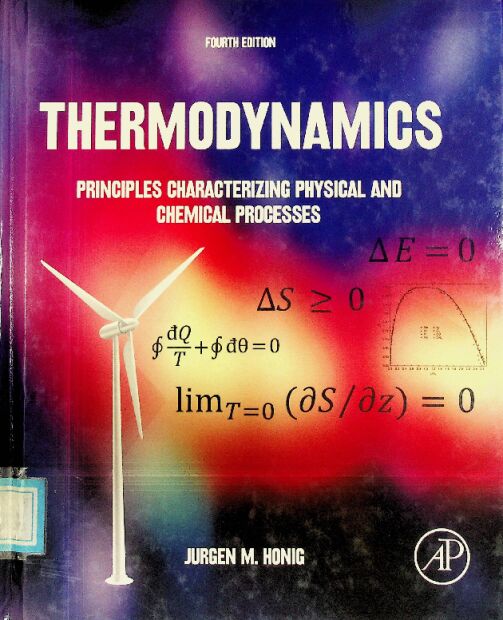
书名:Thermodynamics
责任者:Jurgen M. Honig | Profesor of Chemistry | Emeritus | Department of Chemistry | Purdue University | West Lafayette | Indiana | USA.
ISBN\ISSN:9780128101407,9780124167056,0124167055
出版时间:2014
出版社:Elsevier/Academic Press, Academic Press is an imprint of Elsevier
分类号:物理学
版次:Fourth edition.
页数:xiii, 445 pages :
摘要
Thermodynamics is a self-contained analysis of physical and chemical processes based on classical thermodynamic principles. Emphasis is placed on the fundamental principles with a combination of theory and practice, demonstrating their application to a variety of disciplines. This edition has been completely revised and updated to include new material and novel formulations, including new formulation and interpretation of The Second Law, discussions of heat vs. work, uniqueness of chemical potential, and construction of functions of state. This book will appeal to graduate students and professional chemists and physicists who wish to acquire a more sophisticated overview of thermodynamics and related subject matter.
Clear explanations of abstract theoretical concepts
Complete revision and update, including novel formulations not described elsewhere
Exhaustive coverage of graphical, numerical, and analytical computational techniques
The latest applications in science and engineering
查看更多
前言
Thermodynamics is often regarded as a very esoteric subject; somehow, by use of formulae of abstruse provenance, one arrives at useful results, without knowing how the methodology works. While an enormous amount of material has been already written about this subject matter, this book represents yet another attempt to demystify the process by which, on the basis of a few fundamental principles, one obtains a cornucopia of useful results. Much of the exposition covers standard subject material; however, this volume is more than a linear superposition of preceding books and reviews. I have attempted to include topics that are not normally included in other treatments of the subject and, where possible, to introduce approaches that are not routine. The present version differs from earlier editions in that it includes a summary of statistical mechanics, which allowed me to specify the various thermodynamic functions in terms of atomistic parameters. I have also included new subject matter: the treatment of certain classes of irreversible processes at a very early stage, effects of centrifugal fields, an extensive treatment of anisotropic media, the discussion of electron interactions in solids, order-disorder theory and applications, electronic phase transitions - including reentrant metallic behavior - and a primer on critical phenomena. Throughout I have tried to be a bit less formal: in fact, an alternate title to this book might very well have been: Lectures on Thermodynamics. The extent to which I have succeeded can only be left to the judgment by posterity.
I do wish to acknowledge my indebtedness to the authors of all the source material that I quote. I also particularly profited from extensive discussions with former and present colleagues: Professors Dor Ben Amotz, and James W. Richardson of Purdue University, and Professor Józef Spatek at the Jagiellonian University, Kraków, Poland. I also appreciate the assistance by Dr. Darwin Collins and by Mss. Elizabeth Duselis and Elizabeth Hewitt in the preparation of the typescript. I am greatly indebted to Ms. Pu Wei for her artistic endeavors in the design of the book cover. I also appreciate the assistance of personnel at Elsevier - Science and Technology Books, in their efforts in getting the typescript to press. I continue to be greatly indebted to my wonderful wife, Josephine-in particular, for her patient understanding of my preoccupation with topics that are beyond her immediate interests and ken as a painter, writer, and musician.
Jurgen M.
Honig West Lafayette, IN
November 2013.
查看更多
目录
General Commentary xi
Preface xiii
Chapter 1. Fundamentals 1
1.1 Introductory Definitions 1
Remarks and Queries 4
1.2 The Zeroth Law of Thermodynamics 5
Additional Information 8
1.3 Mathematical Apparatus 9
Remarks 20
1.4 Thermodynamic Forces 20
Reference 21
1.5 Elements of Work 21
Comment and Queries 30
1.6 The Element of Work for a System Subjected to Electromagnetic Fields 30
Remark and Reference 32
1.7 The First Law of Thermodynamics 32
Reference 37
Notes 37
1.8 The Second Law of Thermodynamics 38
Footnotes and Query 42
1.9 Consequences of the First and Second Laws 42
Remarks and Questions 50
1.10 Functions of State; Reprise 51
Appendix A: Remarks Concerning Irreversible Processes 59
Appendix B: Time-Dependent Irreversible Processes 60
Reference 64
Notes 64
1.11 Statements of the Second Law; Thermodynamic Operation of Heat Engines; Kelvin and Planck Statements; Temperature Scale 65
Exercise 67
1.12 Systematization of Results Based on Functions of State 67
Review of Electronic Properties of Metals 87
Exercises and Remark 88
1.13 The Third Law of Thermodynamics 88
Remarks and Queries 90
1.14 The Gibbs–Duhem Relation and Its Analogs 90
Query and Reference 94
1.15 Heat Capacities; Fundamentals and Applications 94
Acknowledgment 105
Exercises and Comments 105
1.16 Effect of Chemical Changes on the Energy of a System 105
Remarks 106
1.17 Stability of a System; Fluctuations 107
Appendices 114
Reference 115
Chapter 2. Thermodynamic Properties of Ideal Systems 117
2.1 Equilibrium in a System of Several Components and Phases 117
Exercises 119
2.2 Achievement of Equilibrium 120
Comment and Exercise 124
2.3 System of One Component and Several Phases; the Clausius–Clapeyron Equation
Reference and Footnote 124
2.4 Properties of Ideal Gases 129
Exercises 134
2.5 Properties of Ideal Solutions in Condensed Phases 134
Reference 136
2.6 The Duhem–Margules Equation and Its Consequences 137
2.7 Temperature Dependence of Composition of Solutions 138
2.8 Lowering of the Freezing Point and Elevation of the Boiling Point of a Solution 139
Exercise 142
2.9 General Description of Chemical Reactions and Chemical Equilibrium; Application to Gases 142
Remarks 148
2.10 Chemical Equilibrium in Homogeneous Condensed Ideal Solutions 149
Comments 152
2.11 Chemical Equilibrium in Ideal Heterogeneous Systems 152
2.12 Equilibrium between Two Ideal Phases 154
Chapter 3. Characterization of Nonideal Solutions 155
3.0 Introductory Remarks 155
3.1 Thermodynamic Treatment of Nonideal Gas Mixtures 155
Notes and Exercise 158
3.2 Temperature and Pressure Dependence of the Fugacity of a Gas 158
3.3 Thermodynamic Description of Real Solutions in the Condensed State 159
Query and Reference 161
3.4 Characterization of Chemical Equilibrium in Nonideal Solutions 161
3.5 Pressure and Temperature Dependence of Activities and Activity Coefficients 168
3.6 Determination of Activity Coefficients and Calorimetric Quantities in Chemical Processes 168
References and Commentary 181
3.7 Determination of Activities from Freezing Point Lowering of Solutions 181
3.8 Thermodynamic Properties of Nonideal Solutions 184
Exercises 192
Exercises 206
3.9 Dependence of Higher Order Phase Transitions on Temperature 207
Exercises and References 217
3.10 Elements of Order–Disorder Theory and Applications 217
References 229
Chapter 4. Thermodynamic Properties of Electrolytes and of EMF Cells 231
4.0 Introductory Comments 231
4.1 Activities of Strong Electrolytes 231
Exercise and Comment 235
4.2 Theoretical Determination of Activities in Electrolyte Solutions; the Debye–C3\Hückel Equation 235
Comment and Exercises 237
Experimental Determination of Activities and Activity Coefficients of Strong Electrolytes 238
Equilibrium Properties of Weak Electrolytes 240
Exercise 245
4.3 Galvanic Cells 245
Remarks 247
4.4 Operation of Galvanic Cells 247
Remarks 250
4.5 Galvanic Cells; Operational Analysis 250
4.6 Liquid Junction Potentials 253
4.7 EMF Dependence on Activities 254
Examples of Operating Cells 255
Types of Operating Cells 256
Queries 258
4.8 Thermodynamic Information from Galvanic Cells 258
Assignment 259
Chapter 5. Thermodynamic Properties of Materials in Externally Applied Fields 261
5.0 Introductory Comments 261
5.1 Thermodynamics of Gravitational and Centrifugal Fields 261
Comment and Exercises 267
5.2 Thermodynamics of Adsorption Processes 267
References and Exercises 275
5.3 Heats of Adsorption 276
Reference and Exercises 280
5.4 Surface vs Bulk Effects: Thermodynamics of Self-Assembly 281
References 290
5.5 Pressure of Electromagnetic Radiation 290
5.6 Thermodynamic Characterization of Electrodynamic Radiation 292
Exercises 297
5.7 Effects of Electric Fields on Thermodynamic Properties of Matter 297
Reference and Exercises 302
5.8 Systematization of Electromagnetic Field Effects in Thermodynamics 302
Comments and Assignments 310
5.9 Adiabatic Diamagnetization and Transitions to Superconductivity 311
5.10 Thermodynamic Characterization of Anisotropic Media 314
Reference 322
5.11 Thermodynamic Properties of Anisotropic Media 322
Reference and Exercise 327
5.12 Thermodynamics of Interacting Electron Assemblies 327
Remarks and References 335
Chapter 6. Irreversible Thermodynamics 337
6.0 Introductory Comments 337
6.1 Generalities 337
Notes and Queries 345
6.2 Shock Phenomena 345
Exercises 351
6.3 Linear Phenomenological Equations 352
6.4 Steady-State Conditions and Prigogine's Theorem 353
Comments and Questions 354
6.5 Onsager Reciprocity Conditions 355
Reference 356
6.6 Thermomolecular Mechanical Effects 356
6.7 Electrokinetic Phenomena 359
Exercises 362
6.8 The Soret Effect 363
Exercises 364
6.9 Thermoelectric Effects 364
Comments and Exercises 369
6.10 Irreversible Thermomagnetic Phenomena in Two Dimensions 369
Exercises 373
Chapter 7. Critical Phenomena 375
7.0 Introductory Remarks 375
7.1 Properties of Materials Near Their Critical Point 375
Notes and References 380
7.2 Homogeneity Requirements, Correlation Lengths, and Scaling Properties 381
Footnotes 386
7.3 Derivation of Griffith's and Rushbrooke's Inequality 386
Reference and Exercise 392
7.4 Scaled Equation of State 393
Reference 393
7.5 Landau Theory of Critical Phenomena and Phase Transitions 393
Reference 405
Chapter 8. A Final Speculation about Ultimate Temperatures—A Fourth Law of Thermodynamics? 407
Reference 408
Chapter 9. Reprise to the Second Law. Mathematical Proof of the Caratheodory's Theorem and Resulting Interpretations 409
9.1 Fundamentals 409
9.2 Proof of Holonomicity 411
9.3 Necessary Condition for Establishing the Carathéodory's Theorem 414
9.4 Relevance to Thermodynamics 416
9.5 Derivation of the Limiting Form for the Debye–Hűckel Equation 417
References and Query 422
Chapter 10. Elements of Statistical Thermodynamics 425
10.1 Distributions and Statistics 425
10.2 The Boltzmann Relation for the Entropy 429
10.3 Distribution Functions 429
10.4 Digression on the Concepts of Work and Heat 432
10.5 Statistical Representation of Functions of State 432
10.6 Summary 433
10.7 Alternative Statistical Interpretation for Entropy in Terms of Properties of a System 434
Footnotes: 436
10.8 Derivation of Curie's Law and Ohm's Law 437
Index 439
查看PDF
查看更多
作者简介
Prof. Honig received a BS degree from Amherst College in 1945 and a PhD degree from the University of Minnesota in 1952. After a postdoctoral appointment year at the James Forrestal Center of Princeton University in 1953, he joined the Department of Chemistry at Purdue University in 1953, and was promoted to Associate Professor in 1958. From 1959-1967, Prof. Honig was Associate Group leader and Group leader at the MIT Lincoln Laboratory in Lexington, MA. He returned as Professor of Chemistry to Purdue University in 1967 and retired from that position in 2000. During the latter years, he was Editor of the Journal of Solid State Chemistry (1982-2000), the Chairman of the Materials Sciences Council (1968-1982), and published over 420 refereed publications and five books. PA\Prof. Honig has earned an honorary degree from the University of Science and Technology (2009, Krakow, Poland; fellow of the New York Academy of Sciences; Wetherill medal (1995); Editor, Journal of Solid State Chemistry (1982- 2000); Honorary Member, Materials Research Society of India; two issues of the Journal of Solid State Chemistry (1990 and 2000) and an issue of Solid State Sciences (2000) dedicated to him; and a session at a Materials Research Society meeting (2000) held in honor of his retirement.
查看更多
馆藏单位
中科院文献情报中心