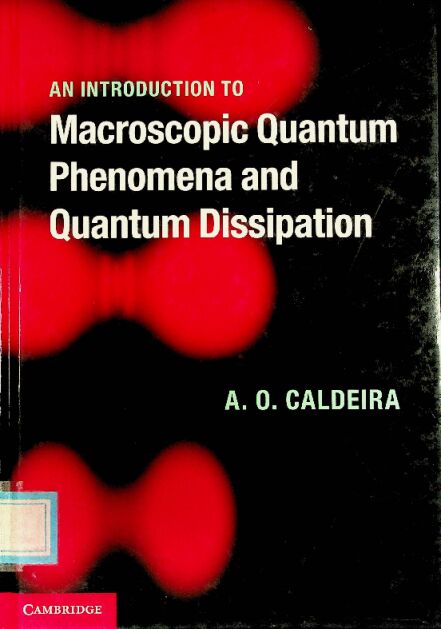
书名:An introduction to macroscopic quantum phenomena and quantum dissipation
ISBN\ISSN:9780521113755,052111375X
出版时间:2014
出版社:Cambridge University Press
摘要
Reviewing macroscopic quantum phenomena and quantum dissipation, from the phenomenology of magnetism and superconductivity to the presentation of alternative models for quantum dissipation, this book develops the basic material necessary to understand the quantum dynamics of macroscopic variables. Macroscopic quantum phenomena are presented through several examples in magnetism and superconductivity, developed from general phenomenological approaches to each area. Dissipation naturally plays an important role in these phenomena, and therefore semi-empirical models for quantum dissipation are introduced and applied to the study of a few important quantum mechanical effects. The book also discusses the relevance of macroscopic quantum phenomena to the control of meso- or nanoscopic devices, particularly those with potential applications in quantum computation or quantum information. It is ideal for graduate students and researchers.
查看更多
前言
On deciding to write this book, I had two main worries: firstly, what audience it would reach and secondly, to avoid as far as possible overlaps with other excellent texts already existing in the literature.
Regarding the first issue I have noticed, when discussing with colleagues, supervising students, or teaching courses on the subject, that there is a gap between the standard knowledge on the conventional areas of physics and the way macroscopic quantum phenomena and quantum dissipation are presented to the reader. Usually, they are introduced through phenomenological equations of motion for the appropriate dynamical variables involved in the problem which, if we neglect dissipative effects, are quantized by canonical methods. The resulting physics is then interpreted by borrowing concepts of the basic areas involved in the problem – which are not necessarily familiar to a general readership – and adapted to the particular situation being dealt with. The so-called macroscopic quantum effects arise when the dynamical variable of interest, which is to be treated as a genuine quantum variable, refers to the collective behavior of an enormous number of microscopic (atomic or molecular) constituents. Therefore, if we want it to be appreciated even by more experienced researchers, some general background on the basic physics involved in the problem must be provided.
In order to fill this gap, I decided to start the presentation of the book by introducing some very general background on subjects which are emblematic of macroscopic quantum phenomena: magnetism and superconductivity. Although I wanted to avoid the presentation of the basic phenomenological equations of motion as a starting point to treat the problem, I did not want to waste time developing long sections on the microsocopic theory of those areas since it would inevitably offset the attention of the reader. Therefore, my choice was to develop this required basic knowledge through the phenomenological theories of magnetism and superconductivity already accessible to a senior undergraduate student. Microscopic details have been avoided most of the time, and only in a few situations are these concepts (for example, exchange interaction or Cooper pairing) employed in order to ease the understanding of the introduction of some phenomenological terms when necessary. In so doing, I hope to have given the general reader the tools required to perceive the physical reasoning behind the so-called macroscopic quantum phenomena.
Once this has been done, the next goal is the treatment of these quantum mechanical systems (or the effects which appear therein) in the presence of dissipation. Here too, a semi-empirical method is used through the adoption of the now quite popular "system-plus-reservoir" approach, where the reservoir is composed of a set of non-interacting oscillators distributed in accordance with a given spectral function. Once again this is done with the aim of avoiding encumbering the study of dissipation through sophisticated many-body methods applied to a specific situation for which we may know (at least in principle) the basic interactions between the variable of interest and the remaining degrees of freedom considered as the environment. The quantization of the composite system is now possible, and the harmonic variables of the environment can be properly traced out of the full dynamics, resulting in the time evolution of the reduced density operator of the system of interest only.
At this point there are alternative ways to implement this procedure. The community working with superconducting devices, in particular, tends to use path integral methods, whereas researchers from quantum optics and stochastic processes usually employ master equations. As the former can be applied to underdamped as well as overdamped systems and its extension to imaginary times has been tested successfully in tunneling problems, I have chosen to adopt it. However, since this subject is not so widely taught in compulsory physics courses, not many researchers are familiar with it and, therefore, I decided to include some basic material as guidance for those who know little or nothing about path integrals.
Now let me elaborate a little on the issue of the overlap with other books. By the very nature of a book itself, it is almost impossible to write anything without overlaps with previously written material. Nevertheless, in this particular case, I think I have partially succeeded in doing so because of the introductory material already mentioned above and also the subjects I have chosen to cover. Although at least half of them are by now standard problems of quantum dissipation and also covered in other books (for example, in the excellent books of U. Weiss or H. P. Breuer and F. Petruccione), those texts are mostly focused on a given number of topics and some equally important material is left out. This is the case, for instance, with alternative models for the reservoir and its coupling to the variable of interest, and the full treatment of quantum tunneling in field theories (with and without dissipation), which is useful for dealing with quantum nucleation and related problems in macroscopic systems at very low temperatures. These issues have been addressed in the present book.
The inclusion of the introductory material on magnetism, superconductivity, path integrals, and more clearly gives this book a certain degree of self-containment. However, the reader should be warned that, as usual, many subjects have been left out as in any other book. I have tried to call the attention of the reader whenever it is not my intention to pursue a given topic or extension thereof any further. In such cases, a list of pertinent references on the subject is provided, and as a general policy I have tried to keep as close as possible to the notation used in the complementary material of other authors in order to save the reader extra work.
In conclusion, I think that this book can easily be followed by senior undergraduate students, graduate students, and researchers in physics, chemistry, mathematics, and engineering who are familiar with quantum mechanics, electromagnetism, and statistical physics at the undergraduate level.
查看更多
目录
Preface page xi
Acknowledgments xiv
1 Introduction 1
2 Elements of magnetism 5
2.1 Macroscopic Maxwell equations: The magnetic moment 6
2.2 Quantum effects and the order parameter 9
2.2.1 Diamagnetism 10
2.2.2 Curie–Weiss theory: Ferromagnetism 11
2.2.3 Magnetization: The order parameter 15
2.2.4 Walls and domains 19
2.3 Dynamics of the magnetization 21
2.3.1 Magnetic particles 24
2.3.2 Homogeneous nucleation 30
2.3.3 Wall dynamics 34
2.4 Macroscopic quantum phenomena in magnets 42
3 Elements of superconductivity 46
3.1 London theory of superconductivity 46
3.2 Condensate wave function (order parameter) 51
3.3 Two important effects 57
3.3.1 Flux quantization 57
3.3.2 The Josephson effect 58
3.4 Superconducting devices 59
3.4.1 Superconducting quantum interference devices (SQUIDs) 59
3.4.2 Current-biased Josephson junctions (CBJJs) 64
3.4.3 Cooper pair boxes (CPBs) 66
3.5 Vortices in superconductors 67
3.6 Macroscopic quantum phenomena in superconductors 79
4 Brownian motion 87
4.1 Classical Brownian motion 88
4.1.1 Stochastic processes 89
4.1.2 The master and Fokker–Planck equations 92
4.2 Quantum Brownian motion 97
4.2.1 The general approach 98
4.2.2 The propagator method 101
5 Models for quantum dissipation 104
5.1 The bath of non-interacting oscillators: Minimal model 104
5.2 Particle in general media: Non-linear coupling model 111
5.3 Collision model 120
5.4 Other environmental models 122
6 Implementation of the propagator approach 127
6.1 The dynamical reduced density operator 127
6.1.1 The minimal model case 127
6.1.2 The non-linear coupling case 136
6.1.3 The collision model case 140
6.2 The equilibrium reduced density operator 147
7 The damped harmonic oscillator 151
7.1 Time evolution of a Gaussian wave packet 151
7.2 Time evolution of two Gaussian packets: Decoherence 159
8 Dissipative quantum tunneling 167
8.1 Point particles 167
8.1.1 The zero-temperature case 168
8.1.2 The finite-temperature case 178
8.2 Field theories 192
8.2.1 The undamped zero-temperature case 193
8.2.2 The damped case at finite temperatures 202
9 Dissipative coherent tunneling 205
9.1 The spin–boson Hamiltonian 205
9.2 The spin–boson dynamics 211
9.2.1 Weak damping limit 211
9.2.2 Adiabatic renormalization 213
9.2.3 Path integral approach 214
10 Outlook 222
10.1 Experimental results 223
10.2 Applications: Superconducting qubits 225
10.2.1 Flux qubits 226
10.2.2 Charge qubits 227
10.2.3 Phase qubits and transmons 228
10.2.4 Decoherence 231
10.3 Final remarks 232
Appendix A Path integrals, the quantum mechanical propagator, and density operators 235
A.1 Real-time path integrals 235
A.2 Imaginary-time path integrals 245
Appendix B The Markovian master equation 247
Appendix C Coherent-state representation 250
Appendix D Euclidean methods 262
D.1 Harmonic approximation 264
D.2 Bistable potential 265
D.3 Metastable potential 267
References 272
Index 279
查看PDF
查看更多
作者简介
A. O. Caldeira is a professor at the Instituto de Física 'Gleb Wataghin', the Universidade Estadual de Campinas (UNICAMP), Brazil. His main research interests are in condensed matter systems at low temperatures, in particular, quantum statistical dynamics of non-isolated systems and strongly correlated systems in low dimensionality.
查看更多
馆藏单位
中科院文献情报中心