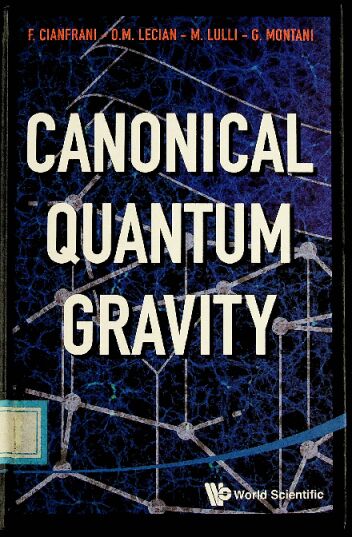
书名:Canonical quantum gravity
责任者:Francesco Cianfrani | Italy | Matteo Lulli | Italy | Giovanni Montani | ENEA - C.R. Frascati | UTFUS-MAG & "Sapienza | University of Wroclaw | Poland | Orchidea Maria Lecian | Sapienza | University of Rome | Italy | Max Planck Institute for Gravitational Physics | Germany & ICRA International Center for Relativistic Astrophysics
出版时间:2014
出版社:World Scientific
前言
The request of a coherent quantization for the gravitational field dynam�ics emerges as a natural consequence of Einstein's Equations: the energy�momentum of a field is source of the spacetime curvature and therefore its microscopic quantum features must be reflected onto microgravity eF fects. The use of expectation values as sources is well-grounded as a first approximation only, and does not fulfill the requirements of a fundamental theory.
However, as is well-known, the achievement of a consistent Quantum Gravity theory remains a complete open task, due to a plethora of differ�ent subtleties, which are here summarized in the two main categories: i) General Relativity is a background-independent theory and therefore any analogy with the non-Abelian gauge formalisms must deal with the con�cept of a dynamic metric field; ii) the implementation in the gravitational sector of standard prescriptions, associated with the quantum mechanics paradigms, appears as a formal procedure, whose real physical content is still elusive.
查看更多
目录
Preface xi
List of Figures xix
List of Notations xxi
1. Introduction to General Relativity 1
1.1 Parametric manifold representation 1
1.2 Tensor formalism 3
1.3 Affine properties of the manifold 5
1.3.1Ordinary derivative 5
1.3.2 Covariant derivative 5
1.3.3 Properties of the affine connections 6
1.4 Metric properties of the manifold 7
1.4.1 Metric tensor 7
1.4.2 ChristofFel symbols 8
1.5 Geodesic equation and parallel transport 9
1.6 Levi-Civita tensor 10
1.7 Volume element and covariant divergence 13
1.8 Gauss and Stokes theorems 14
1.9 The Riemann tensor 16
1.9.1 Levi-Civita construction 16
1.9.2 Algebraic properties and Bianchi identities 19
1.10 Geodesic deviation 19
1.11 Einstein's equations 21
1.11.1 Equivalence Principle 21
1.11.2 Theory requirements 22
1.11.3 Field equations 24
1.12 Vierbein representation 27
2. Elements of Cosmology 31
2.1 The Robertson-Walker geometry 32
2.2 Kinematics of the Universe 34
2.3 Isotropic Universe dynamics 37
2.4 Universe thermal history 40
2.4.1Universe critical parameters 44
2.5 Inflationary paradigm 46
2.5.1Standard Model paradoxes 47
2.5.2 Inflation mechanism 50
2.5.3 Re-heating phase 54
3.Constrained Hamiltonian Systems 57
3.1 Preliminaries 57
3.2 Constrained systems 61
3.2.1 Primary and secondary constraints 62
3.2.2 First- and second-class constraints 64
3.3 Canonical transformations 66
3.3.1Strongly canonical transformations 66
3.3.2 Weakly canonical transformations 68
3.3.3 Gauged canonical transformations 69
3.4 Electromagnetic field 70
3.4.1 Modified Lagrangian formulation 70
3.4.2 Hamiltonian formulation 72
3.4.3 Gauge transformations 80
3.4.4 Gauged canonicity 83
4. Lagrangian Formulations 87
4.1 Metric representation 88
4.1.1 Einstein-Hilbert formulation 88
4.1.2 Stress-Energy tensor 90
4.1.3 ΓΓ formulation 92
4.1.4 Dirac formulation 97
4.1.5 General f (R) Lagrangian densities 100
4.1.6 Palatini formulation 102
4.2 ADM formalism 104
4.2.1 Spacetime foliation and extrinsic curvature 105
4.2.2 Gauss-Codazzi equation 109
4.2.3 ADM Lagrangian density 111
4.3 Boundary terms 113
4.3.1 Gibbons-York-Hawking boundary term 114
4.3.2 Comparison among different formulations 115
5.Quantization Methods 119
5.1 Classical and quantum dynamics 119
5.1.1Dirac observables 120
5.1.2 Poisson brackets and commutators 121
5.1.3 Schrodinger representation 122
5.1.4 Heisenberg representation 124
5.1.5 The Schrodinger equation 124
5.1.6 Quantum to classical correspondence: Hamilton-Jacobi equation 125
5.1.7 Semi-classical states 127
5.2 Weyl quantization 129
5.2.1Weyl systems 130
5.2.2 The Stone-von Neumann uniqueness theorem 130
5.3 GNS construction 131
5.4 Polymer representation 133
5.4.1 Difference operators versus differential operators 133
5.4.2 The polymer representation of Quantum Mechanics 134
5.4.3 Kinematics 135
5.4.4 Dynamics 136
5.4.5 Continuum limit 137
5.5 Quantization of Hamiltonian constraints 138
5.5.1Non-relativistic particle 139
5.5.2 Relativistic particle 140
5.5.3 Scalar field 142
5.5.4 The group averaging technique 143
6.Quantum Geometrodynamics 145
6.1 The Hamiltonian structure of gravity 145
6.1.1 ADM Hamiltonian density 145
6.1.2 Constraints in the 3+1 representation 147
6.1.3 The Hamilton-Jacobi equation for the gravity tional field 150
6.2 ADM reduction of the Hamiltonian dynamics 151
6.3 Quantization of the gravitational field 152
6.3.1 Quantization of the primary constraints 153
6.3.2 Quantization of the supermomentum constraint 153
6.3.3 The Wheeler-DeWitt equation 154
6.4 Shortcomings of the Wheeler-DeWitt approach 155
6.4.1 The definition of the Hilbert space 155
6.4.2 The functional nature of the theory 156
6.4.3 The frozen formalism: the problem of time 157
7. Gravity as a Gauge Theory 165
7.1 Gauge theories 165
7.1.1 The Yang-Mills formulation 165
7.1.2 Hamiltonian formulation 168
7.1.3 Lattice gauge theories 168
7.2 Gravity as a gauge theory of the Lorentz group? 176
7.2.1 Spinors in curved spacetime 176
7.2.2 Comparison between gravity and Yang-Mills theories 178
7.3 Poincare gauge theory 179
7.4 Holst action 183
7.4.1 Lagrangian formulation 183
7.4.2 Hamiltonian formulation 184
7.4.3 Ashtekar variables 188
7.4.4 Removing the time-gauge condition 190
7.4.5 The Kodama functional as a classical solution of the constraints 197
8. Loop Quantum Gravity 199
8.1 Smeared variables 200
8.1.1 Why a reformulation in terms of holonomies? 201
8.2 Hilbert space representation of the holonomy-flux algebra 203
8.2.1 Holonomy-flux algebra 203
8.2.2 Kinematical Hilbert space 204
8.3 Kinematical constraints 208
8.3.1 Solution of the Gauss constraint: invariant spin�networks 209
8.3.2 Three-difFeomorphisms invariance and s-knots 210
8.4 Geometrical operators: discrete spectra 212
8.4.1 Area operator 212
8.4.2 Volume operator 214
8.5 The scalar constraint operator 216
8.5.1 Spin foams and the Hamiltonian constraint 219
8.6 Open issues in Loop Quantum Gravity 221
8.6.1 Algebra of the constraints 222
8.6.2 Semiclassical limit 223
8.6.3 Physical scalar product 224
8.6.4 On the physical meaning of the Immirzi parameter 225
8.7Master Constraint and Algebraic Quantum Gravity 227
8.8 The picture of quantum spacetime 228
9. Quantum Cosmology 231
9.1The minisuperspace model 234
9.2 General behavior of Bianchi models 236
9.2.1 Quantum Picture 238
9.2.2 Matter contribution 240
9.3 Bianchi I model 242
9.4 Bianchi IX model 244
9.4.1 Quantum dynamics 247
9.4.2 Semiclassical behavior 250
9.4.3 The quantum behavior of the isotropic Universe 253
9.5 BKL conjecture 256
9.6 Cosmology in LQG 258
9.6.1 Loop Quantum Cosmology 259
9.6.2 Other approaches 270
Bibliography 275
Index 295
查看更多
馆藏单位
中科院文献情报中心