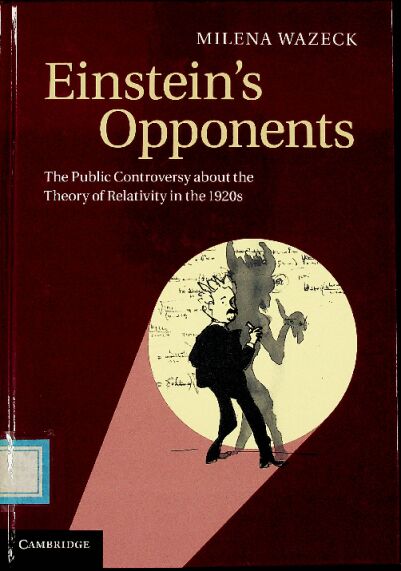
书名:Einstein s opponents
责任者:Milena Wazeck | University of East Anglia ; Geoffrey S. Ko | Kent State University.
出版时间:2014
出版社:Cambridge University Press
前言
I spent the summer of 2002inan archive room with no windows.Stored there, in moving boxes and banana crates, were the papers of the physicist and Einstein opponent Ernst Gehr cke, which had just been acquired by the Max Planck Institute for the History of Science(whose German abbreviation is MPI WG) .My initial sorting of the material was followed by countless weekends of reading.Fiery pamphlets against the theory of relativity accompanied by agitative correspondence and solemnly worded alternative universal theories set against modern physics cast light in this small room on a shadowy world at the beginning of the twentieth century.Who were all these people who protested so vehemently against Einstein's theory?What provoked them to consider one of the most important physics theories of the twentieth century to be one of the greatest threats of their time?In order to answer these questions, this book brings together two strands of research where, until now, few connections have been apparent-the history of the popular-ization of science and the history of modern physics.It will show that the critics of the theory of relativity came from an on-academic social background whose roots extend farther back than the 1920s-in fact their roots developed in the course of the expansion of the sciences and their popularization in the nineteenth century.
In order to analyze the historical phenomenon of non-academic criticism of the theory of relativity, a discourse analysis approach was applied to an area that has hardly been touched by historical discourse analysis, namely the history of modem physics.The heated public controversy about Einstein's theory of relativity is understood here as a discourse of marginalized knowledge and thus subjected to a new analytical perspective that is, I hope, instructive to both the history of science and the sociology of knowledge.
This book developed from an interest in the role of science for the concept of reality in modern societies that I developed during my studies of political science.It is thanks to J iir genRe nn that I received the intellectual and institutional flexibility that was necessary for this work.Our collaboration in the context of various research projects in his department at the Max Planck Institute for the History of Science encouraged me to understand the history of knowledge as a comprehensive research field that must also deal with bodies of knowledge that extend beyond established academic sciences.The linking of source-oriented research with theoretical reflec-tion, as is practiced in these research projects, decisively shaped my approach to research questions.
The present work was accepted as a dissertation by the Faculty of Humanities(I) at Humboldt University of Berlin, and has been slightly revised for publication. I would like to thank JiirgenRennandRiidigervom Bruch for supervising this work as first and second readers; my thanks also goto Gabriele Metzler for her stimulating third reader's report.I must also thank my colleagues at the Max Planck Institute for the History of Science, Katja Bode ker, Jochen Bi ittner, Peter Damerow, Lindy Diva rci, Carmen Hammer, Dieter Hoffmann, Christoph Lehner, Simone Rieger, Matthias Schemmel, Matteo Valle rian i, and many others, for countless helpful, encouraging, and stimulating conversations.Safia Azz o uni, Katja Bode ker, Dieter Hoffmann and Matthias Schemmel were careful readers of earlier versions of this work or portions thereof.I always benefitted from their critical comments and friendly pointers.I would like to express my particular thanks to Matthias Schemmel for always being willing to clarify physics issues.
This book refers to source material that has been newly discovered in some cases. The support of the library at the Max Planck Institute for the History of Science under its director, Urs Schoepf lin, made many things easier and somethings possible in the first place; my heartfelt thanks goto Bianca Henn for her archival cataloging of Gehr cke's papers.Additionally, I would like to thank Ann Kenne of the Department of Special Collections of the University of St.Thomas for her help in providing archival material.
Many thanks to Simon Capelin and his team from Cambridge University Press for their help producing this book.Thanks also goto Geoffrey S.Koby for his excellent and fast translation of the manuscript from the German.The translation of this book, originally published in German in 2009, was funded by Geisteswissenschaften International-Translation Funding for Work in the Humanities and Social Sciences.I am very grateful to have received this grant.The manuscript was slightly revised for the English edition.
This book is dedicated to my sister Jan a and my father J ii rgen.Thankyou for always being there for me.
查看更多
目录
Translator's preface: making the imaginary accessible-translating Einstein's Opponents page vii
Preface xix
Abbreviations xxi
Introduction 1
1 The world riddle solvers 15
1.1 The darkside of the popularization of science 15
1.2 The phenomenon of world riddle solving 20
1.3 Contexts of world riddle solving 23
1.4 The world riddle solvers' conception of science 41
1.5 The anti-academic attitude and dissociation from academic research 58
1.6 Provisional appraisal of world riddle solving 62
2 The confrontation with the theory of relativity 66
2.1 The triumphal march of the theory of relativity in the public sphere 66
2.2 The mental block to reception 76
2.3 The defensive attitude to the "attack" of modern physics 81
3 The debate on the content of the theory of relativity 90
3.1 The criticism of there organization of fundamental physical concepts by the theory of relativity 91
3.2 Two conceptions of science 147
3.3 The content-based accusations of plagiarism 157
4 Marginalization and protest: the strategic dispute with the theory of relativity 176
4.1 Marginalization 177
4.2 Argumentative strategies against marginalization 216
4.3 Network formation and protest organizations of Einstein's opponents 237
Conclusion 307
References 313
Secondary literature 313
Sources 324
Quoted newspaper and periodical articles 348
Unpublished sources 351
Index 352
查看更多
作者简介
Milena Wazeck is a Newton International Fellow at the University of East Anglia, and an historian of science interested in the intersection of modern physics and its social context.
查看更多
馆藏单位
中科院文献情报中心