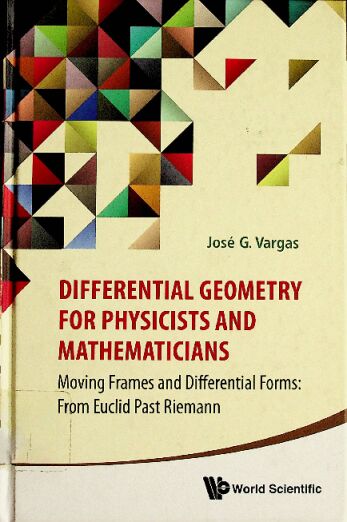
书名:Differential geometry for physicists and mathematicians
ISBN\ISSN:9789814566391,981456639X
出版时间:2014
出版社:World Scientific
前言
Preface The principle that informs this book.This is a book on differential geometry that uses the method of moving frames and the exterior calculus throughout.That maybe common to a few works.What is special about this one is thefollowing.After introducing the basic theory of differential forms and pertinent algebra,we study the“flat cases”known as affine and Euclidean spaces,and simple examples of their generalizations.In so doing,we seek understanding of advanced concepts by first dealing with them in simple structures.Differential geometry books often resort to formal definitions of bundles,Lie algebras,etc.that are best understood by discovering them in a natural way in cases of interest.Those books then provide very recondite examples for the illustration of advanced concepts,say torsion,eventhough very simple examples exist.Misunderstandings ensue.In 1492 Christopher Columbus crossed the Atlantic using an affine connection in a simplified form(a connection is nothing but a rule to navigate a manifold) .He asked the captains of the other two ships in his small flotilla to always maintain what he considered to be the same direction:West.That connection has torsion.Elie Cart an introduced it in the mathematical literature centuries later[13] .We can learn connections from a practical point of view, the practical one of Columbus.That will help us to easily understand concepts like frame bundle,connection,valued ness,Lie algebra,etc.,which might otherwise look intimidating.Thus,for example,we shall slowly acquire a good understanding of a fine connections as differential 1-forms in the aff ne frame bundle of a differentiable manifold taking values in the Lie algebra of the a fine group and having such and such properties.Replace the term a fine with the terms Euclidean,conformal,projective,etc.and you have entered the theories of Euclidean,projective,conformal...connections.Cartan's versus the modern approach to geometry.It is sometimes stated that E.Cart an's work was not rigorous,and that it is not possible to make it SO.This statement has led to the development of other methods to do differential geometry,full of definitions and distracting concepts;not the style that physicists like.
查看更多
目录
Dedication V
Acknowledgements vii
Preface ix
I INTRODUCTION 1
1 ORIENTATIONS 3
1.1Selective capitalization of section titles 3
1.2Classical in classical differential geometry 4
1.3Intended readers of this book 5
1.4The foundations of physics in this BOOK 6
1.5Mathematical VIRUSES 9
1.6FREQUENT MISCONCEPTIONS 11
1.7Prerequisite,anticipated mathematical CONCEPTS 14
II TOOLS 19
2DIFFERENTIAL FORMS 21
2.1Acquaintance with differential forms 21
2.2Differentiable manifolds,pedestrian ly 23
2.3Differential 1-forms 25
2.4Differential r-forms 30
2.5Exterior products of differential forms 34
2.6Change of basis of differential forms 35
2.7Differential forms and measurement 37
2.8Differentiable manifolds DEFINED 38
2.9Another definition of differentiable MANIFOLD 40
3VECTOR SPACES AND TENSOR PRODUCTS 43
3.1INTRODUCTION 43
3.2Vector spaces(over the reals) 45
3.3Dual vector spaces 47
3.4Euclidean vector spaces 48
3.4.1Definition 48
3.4.2Orthonormal bases 49
3.4.3Reciprocal bases 50
3.4.4Orthogonalization 52
3.5Not quite right concept of VECTOR FIELD 55
3.6Tensor products:theoretical minimum 57
3.7Formal approach to TENSORS 58
3.7.1Definition of tensor space 58
3.7.2Transformation of components of tensors 59
3.8Clifford algebra 61
3.8.1Introduction 61
3.8.2Basic Clifford algebra 62
3.8.3The tangent Clifford algebra of 3-D Euclidean vector space 64
3.8.4The tangent Clifford algebra of spacetime 65
3.8.5Concluding remarks 66
4EXTERIOR DIFFERENTIATION 67
4.1Introduction 67
4.2Disguised exterior derivative 67
4.3The exterior derivative 69
4.4Coordinate independent definition of exterior derivative 70
4.5Stokes theorem 71
4.6Differential operators in language of forms 73
4.7The conservation law for scalar-valued ness 77
4.8Lie Groups and their Lie algebras 79
III TWO KLEIN GEOMETRIES 83
5 AFFINE KLEIN GEOMETRY 85
5.1A fine Space 85
5.2The frame bundle of affine space 87
5.3The structure of a fine space 89
5.4Curvilinear coordinates:holonomic bases 91
5.5General vector basis fields 95
5.6Structure of a fine space on SECTIONS 97
5.7Differential geometry as calculus 99
5.8Invariance of connection differential FORMS 101
5.9The Lie algebra of the affine group 103
5.10 The Maurer-Cart an equations 105
5.11 HORIZONTAL DIFFERENTIAL FORMS 107
6EUCLIDEAN KLEIN GEOMETRY 109
6.1Euclidean space and its frame bundle 109
6.2Extension of Euclidean bundle to affine bundle 112
6.3Meanings of covariance 114
6.4Hodge duality and star operator 116
6.5The Laplacian 119
6.6Euclidean structure and integrability 121
6.7The Lie algebra of the Euclidean group 123
6.8Scalar-valuedclifforms:Kahlercalculus 124
6.9Relation between algebra and geometry 125
IV CART AN CONNECTIONS 127
7 GENERALIZED GEOMETRY MADE SIMPLE 129
7.1Of connections and topology 129
7.2Planes 130
7.2.1The Euclidean 2-plane 131
7.2.2Post-Klein 2-plane with Euclidean metric 132
7.3The 2-sphere 134
7.3.1The Columbus connection on the punctured 2-sphere 134
7.3.2The Levi-Civita connection on the 2-sphere 136
7.3.3Comparison of connections on the 2-sphere 137
7.4The 2-torus 138
7.4.1Canonical connection of the 2-torus 138
7.4.2Canonical connection of the metric of the 2-torus 140
7.5Abridged Riemann's equivalence problem 140
7.6Use and misuse of Levi-Civita 141
8AFFINE CONNECTIONS 143
8.1Lie differentiation,INVARIANTS and vector fields 143
8.2Affine connections and equations of structure 147
8.3Tensorial ity issues and second differentiations 150
8.4Developments and annulment of connection 153
8.5Interpretation of the aff ne curvature 154
8.6The curvature tensor field 156
8.7Auto parallels 158
8.8Bianchi identities 159
8.9Integrability and interpretation of the torsion 160
8.10 Tensor-valued ness and the conservation law 161
8.11The zero-torsion case 164
8.12Horrible covariant derivatives 165
8.13Afine connections:rigorous APPROACH 167
9EUCLIDEAN CONNECTIONS 171
9.1Metrics and the Euclidean environment 171
9.2Euclidean structure and Bianchi IDENTITIES 173
9.3The two pieces of a Euclidean connection 177
9.4A fine extension of the Levi-Civita connection 178
9.5Computation of the con torsion 179
9.6Levi-Civita connection by inspection 180
9.7Stationary curves and Euclidean AUTO PARALLELS 185
9.8Euclidean and Riemannian curvatures 188
10 RIEMANNIAN SPACES AND PSEUDO-SPACES 191
10.1Klein geometries in greater DETAIL 191
10.2 The false spaces of Riemann 193
10.3 Method of EQUIVALENCE 195
10.4Riemannian spaces 197
10.5Annulment of connection at a point 199
10.6 Emergence and conservation of Einstein's tensor 201
10.7 EINSTEIN'S DIFFERENTIAL 3-FORM 202
10.8 Einstein's3-form:propertiesandequations 205
10.9 Einstein equations for Schwarzschild 208
V THE FUTURE? 213
11 EXTENSIONS OF CARTAN 215
11.1 INTRODUCTION 215
11.2Cartan-Finsler-CLIFTON 216
11.3Cartan-KALUZA-KLEIN 218
11.4Cartan-Clifford-KAHLER 220
11.5Cartan-Kahler-Einstein-YANG-MILLS 221
12 UNDERSTAND THE PAST TO IMAGINE THE FUTURE 225
12.1 Introduction 225
12.2 History of some geometry-related algebra 225
12.3 History of modern calculus and differential forms 227
12.4 History of standard differential GEOMETRY 229
12.5 Emerging unification of calculus and geometr 233
12.6 Imagining the future 235
13A BOOK OF FAREWELLS 237
13.1 Introduction 237
13.2 Farewell to vector algebra and calculus 237
13.3 Farewell to calculus of complex VARIABLE 239
13.4 Farewell to Dirac's CALCULUS 240
13.5 Farewell to tensor calculus 242
13.6 Farewell to auxiliary BUNDLES? 243
APPENDIX A:GEOMETRY OF CURVES AND SURFACES 247
A. 1 Introduction 247
A.2 Surfaces in 3-D Euclidean space 248
A.2.1Representations of surfaces:metrics 248
A.2.2Normal to a surface,orthonormal frames,area 250
A.2.3The equations of Gauss and Weingarten 251
A. 3 Curves in 3-D Euclidean space 252
A.3.1Frenet's frame field and formulas 253
A.3.2Geodesic frame fields and formulas 254
A.4Curves on surfaces in 3-D Euclidean space 254
A.4.1Canonical frame field of a surface 254
A.4.2Principal and total curvatures;umbi lics 255
A.4.3Euler's,Me us nier'sand Rodrigues'es theorems 256
A.4.4Levi-Civita connection induced from 3-D Euclidean space 256
A.4.5Theorem aegregiumandCodazzi equations 257
A.4.6The Gauss-Bonnet formula257
A.4.7Computation of the“extrinsic connection”of a surface 259
APPENDIX B:“BIOGRAPHIES”(“PUBLI”GRAPHIES) 261
B.1Elie Joseph Cart an(1869-1951) 261
B.1.1Introduction 261
B.1.2Algebra 262
B.1.3Exterior differential systems 263
B.1.4Genius even if we ignore his working on algebra,exterior systems proper and differential geometry 263
B.1.5Differential geometry:264
B.1.6Cart an the physicist 265
B.1.7Cart an as critic and mathematical technician 266
B.1.8Cart a nasa writer 267
B.1.9Summary 268
B.2Hermann Grassmann(1808-1877) 269
B.2.1Mini biography 269
B.2.2Multiplications galore 269
B.2.3Tensor and quotient algebras 270
B.2.4Impact and historical context 271
APPENDIX C:PUBLICATIONS BY THE AUTHOR 273
References 277
Index 285
查看PDF
查看更多
馆藏单位
中科院文献情报中心