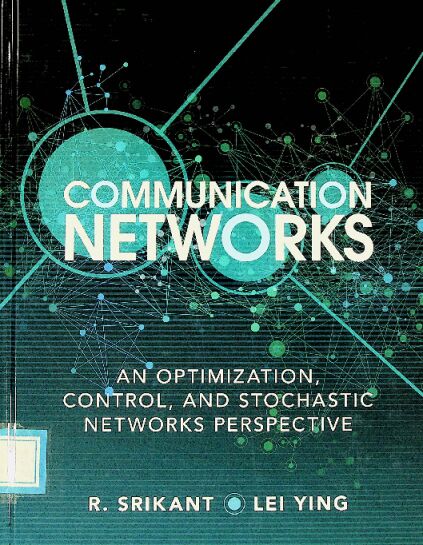
书名:Communication networks
责任者:R. Srikant | University of Illinois at Urbana-Champaign | Lei Ying | Arizona State University.
出版时间:2014
出版社:Cambridge University Press,
摘要
Communication Networks blends control, optimization, and stochastic network theories with features that support student learning to provide graduate students with an accessible, modern approach to the design of communication networks.
Covers a broad range of performance analysis tools, including important advanced topics that are made accessible to graduate students for the first time.
Taking a top-down approach to network protocol design, the authors begin with the deterministic model and progress to more sophisticated models.
Network algorithms and protocols are tied closely to the theory, engaging students and helping them understand the practical engineering implications of what they have learnt.
The background behind the mathematical analyses is given before the formal proofs and is supported by worked examples, enabling students to understand the big picture before going into the detailed theory.
End-of-chapter exercises cover a range of difficulties; complex problems are broken down into several parts, many with hints to guide students. Full solutions are available to instructors.
查看更多
前言
Why we wrote this book
Traditionally, analytical techniques for communication networks discussed in textbooks fall into two categories: (i) analysis of network protocols, primarily using queueing theoretic tools, and (ii) algorithms for network provisioning which use tools from optimization theory. Since the mid 1990s, a new viewpoint of the architecture of a communication network has emerged. Network architecture and algorithms are now viewed as slow-timescale, distributed solutions to a large-scale optimization problem. This approach illustrates that the layered architecture of a communication network is a natural by-product of the desire to design a fair and stable system. On the other hand, queueing theory, stochastic processes, and combinatorics play an important role in designing low-complexity and distributed algorithms that are viewed as operating at fast time scales.
Our goal in writing this book is to present this modern point of view of network protocol design and analysis to a wide audience. The book provides readers with a comprehensive view of the design of communication networks using a combination of tools from optimization theory, control theory, and stochastic networks, and introduces mathematical tools needed to analyze the performance of communication network protocols.
Organization of the book
The book has been organized into two major parts. In the first part of the book, with a few exceptions, we present mathematical techniques only as tools to design algorithms implemented at various layers of a communication network. We start with the transport layer, and then consider algorithms at the link layer and the medium access layer, and finally present a unified view of all these layers along with the network layer. After we cover all the layers, we present a brief introduction to peer-to-peer applications which, by some estimates, form a significant portion of Internet traffic today.
The second part of the book is devoted to advanced mathematical techniques which are used frequently by researchers in the area of communication networks. We often sacrifice generality by making simplifying assumptions, but, as a result, we hope that we have made techniques that are typically found in specialized texts in mathematics more broadly accessible. The collection of mathematical techniques relevant to communication networks is vast, so we have perhaps made a personal choice in the selection of the topics. We have chosen to highlight topics in basic queueing theory, asymptotic analysis of queues, and scaling laws for wireless networks in the second part of the book.
We note that two aspects of the book are perhaps unique compared to other textbooks in the field: (i) the presentation of the mathematical tools in parallel with a top-down view of communication networks, and (ii) the presentation of heavy-traffic analysis of queueing models using Lyapunov techniques.
The background required to read the book
Graduate students who have taken a graduate-level course in probability and who have some basic knowledge of optimization and control theory should find the book accessible. An industrious student willing to put in extra effort may find the book accessible even with just a strong undergraduate course in probability. Researchers working in the area of communication networks should be able to read most chapters in the book individually since we have tried to make each chapter as self contained as possible. However, occasionally we refer to results in earlier chapters when discussing the material in a particular chapter, but this overlap between chapters should be small. We have provided a brief introduction to the mathematical background required to understand the various topics in the book, as and when appropriate, to aid the reader.
How to use the book as an instructor
We have taught various graduate-level courses from the material in the book. Based on our experience, we believe that there are two different ways in which this book can be used: to teach either a single course or two courses on communication networks. Below we provide a list of chapters that can be covered for each of these options.
A two-course sequence on communication networks.
Course 1 (modeling and algorithms): Chapters 1–6 except Section 3.5, and Sections 7.1, 7.2, 7.4.1, and Chapter 8. The mathematical background, Sections 2.1 and 2.3, can be taught as and when necessary when dealing with specific topics.
Course 2 (performance analysis): Chapters 9 (cover Section 8.2 before Section 9.14), 10, and 11. We recommend reviewing Chapter 3 (except Section 3.5), which would have been covered in Course 1 above, before teaching Chapter 10.
A single course on communication networks, covering modeling, algorithms, and performance analysis: Chapters 1–6 except Section 3.5, Sections 9.1–9.10 of Chapter 9, and Chapters 10 and 11.
Acknowledgements
This book grew out of courses offered by us at the University of Illinois at Urbana Champaign, Iowa State University, and Arizona State University. The comments of the students in these courses over the years have been invaluable in shaping the material in the book. We would like to acknowledge Zhen Chen, Javad Ghaderi, Juan Jose Jaramillo, Xiaohan Kang, Joohwan Kim, Siva Theja Maguluri, Chandramani Singh, Weina Wang, Rui Wu, Zhengyu Zhang, and Kai Zhu in particular, who read various parts of the book carefully and provided valuable comments. We also gratefully acknowledge collaborations and/or discussions with Tamer Ba¸sar, Atilla Eryilmaz, Bruce Hajek, Frank Kelly, P. R. Kumar, Sean Meyn, Sanjay Shakkottai, Srinivas Shakkottai, Ness Shroff, and Don Towsley over the years, which helped shape the presentation of the material in this book.
查看更多
目录
Preface page xi
1 Introduction 1
I Network architecture and algorithms 5
2 Mathematics of Internet architecture 7
2.1 Mathematical background: convex optimization 7
2.1.1 Convex sets and convex functions 7
2.1.2 Convex optimization 11
2.2 Resource allocation as utility maximization 15
2.2.1 Utility functions and fairness 17
2.3 Mathematical background: stability of dynamical systems 19
2.4 Distributed algorithms: primal solution 21
2.4.1 Congestion feedback and distributed implementation 24
2.5 Distributed algorithms: dual solution 26
2.6 Feedback delay and stability 27
2.6.1 Linearization 29
2.7 Game-theoretic view of utility maximization 30
2.7.1 The Vickrey–Clarke–Groves mechanism 31
2.7.2 The price-taking assumption 34
2.7.3 Strategic or price-anticipating users 35
2.8 Summary 41
2.9 Exercises 42
2.10 Notes 47
3 Links: statistical multiplexing and queues 49
3.1 Mathematical background: the Chernoff bound 49
3.2 Statistical multiplexing and packet buffering 51
3.2.1 Queue overflow 52
3.3 Mathematical background: discrete-time Markov chains 55
3.4 Delay and packet loss analysis in queues 64
3.4.1 Little’s law 64
3.4.2 The Geo/Geo/1 queue 67
3.4.3 The Geo/Geo/1/B queue 69
3.4.4 The discrete-time G/G/1 queue 70
3.5 Providing priorities: fair queueing 72
3.5.1 Key properties 76
3.6 Summary 78
3.7 Exercises 79
3.8 Notes 85
4 Scheduling in packet switches 86
4.1 Switch architectures and crossbar switches 87
4.1.1 Head-of-line blocking and virtual output queues 88
4.2 Capacity region and MaxWeight scheduling 90
4.2.1 Intuition behind the MaxWeight algorithm 96
4.3 Low-complexity switch scheduling algorithms 96
4.3.1 Maximal matching scheduling 96
4.3.2 Pick-and-compare scheduling 102
4.3.3 Load-balanced switches 102
4.4 Summary 105
4.5 Exercises 106
4.6 Notes 109
5 Scheduling in wireless networks 110
5.1 Wireless communications 110
5.2 Channel-aware scheduling in cellular networks 114
5.3 The MaxWeight algorithm for the cellular downlink 116
5.4 MaxWeight scheduling for ad hoc P2P wireless networks 122
5.5 General MaxWeight algorithms 125
5.6 Q-CSMA: a distributed algorithm for ad hoc P2P networks 129
5.6.1 The idea behind Q-CSMA 129
5.6.2 Q-CSMA 130
5.7 Summary 134
5.8 Exercises 135
5.9 Notes 140
6 Back to network utility maximization 142
6.1 Joint formulation of the transport, network, and MAC problems 142
6.2 Stability and convergence: a cellular network example 151
6.3 Ad hoc P2P wireless networks 155
6.4 Internet versus wireless formulations: an example 157
6.5 Summary 159
6.6 Exercises 160
6.7 Notes 163
7 Network protocols 165
7.1 Adaptive window flow control and TCP protocols 166
7.1.1 TCP-Reno: a loss-based algorithm 167
7.1.2 TCP-Reno with feedback delay 170
7.1.3 TCP-Vegas: a delay-based algorithm 171
7.2 Routing algorithms: Dijkstra and Bellman–Ford algorithms 175
7.2.1 Dijkstra’s algorithm: link-state routing 176
7.2.2 Bellman–Ford algorithm: distance-vector routing 179
7.3 IP addressing and routing in the Internet 182
7.3.1 IP addressing 183
7.3.2 Hierarchical routing 184
7.4 MAC layer protocols in wireless networks 186
7.4.1 Proportionally fair scheduler in cellular downlink 187
7.4.2 MAC for WiFi and ad hoc networks 188
7.5 Summary 191
7.6 Exercises 192
7.7 Notes 194
8 Peer-to-peer networks 195
8.1 Distributed hash tables 195
8.1.1 Chord 196
8.1.2 Kademlia 202
8.2 P2P file sharing 207
8.2.1 The BitTorrent protocol 208
8.3 Structured P2P streaming 210
8.4 Unstructured P2P streaming 215
8.5 The gossip process 219
8.6 Summary 221
8.7 Exercises 222
8.8 Notes 225
II Performance analysis 227
9 Queueing theory in continuous time 229
9.1 Mathematical background: continuous-time Markov chains 229
9.2 Queueing systems: introduction and definitions 237
9.3 The M/M/1 queue 239
9.4 The M/M/s/s queue 241
9.4.1 The PASTA property and blocking probability 242
9.5 The M/M/s queue 242
9.6 The M/GI/1 Queue 243
9.6.1 Mean queue length and waiting time 246
9.6.2 Different approaches taken to derive the P-K formula 247
9.7 The GI/GI/1 queue 249
9.8 Reversibility 251
9.8.1 The M/M/1 queue 253
9.8.2 The tandem M/M/1 queue 254
9.9 Queueing systems with product-form steady-state distributions 254
9.9.1 The Jackson network 255
9.9.2 The multi-class M/M/1 queue 256
9.10 Insensitivity to service-time distributions 258
9.10.1 The M/M/1-PS queue 259
9.10.2 The M/GI/1-PS queue 259
9.11 Connection-level arrivals and departures in the internet 263
9.12 Distributed admission control 267
9.13 Loss networks 269
9.13.1 Large-system limit 271
9.13.2 Computing the blocking probabilities 274
9.13.3 Alternative routing 275
9.14 Download time in BitTorrent 276
9.15 Summary 280
9.16 Exercises 282
9.17 Notes 289
10 Asymptotic analysis of queues 290
10.1 Heavy-traffic analysis of the discrete-time G/G/1 queue 291
10.2 Heavy-traffic optimality of JSQ 294
10.3 Large deviations of i.i.d. random variables: the Cramer–Chernoff theorem 302
10.4 Large-buffer large deviations 307
10.5 Many-sources large deviations 312
10.6 Summary 317
10.7 Exercises 318
10.8 Notes 321
11 Geometric random graph models of wireless networks 323
11.1 Mathematical background: the Hoeffding bound 323
11.2 Nodes arbitrarily distributed in a unit square 325
11.3 Random node placement 328
11.4 Summary 335
11.5 Exercises 336
11.6 Notes 339
References 340
Index 349
查看更多
作者简介
Lei Ying is an Associate Professor in the School of Electrical, Computer and Energy Engineering at Arizona State University, and former Northrop Grumman Assistant Professor at Iowa State University. He is a winner of the NSF CAREER Award and the DTRA Young Investigator Award. His research interests are broadly in the area of stochastic networks, including wireless networks, P2P networks, cloud computing, and social networks.
查看更多
馆藏单位
中科院文献情报中心