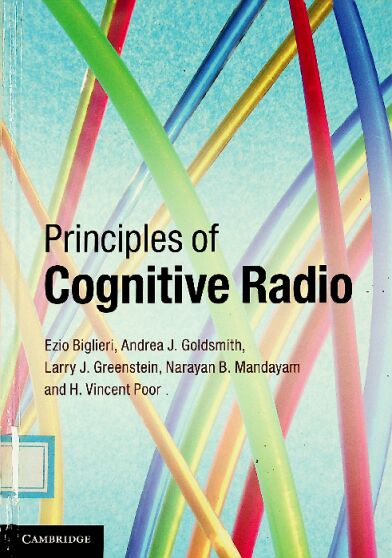
书名:Principles of cognitive radio
责任者:Ezio Biglieri ... [et al.].
ISBN\ISSN:9781107028753,1107028752
出版时间:2013
出版社:Cambridge University Press,
摘要
Principles of Cognitive Radio
Widely regarded as one of the most promising emerging technologies for driving the future development of wireless communications, cognitive radio has the potential to mitigate the problem of increasing radio spectrum scarcity through dynamic spectrum allocation.
Drawing on fundamental elements of information theory, network theory, propagation, optimization, and signal processing, a team of leading experts present a systematic treatment of the core physical and networking principles of cognitive radio, and explore key design considerations for the development of new cognitive radio systems.
Containing all the underlying principles you need to develop practical applications in cognitive radio, this book is an essential reference for students, researchers, and practitioners alike in the field of wireless communications and signal processing.
查看更多
前言
The radio spectrum is one of the most important resources for communications. Traditionally, spectrum governance throughout the world has tended towards exclusivity of its use in large geographic areas, allocating frequency bands for specific applications and assigning licenses to specific users or service providers. This policy has generated a shortage of frequencies available for emerging wireless products and services, as most frequencies are now assigned. Moreover, exclusivity creates underutilization of the spectrum, as very rarely can all licensees make full use of the frequencies assigned to them. These facts have motivated the search for technologies able to alleviate the artificial scarcity of spectrum by adapting to changing environmental and network-usage conditions.
What is perhaps the most natural among these technologies involves opportunistic use of the spectrum, whereby secondary (unlicensed) users are able to occupy the portions of the spectrum left temporarily free by the licensed primary users. The stringent requirement here is that secondary users should not interfere with the primary users, which this paradigm of operation (later called interweaving) achieves using the simplest form of orthogonalization, one that only requires knowledge of the state of a frequency band, i.e., whether it is free or occupied. The fact that the spectrum can be shared by primary and secondary users, with the latter exploiting their cognition of the environment in which transmission is taking place, has led to the development of the concept of Cognitive Radio (CR), whose idea was first introduced in [1] in 1999. Further paradigms, potentially more efficient than interweaving, have subsequently emerged. In the underlay paradigm, the secondary transmitter overlaps in frequency with the primary user, after making sure that the interference level it causes is below a given threshold. The overlay paradigm assumes that the secondary user has knowledge of the primary user’s transmission scheme and of the channel, and uses this knowledge by choosing a transmission scheme that causes an irrelevant amount of interference. In its multiple aspects, CR is now widely regarded as one of the most promising technologies for future wireless communications, a technology that may potentially mitigate, through dynamic spectrum access, the radio spectrum scarcity problem. The US Federal Communications Commission has approved the use of mobile devices in unused television bands, and there is considerable support worldwide for this new concept. Wide interest in the field has also been displayed in academic research. Since CR theory is still in its early stage, there is a need for a book describing the principles on which CR is based, and laying out in a unified way the background needed for further developments and innovative applications. This background blends propagation theory, information theory, detection theory, optimization theory, networking, and signal processing. Given the importance of the discipline, and the number of unique features that characterize it, this book, which covers the fundamental aspects of CR and especially those that are the most promising for commercial implementation, should be of considerable interest to researchers and practitioners in this field.
This book is organized into five chapters, each meant to be self-contained (with the possible exception of Chapter 5, which may need knowledge of material in Chapter 4 if the reader is not conversant with the basics of detection theory). Chapter 1 introduces the concepts of CR, illustrates the present and future of spectrum management policies, and examines network design and standardization activity. Chapter 2 is devoted to the information-theoretic aspects of CR. Specifically, it develops the fundamental capacity limits, guidelines for the spectral efficiency possible in CR using each of its three paradigms, as well as practical design ideas to optimize performance. These fundamental limits are based on the amount of side information that can be gathered about the radio environment and can be used to improve spectrum utilization as well as the complexity of the CR technique employed. Chapter 3 describes the propagation channels that are typical of CR environments, and presents models for path loss, Doppler spectrum, delay spread, and other relevant features. These models are useful to both designers and analysts, who need to characterize the spectral, temporal, and spatial variations of the channel responses in CR networks. Chapter 4 describes techniques for spectrum sensing, to be used in interweaving and underlay. Interweaving involves the classification and the performance analysis of a number of decision rules intended to identify spectral regions that are empty and hence can be used by secondary users, while underlay is treated by introducing the concept of interference temperature. Finally, Chapter 5 contains the discussion of a number of advanced topics related to spectrum exploration and exploitation. These include techniques, such as distributed, sequential and quickest detection, that are important in optimizing spectrum sensing and identifying available spectral opportunities. This chapter further explores highlevel methodologies, including dynamic programming, bandit problems, reinforcement learning, and game theory, in the context of their applications to sensing and access policy design for CR systems. We hasten to observe here that space limitations prevent us from covering the whole range of CR-related topics. In particular, this book does not cover many of the networking aspects of CR, protocols, and standardization efforts.
Our presentation of the subject aspires to combine the features of a textbook and a guide through the research literature. Thus, the book is aimed at graduate students and researchers, as well as at practitioners in industry. Having an emphasis on principles, it can be used as a textbook in a beginning-graduate course entirely devoted to CR, or as a complementary book in courses devoted to wireless communications. It was written assuming no special prerequisite knowledge for reading it, beyond the usual contents of basic communication, information theory, and signal processing courses given in standard electrical engineering curricula. These basics are extended here to the theoretical aspects of CR that are specific to this new technology.
While we know that no book is so poorly written that it cannot be useful in some part, we are also aware that no book is so perfect that nothing wrong can be found in it. Thus, we would be grateful to readers who inform us of any mistakes or inaccuracies that they may find herein.
References
[1] J. Mitola III, Cognitive Radio: Model-Based Competence for Software Radio, Licentiate Thesis, The Royal Institute of Technology. Stockholm, Sweden, Aug. 1999.
查看更多
目录
Contributors page xiii
Preface xv
Acknowledgments xviii
Notation xix
1 The concept of cognitive radio 1
1.1 Motivation for cognitive radios: spectrum is underutilized 1
1.2 What is cognitive radio? 2
1.2.1 Agile radios and dynamic spectrum access 2
1.2.2 User hierarchy in cognitive radio networks 3
1.2.3 Usage scenarios for cognitive radio 3
1.2.4 Cognitive radio bands 4
1.3 Spectrum policy: present and future 5
1.3.1 Role of spectrum policy 5
1.4 Data explosion: future spectrum implications 7
1.5 Applications of cognitive radio 8
1.5.1 Dynamic spectrum access in cellular systems 9
1.5.2 Cellular data boost 9
1.5.3 Machine-to-machine communications 10
1.5.4 Distribution and backhaul 11
1.5.5 Cognitive digital home 12
1.5.6 Long range vehicle-to-vehicle network 12
1.6 Cognitive radio network design 13
1.6.1 Global control plane 13
1.6.2 Spectrum servers, spectrum brokers, and network information servers 15
1.6.3 Security aspects of cognitive radio 18
1.7 Hardware and system design considerations 19
1.7.1 Design tradeoffs in usage scenarios 19
1.7.2 Antenna design in cognitive radio systems 20
1.7.3 Analog-to-digital converters 21
1.7.4 Wideband channels and noncontiguous transmission 21
1.8 Spectrum coexistence in cognitive radio networks 25
1.8.1 Spectrum pooling and bandwidth exchange 26
1.8.2 Cross-layer scheduling in cognitive radio networks 29
1.9 Prototyping 30
1.10 Standardization activity in cognitive radio 33
1.11 Organization of this book 35
References 35
2 Capacity of cognitive radio networks 41
2.1 Introduction 41
2.2 Cognitive radio network paradigms 41
2.2.1 Underlay paradigm 42
2.2.2 Overlay paradigm 43
2.2.3 Interweave paradigm 45
2.2.4 Comparison of cognitive radio paradigms 46
2.3 Fundamental performance limits of wireless networks 47
2.3.1 Performance metrics 48
2.3.2 Mathematical definition of capacity 55
2.3.3 Capacity region of wireless networks 59
2.4 Interference channels without cognition 63
2.4.1 K-user interference channels 63
2.4.2 Two-user interference channel capacity 64
2.4.3 Interference channel techniques for cognitive radios 68
2.5 Underlay cognitive radio networks 69
2.5.1 Underlay capacity region 70
2.5.2 Capacity results for specific scenarios 72
2.6 Interweave cognitive radio networks 76
2.6.1 Shannon capacity 77
2.6.2 Random switch model for secondary channels 80
2.6.3 Scaling laws for interweave networks 83
2.7 Overlay cognitive radio networks 84
2.7.1 Cognitive encoder for the two-user overlay channel 85
2.7.2 Capacity results 89
2.7.3 K-user overlay networks 92
2.8 Summary 93
2.9 Further reading 96
References 96
3 Propagation issues for cognitive radio 102
3.1 Introduction 102
3.1.1 Propagation in the cognitive radio bands 102
3.1.2 Impact of propagation on sensing 103
3.1.3 Impact of propagation on transmission 104
3.1.4 Outline of the chapter 105
3.2 Generic channel response 105
3.3 Introduction to path loss 107
3.3.1 Free-space path loss 107
3.3.2 Path loss in CR scenarios 107
3.4 Path loss models for wireless channels 108
3.4.1 General formulation 108
3.4.2 Shadow fading, S 111
3.4.3 Median path loss, P Lmed 112
3.4.4 Antenna gain and the gain reduction factor 114
3.5 Path loss models for tower-based scenarios 115
3.5.1 Transmissions from TV towers 115
3.5.2 Tower-to-tower paths at low-to-moderate heights 117
3.6 Small-scale fading and the Ricean K-factor 118
3.6.1 Spatial variation of field strength 118
3.6.2 Temporal fading on mobile radio links 122
3.6.3 Temporal fading on fixed wireless links 122
3.7 Small-scale fading and the Doppler spectrum 123
3.7.1 Doppler frequency 123
3.7.2 The angle-of-arrival and Doppler spectra 124
3.7.3 The autocorrelation function, A(Δt) 125
3.7.4 The Doppler spectrum for fixed terminals 126
3.7.5 Dispersion 127
3.8 Delay dispersion 128
3.8.1 "Narrowband" vs. "wideband" 128
3.8.2 Wideband channels 128
3.8.3 Time-variant impulse response 129
3.8.4 The power delay profile, P(τ ) 130
3.8.5 The frequency correlation function, F(Δf) 131
3.8.6 A model and values for the delay spread 132
3.8.7 Ultra-wideband (UWB) channels 133
3.9 Angle dispersion 134
3.9.1 Directions of arrival and departure 134
3.9.2 Models for the APS shape and angular spread 136
3.9.3 Joint dispersions 137
3.10 Polarization 138
3.11 Special environments 139
3.11.1 Vehicle-to-vehicle (V2V) propagation 139
3.11.2 Wireless sensor networks (WSNs) 140
3.12 Summary of key model parameters 141
3.12.1 Path loss models 141
3.12.2 Ricean K-factor models 141
3.12.3 Delay dispersion models 141
3.12.4 Frequency dispersion models 142
3.12.5 Comprehensive models 142
3.12.6 Usage of models 142
3.13 Summary 142
3.14 Further reading 143
References 144
4 Spectrum sensing 150
4.1 Introduction 150
4.2 Interference temperature for cognitive underlaying 151
4.3 White-space detection for cognitive interweaving 153
4.3.1 Energy sensing 157
4.3.2 Coherent detection 160
4.3.3 Cyclostationarity-based detection 161
4.3.4 Autocorrelation-based detection 163
4.4 An application: spectrum sensing with OFDM 166
4.4.1 Neyman–Pearson detection 167
4.4.2 Detection based on second-order statistics 169
4.5 Effects of imperfect knowledge of noise power 170
4.5.1 Energy sensing 171
4.5.2 Pilot-tone-aided coherent sensing 172
4.5.3 Cyclostationarity-based detection 173
4.6 Effects of an inaccurate model of interference 174
4.6.1 Basics of moment-bound theory 174
4.6.2 Energy sensing 176
4.6.3 Pilot-tone-aided coherent sensing 178
4.7 Summary 180
4.8 Further reading 180
References 181
5 Spectrum exploration and exploitation 184
5.1 Introduction 184
5.1.1 Chapter motivation 184
5.1.2 Preview of the chapter 186
5.2 Advanced spectrum sensing techniques 187
5.2.1 Distributed detection in spectrum sensing 187
5.2.2 Sequential and quickest detection 202
5.3 Optimized spectrum exploration and exploitation: sensing and access policy design 212
5.3.1 Optimization techniques 213
5.3.2 Bandit problems 220
5.3.3 Reinforcement learning 227
5.3.4 Game-theoretic approaches 237
5.3.5 Location awareness and geolocation 242
5.4 Summary 243
5.5 Further reading 245
References 246
Bibliography 259
Index 295
查看更多
作者简介
H. Vincent Poor is the Dean of Engineering and Applied Science, and Michael Henry Strater University Professor of Electrical Engineering, at Princeton University, New Jersey.
查看更多
馆藏单位
中科院文献情报中心